
Close Menu
    Trending
    • Congress Never Authorized The Iran War
    • Jelly Roll Compares Cheat Meals To Addiction: ‘Blood’
    • WHO says it has less than half funding needed to fight Ebola
    • How new Yemen tensions could complicate the global energy crisis | Energy
    • Conor McGregor plans UFC return, but injury clouds comeback attempt
    • As a Kid, He Relished Hot Dog on a Stick. Now He Owns It.
    • Scientists catch bacteria sharing proteins to survive antibiotics
    • Career Politicians Do NOT Represent The People
    Benjamin Franklin Institute
    Tuesday, July 14
    • Home
    • Politics
    • Business
    • Science
    • Technology
    • Arts & Entertainment
    • International
    Benjamin Franklin Institute
    Home»Science»NASA’s experimental quiet supersonic plane passes another critical milestone
    Science

    NASA’s experimental quiet supersonic plane passes another critical milestone

    Team_Benjamin Franklin InstituteBy Team_Benjamin Franklin InstituteJune 14, 2026No Comments3 Mins Read
    Share Facebook Twitter Pinterest Copy Link LinkedIn Tumblr Email VKontakte Telegram
    Share
    Facebook Twitter Pinterest Email Copy Link


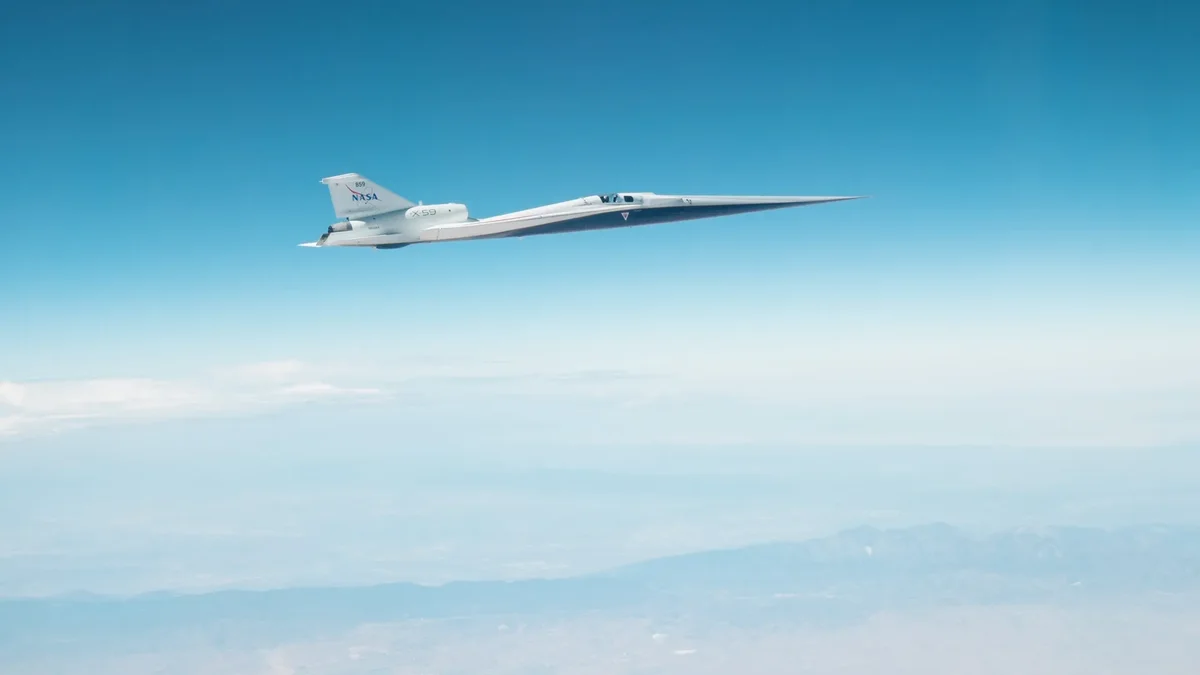
    Just days after NASA’s experimental X-59 plane flew at supersonic speeds for the first time, the space agency has announced another milestone for the research aircraft.

    The plane is designed to travel faster than the speed of sound without creating loud sonic booms—instead it generates what NASA describes as a “sonic thump.”

    On Friday the X-59 flew at Mach 1.4, or around 924 miles per hour, at an altitude of 55,000 feet. This is the speed and altitude the plane must reach in order to fly over populated areas. Future flights will give NASA crucial data about how quiet people perceive the plane to be.


    On supporting science journalism

    If you’re enjoying this article, consider supporting our award-winning journalism by subscribing. By purchasing a subscription you are helping to ensure the future of impactful stories about the discoveries and ideas shaping our world today.


    When aircraft travel faster than the speed of sound, the pressure waves they produce are funneled toward the rear of the aircraft, where they form a cone; if the aircraft flies low enough for the cone to glance off Earth, the result is a sonic boom. These loud bangs (and the high cost of the technology) were the reason why the world’s only supersonic passenger plane, the Concorde, was retired in 2003.

    The X-59 is designed for a quieter faster-than-the-speed-of-sound flight. It has a long nose that dissipates the pressure waves to the point that the aircraft may produce only a “supersonic thump,” which NASA has said will sound somewhere between a distant thunder crack and a car door slamming down the block.

    NASA’s X‑59 eXternal Vision System (XVS) shows Mach 1.4 at 55,030 feet on Friday, June 12, 2026.

    An F-15 research jet has been chaperoning the X-59 on its flights so far; because the F-15 is a traditional supersonic aircraft, its sonic booms have obscured whatever noise the X-59 might make. NASA plans to mount a shock sensor to the F-15 to measure the X-59’s shock wave signature during future flights to see if it is performing as desired. After that, the space agency will perform more flights at different altitudes and speeds, as well as measure the aircraft’s acoustic signature.

    “Each flight brings NASA one step closer to flying the X-59 over communities and gathering feedback that could help shape the future of commercial supersonic flight over land,” NASA said in a statement.

    It’s Time to Stand Up for Science

    If you enjoyed this article, I’d like to ask for your support. Scientific American has served as an advocate for science and industry for 180 years, and right now may be the most critical moment in that two-century history.

    I’ve been a Scientific American subscriber since I was 12 years old, and it helped shape the way I look at the world. SciAm always educates and delights me, and inspires a sense of awe for our vast, beautiful universe. I hope it does that for you, too.

    If you subscribe to Scientific American, you help ensure that our coverage is centered on meaningful research and discovery; that we have the resources to report on the decisions that threaten labs across the U.S.; and that we support both budding and working scientists at a time when the value of science itself too often goes unrecognized.

    In return, you get essential news, captivating podcasts, brilliant infographics, can’t-miss newsletters, must-watch videos, challenging games, and the science world’s best writing and reporting. You can even gift someone a subscription.

    There has never been a more important time for us to stand up and show why science matters. I hope you’ll support us in that mission.


    Source link

    Share. Facebook Twitter Pinterest LinkedIn Tumblr Email Telegram Copy Link

    Related Posts

    Science

    Scientists catch bacteria sharing proteins to survive antibiotics

    July 14, 2026
    Science

    Scientists overwhelmingly against rule change that would give political appointees say over science grants

    July 14, 2026
    Science

    Why have their been so many record-breaking heat waves this summer?

    July 14, 2026
    Science

    We finally know the name of a Maya mathematician

    July 13, 2026
    Science

    Scientists spot sugar in interstellar space for the first time ever

    July 13, 2026
    Science

    Mathematicians still don’t know the fastest way to multiply numbers

    July 13, 2026
    Editors Picks

    European carmakers call for ‘grand bargain’ with Donald Trump to avoid trade war

    January 16, 2025

    Where mortgage rates are headed in 2026, according to 21 experts

    February 15, 2026

    Inside the company selling quantum entanglement

    March 8, 2026

    Domino’s gets a new CEO amid slowing sales—but is it enough to save pizza chains?

    June 23, 2026

    Mets’ Nolan McLean has easy explanation for latest rough outing

    May 26, 2026
    About Us
    About Us

    Welcome to Benjamin Franklin Institute, your premier destination for insightful, engaging, and diverse Political News and Opinions.

    The Benjamin Franklin Institute supports free speech, the U.S. Constitution and political candidates and organizations that promote and protect both of these important features of the American Experiment.

    We are passionate about delivering high-quality, accurate, and engaging content that resonates with our readers. Sign up for our text alerts and email newsletter to stay informed.

    Latest Posts

    Congress Never Authorized The Iran War

    July 14, 2026

    Jelly Roll Compares Cheat Meals To Addiction: ‘Blood’

    July 14, 2026

    WHO says it has less than half funding needed to fight Ebola

    July 14, 2026

    Subscribe for Updates

    Stay informed by signing up for our free news alerts.

    Paid for by the Benjamin Franklin Institute. Not authorized by any candidate or candidate’s committee.
    • Privacy Policy
    • About us
    • Contact us

    Type above and press Enter to search. Press Esc to cancel.