

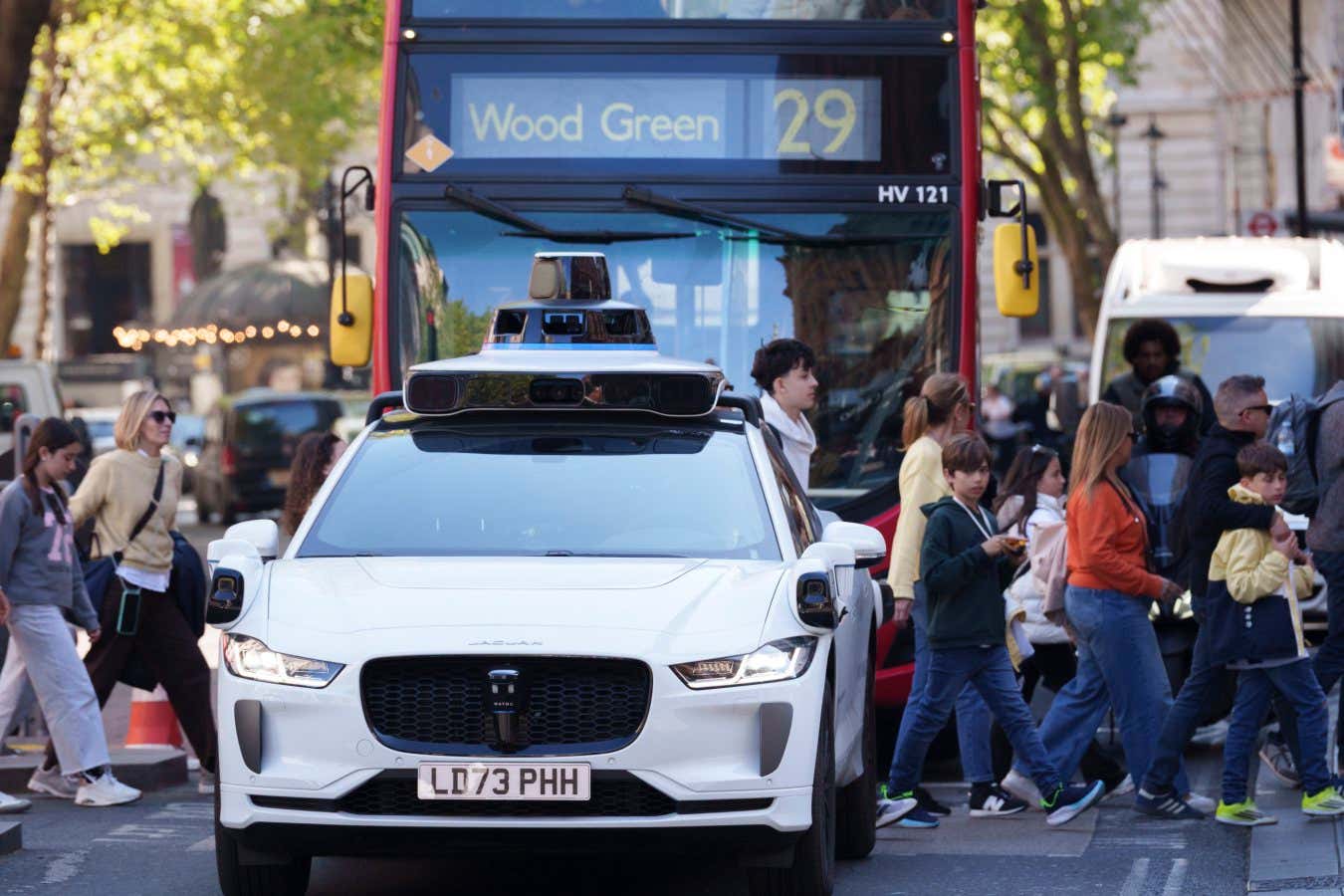
Waymo driverless cars are in London, but is this a positive move for road safety?
Richard Baker/In Pictures via Getty images
Waymo’s driverless cars have been rolling through London for months, although they aren’t taking passengers yet and a human sits ready to seize control if needed. Every time I’ve encountered them, they have seemed cautious and predictable. But recently, I had a near miss.
I was circling a roundabout as I cycled home from work and a Waymo was about to pull onto it in front of me. I had priority, but it didn’t seem to be slowing and looked to be heading straight for me, then suddenly stopped.
It wasn’t the scariest incident I’ve had on a bike – it wasn’t even the worst one that day. I didn’t feel in serious danger; I had seen it happening and was ready. The incident only stood out among the dozens of tense moments that happen on every commute because it was AI behind the wheel, not a person.
Out of curiosity, I sent Waymo the time and place, and asked what had happened. “The ADS [automated driving system] detected a cyclist travelling near the outer edge of the roundabout approaching from the right,” says a company spokesperson. “The safety driver assumed manual control of the vehicle to apply the brakes at the entrance of the roundabout.” In short, the AI didn’t look like it was going to stop, so a human jumped in.
I asked Waymo how often humans have to do that in London, but the company told me it doesn’t have that data and doesn’t like to focus on it as a metric. I also asked what had happened to confuse the AI – after all, I was cycling perfectly legally and my bike is neon yellow, so there’s no real excuse – and what was going to be done to improve the algorithm as a result. I got no response.
Several other London cyclists have told me that Waymos have acted well around them, but one recalled an incident near roadworks when a sign saying “NARROW LANES DON’T OVERTAKE CYCLISTS” somehow prompted a Waymo to do exactly that. Yet Simon Munk at London Cycling Campaign says that, on the whole, these cars have been acting very cautiously around cyclists.
I wrote about my feelings on AI drivers last year, knowing that tech companies were bringing these cars to London. My take then was that I may be better off surrounded by unpredictable and imperfect AI drivers than tired, distracted and angry human ones. I’ve been knocked off my bike several times by humans. I don’t think my incident with Waymo has changed my mind. Then again, one did once sail through police tape blocking a road, but the company said a person was in control at the time.
I don’t fully trust AI to operate a car near me, but I don’t fully trust people to do it either. But my argument is that AI can keep learning, and relatively quickly. What’s more, the sensors that tell these models about the world and help them spot hazards will get more accurate and powerful. AI may or may not be the lesser of two evils now, but I have faith it can be in the future.
Munk says there are huge potential pros and cons in driverless cars for cyclists and pedestrians: they could make streets safer, more predictable places, or become a menace that further marginalises vulnerable road users. And while Waymo has done well in San Francisco, London is a “different level”, he says, in terms of complexity and chaos. Munk recalls the company proudly showing him a video of one of its cars successfully navigating what it said was a chaotic San Francisco junction that really stress-tested the technology – but he has at least half a dozen worse ones on his commute.
Munk also worries that once these cars are up and running, even if they seem safe at first, later software updates could change their behaviour. We can’t simply sign-off on driverless cars as safe: they will need close and constant scrutiny to keep companies honest and citizens protected.
There is going to be a flurry of other driverless car players coming to London – Wayve driverless taxis could arrive within the next few months, and may or may not take a cautious approach. Just as one driver can be safer than another, one AI can be safer than another. And just as a safe driver can get tired, irritable and careless, AI can be tweaked at will to act however a company wants. Last year, for instance, Waymo made its cars more assertive, which resulted in them acting like “an aggressive New York taxi driver”. This was designed to stop them slowing traffic, but made a lot of San Franciscans wary.
We’ve even seen worrying signs of “solutions” to road safety that shamelessly offload the problem of safety to pedestrians, suggesting they all wear special vests to make life easier for autonomous cars.
“Five years from now [or] 10 years from now, when these things are just everyday, do [these companies] go ‘do you know what, our passengers are getting slow journeys, do we just speed them up a little bit [and] cut a few corners?’” asks Munk. “Or does a rival service land and say ‘we’re 20 per cent faster than Waymos and 20 per cent cheaper’, and they do that by speeding up 20 per cent and being 20 per cent more aggressive?’ The reality is we’re going to have to be vigilant.”
Topics: