

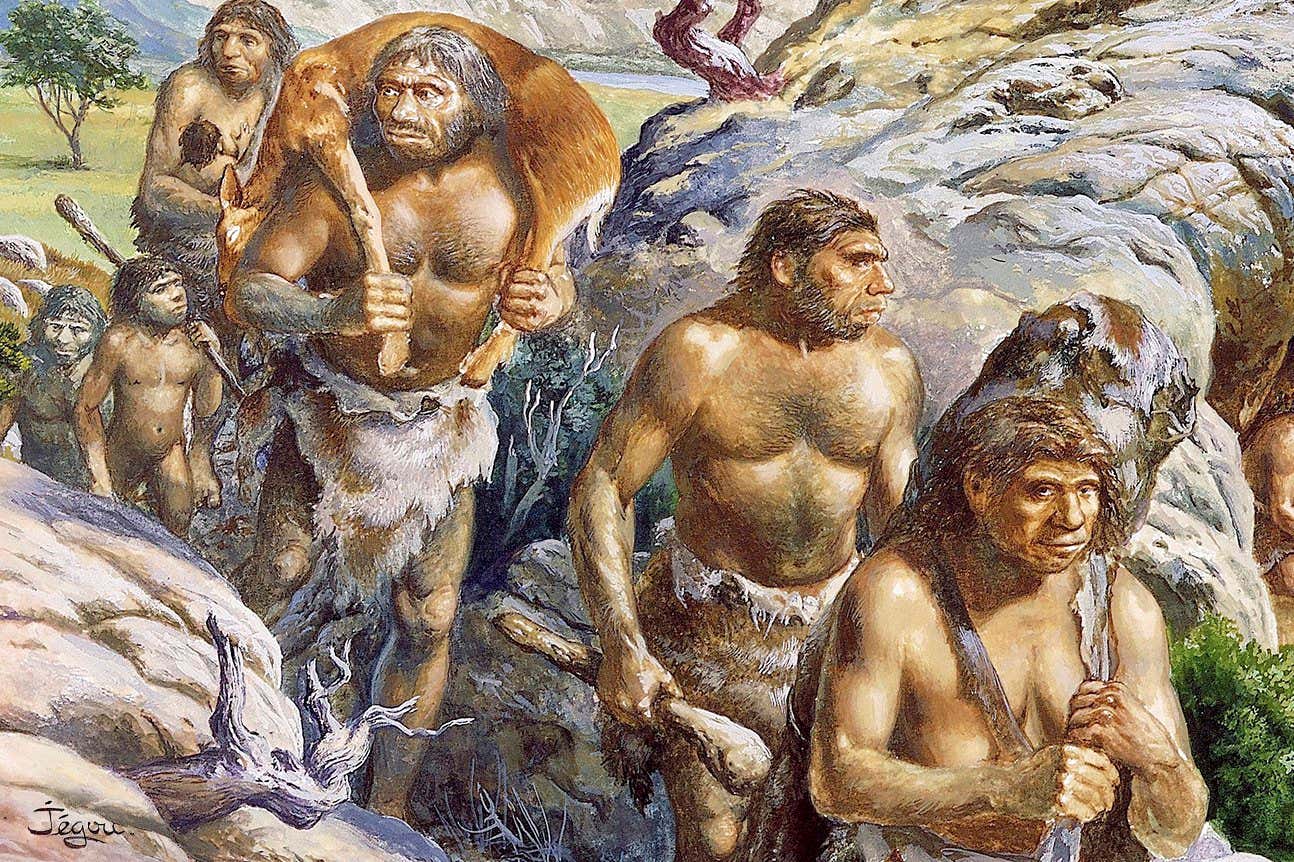
The migration out of Africa may have not have been quite so straightforward as we once thought
CHRISTIAN JEGOU/SCIENCE PHOTO LIBRARY
This is an extract from Our Human Story, our newsletter about the revolution in archaeology. Sign up to receive it in your inbox every month.
The great out-of-Africa migration is one of the canonical events in the human evolutionary story. Our species arises in Africa, becomes dominant, then around 60,000 years ago, ventures beyond it to conquer every continent (bar Antarctica), leaving every other hominin species in the dust.
We know that some version of this is true, thanks to genetics. African populations have more genetic diversity than any others, by far. European, Japanese, Indigenous Australian, and Indigenous American peoples may look different, but genetically these groups are quite alike, while even neighbouring groups in Africa can be more distinct genetically. This is a telltale sign that our species spread from Africa. The people who travelled beyond Africa only carried a sampling of the continent’s genetic diversity, and that limited pool of genetic variants is what gave rise to all non-African populations today.
I include that, even though it may be familiar to some readers, because I want to reiterate two basic facts. First, the out-of-Africa migration happened. Second, it shaped our species in a big way.
With that in mind, I will now mess with the story. Out-of-Africa happened, but it may not have happened in the way we imagine it.
Molecules and artefacts
I’ve become increasingly confused by the details of the big out-of-Africa migration over the last few years, but I couldn’t quite put my finger on what was bothering me. However, archaeologist Huw Groucutt at the University of Malta has been thinking it through more systematically, and on 15 April he published a study in Quaternary Science Reviews, outlining his concerns about the narrative.
The first thing Groucutt highlights is that the archaeological data doesn’t match the genetics. He writes: “There is no convincing archaeological signal linking Africa and Eurasia at the time that genomic data is typically interpreted as suggesting successful dispersal into Asia.” In other words, if large numbers of Homo sapiens were travelling from Africa to Eurasia around 60,000 years ago, we ought to find some traces of that migration – and we don’t.
Beyond that, Groucutt flags two linked issues. The first is the difficulty of obtaining precise dates for archaeological sites or for processes like migration. And the second is more conceptual: a lingering fixation with “revolutions” in prehistory, which clouds our thinking.
Let’s consider the dating issue first. Depending on which genetic analysis you read, even in fairly recent studies, the timing of the big out-of-Africa migration varies quite a bit: from “about 56,000 years ago” to “less than 55,000 years ago”, “most likely 50,300–59,400 years ago” or even “earlier than 75,000 years ago”. For such a recent event (in geological terms), this is a wide uncertainty range.
Groucutt argues that the more specific attempts at dating the migration are over-interpretations. They are the result of leaning too heavily on models, which are necessarily simplified, to interpret the raw genetic data. “The fact is, we don’t really understand how ancient populations were spread and interacting,” he says. “There is a heavy dose of the model influencing the outcome.”

Reconstructed skull of an early Denisovan
Gary Todd (CC0)
For instance, genetic models often assume that people were interbreeding entirely at random. We know that’s not true: human populations are structured into groups and subgroups. People are more likely to breed with people that, say, live near them, or share some key similarity, such as religious belief or an interest in sailing (whatever floats your boat). Stone Age populations in Africa were also subdivided, in ways that we only partially understand. “It’s just very hard to model that,” says Groucutt.
There’s also a tendency to treat splits between populations as sharply defined events. This is reflected in the family trees we draw of human species, and even in language like “the split”. I’ve often written about Ancestor X, the last shared ancestor of humans, Neanderthals and Denisovans, and how that population split and gave rise to those three groups. That language makes it sound like a discrete event, something that happened at a specific time and place.
That does sometimes happen, of course. Sometimes a population of animals gets split in two by some dramatic event, like one group being carried away by a flood. But populations can also divide in slow and protracted ways, perhaps living separately for a few hundred years then coming back together for a decade, then moving apart again, then having a period of occasionally exchanging mates, then going no-contact for a while, then doing some intense interbreeding, and finally separating for good.
The same is probably true of the out-of-Africa migration. There was no single big migration, but rather lots of little ones, spaced out over thousands of years with no central planning or overall goal. None of them was “the” migration.
Hence Groucutt argues, and I think I’m going to follow this advice from now on, that we should give a wider timeframe for the out-of-Africa migration. Saying it happened 60,000 years ago, or even 50,000 to 70,000 years ago, is misleading. All we can say with confidence is that it was happening between 100,000 and 50,000 years ago.
Which brings us to the second point: our tendency to look for delimited “events” and even “revolutions” in prehistory.
Revolution schmevolution

Hand paintings in Sumpang Bita cave in Indonesia
Nature Picture Library / Alamy
Over and over, researchers have tried to identify dramatic turning points in prehistory. These “revolutions” would be times of unusually rapid and significant change, perhaps happening in a specific location and subsequently spreading.
For instance, it has been claimed that around 50,000 years ago our species became “behaviourally modern”. This means we started making specialised tools, creating art, performing rituals, perhaps speaking in true language. This has been presented as a “great leap forward” or, in more technical language, “the Upper Palaeolithic Revolution”.
Virtually no active researchers believe this anymore, says Groucutt. That’s because archaeology tells us that these behaviours emerged gradually and may have been developed independently in different parts of the world. We now suspect that other hominins also made art, notably Neanderthals – so there is no sign of an abrupt emergence of this behaviour. Likewise, language seems to have deep roots.
However, such ideas were commonplace in the 20th century. The archaeologist V. Gordon Childe (1892-1957) characterised the advent of farming as the “Neolithic Revolution”. This was shortly followed by the “Urban Revolution” as people started living in increasingly dense villages and towns. Again, this turns out to be a big oversimplification. People often engage in “proto-farming” while also hunting and gathering, and they sometimes live in dense settlements without also farming.
Still, the idea of revolutions in prehistory persists today as “a shadow or a hangover”, Groucutt says. In particular, it has crept into the ways we read genetic data.
“People talk about the out-of-Africa ‘event’,” says Groucutt. But the migration probably consisted of “tiny groups of people over tens of thousands of years, scattered over huge areas,” he says. “It’s not much of an ‘event’ to me.” Instead, it was a process, a long window of time in which some groups of people were moving out of Africa (and perhaps some of them went back in, bringing useful information).
In previous periods, dispersals out of Africa may well have been less frequent, but they did happen. Modern humans seem to have been living at the sites of Skhul and Qafzeh in Israel as early as 130,000 years ago. There are also earlier claims, from Misliya in Israel and Apidima in Greece (although, at the risk of overcomplicating things, Groucutt questions the dating of both).
The genetics tells us that it’s only the later dispersals, after 100,000 years ago, that contributed to modern non-African populations. The earlier migrants have left no detectable trace in our DNA. But they may have affected us in indirect ways, for instance via interbreeding with Neanderthals.
I suspect that the lingering influence of the “revolution” narrative may be a reflection of some of our deepest biases. We’re storytelling apes, and stories often have dramatic turning points and big climaxes, which tend to be the bits we remember. Luke Skywalker takes the one-in-a-million shot; Elle Woods traps a key witness in a lie; Rick tells Ilsa to get on the plane. It’s harder to call to mind all the ways the story patiently gets the pieces into place for those climaxes – but the buildup is essential, nevertheless.
Join an immersive journey into the Cradle of Humankind, combining real fossil excavations, expert-led research access and iconic palaeoanthropological sites Topics:
Journey to the Cradle of Humankind: South Africa