

Updated May 29, 2026 at 2:00 PM
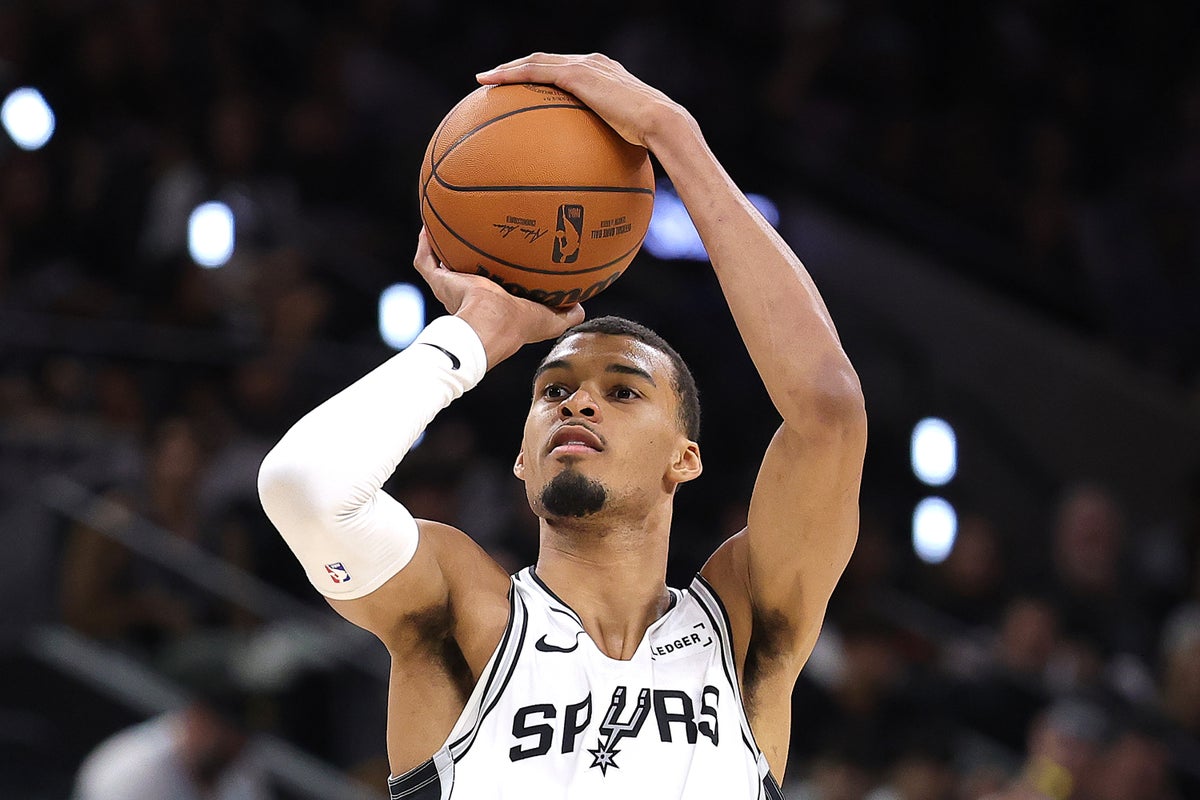
Even casual basketball fans know that Victor “Wemby” Wembanyama is a phenom. At a towering seven feet, four inches tall, the San Antonio Spurs forward-center is among the National Basketball Association’s (NBA’s) top defenders at the net and a serious threat on offense—often attempting five or more three-point shots per game. His combination of height, agility and all-around basketball prowess are so out of this world, in fact, that some fans have even taken to calling him “the Alien.”
In the ongoing playoffs, his three-point shooting has been on full display. In the first game of the best-of-seven NBA Western Conference Finals earlier this month, for instance, Wembanyama hit a deep three to tie the game against the Oklahoma City Thunder (OKC) with less than a minute remaining on the clock in overtime. Wembanyama and the Spurs won the game in double overtime.
Whichever team wins this series will take on the New York Knicks in the NBA Finals in June. Ahead of the Spurs and OKC’s Game 6 match on Thursday—which the Spurs won—Scientific American spoke with experts in physics and biomechanics about the science of Wemby’s epic shots to find out: How does the tallest player in the NBA keep hitting all those threes?
On supporting science journalism
If you’re enjoying this article, consider supporting our award-winning journalism by subscribing. By purchasing a subscription you are helping to ensure the future of impactful stories about the discoveries and ideas shaping our world today.
The science of Wemby
The NBA’s tallest players typically aren’t known for taking such deep shots as Wemby. “He’s just launching that thing,” says Larry Silverberg, an emeritus professor in mechanical and aerospace engineering at North Carolina State University. “It’s extremely unique,” he says.
A lot goes into making a three-point basketball shot. For one, there’s the player: their height, the size of their hands and arms and the mechanics of their movement affect the shot. There’s also the aim of the ball, as well as its backspin, speed and angle of release, Silverberg explains. All these factors and more come together in determining the success of a shot.
All things being equal, experts say that height is typically thought of as an advantage on the court because taller players are physically closer to the basket ring, which stands at 10 feet above the ground, and they are harder for smaller players to block. In other words, If the Golden State Warriors’ Stephen Curry, one of the best three-point shooters of all time, was seven feet, four inches instead of six feet, two inches, he’d likely have an even greater shooting advantage. A 2008 study by Silverberg and a co-author suggested that free-throw shooters who release the ball from a higher starting point likely have greater accuracy, “as long as this does not adversely affect the player’s launch consistency.”
Taller players should, in theory, be better shooters, but that doesn’t always translate in a real-life setting, says Dimitrije Cabarkapa. A former collegiate basketball player, Cabarkapa is associate director of the Jayhawk Athletic Performance Laboratory at the University of Kansas, which is part of the Wu Tsai Human Performance Alliance, a research institute dedicated to improving human health.
In part, that may be because the NBA’s so-called big guys usually aren’t encouraged to specialize in shooting threes at an early age, and sometimes it also comes down to an individual player’s coordination and mechanics, Cabarkapa says.
“Many tall players have difficulty with these shots because their long arms can make the shooting motion harder to coordinate consistently,” says Amy Pope, a principal lecturer in physics and astronomy at Clemson University.
For Wemby, that problem doesn’t appear to be an issue: “When Victor Wembanyama shoots a successful three-pointer, what stands out to me is his body mechanics,” Pope says. “His torso stays nearly vertical. Many shorter shooters need a stronger upward jump and more forward momentum to get the necessary range. Wembanyama’s release point is so high that he does not need this large boost from his legs, giving his body a straight appearance.” In fact, all he needs for the right exit velocity is “a small vertical jump,” she says.
Wemby is also notably flexible—which can be its own advantage. For the best shooting proficiency, research by Cabarkapa and his colleagues shows that three-point shooting starts from the “bottom up.” “You’ve got to put your butt closer to the ground, keep your torso in near vertical position and make sure that your elbow is tucked under the basketball,” he says. It also helps to have greater “flexion,” or bend, in your hips, knees and ankles.
“If somebody doesn’t have a proper range of motion in the knee or hip joint, they may not be able to achieve enough flexion in those joints, which is necessary to generate force and perform an efficient shooting motion,” he says. And some skills, of course, go beyond biomechanics.
“[Wembanyama] knows he’s seven-foot-four. He knows that people generally are not going to block him, but he goes the extra mile. He says, ‘I’m going to take it from even further out,’” Silverberg says. “Besides being tall, agile and skilled, he’s even being a little bit creative there by deciding to work on a shot that nobody else would. I think that’s pretty neat.”