

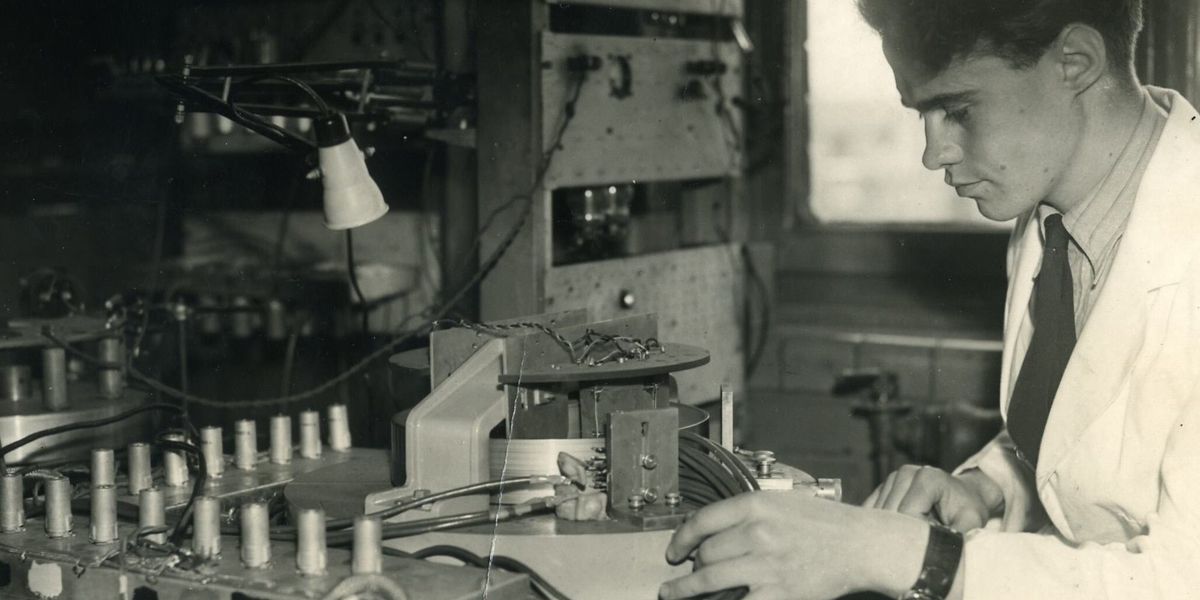
In the late 1940s—when computer engineers were grappling with unreliable hardware and noisy transmission environments—a team of engineers inside a modest lab at the University of Manchester, England, confronted a problem so fundamental that it threatened the viability of digital computing itself. Machines could generate bits, but they could not reliably read them back.
The inconsistent reading back of memory data did not initially present itself as a grand theoretical challenge. It showed up as something more mundane: inconsistent computing results.
Engineers including Frederic C. Williams, Tom Kilburn, and G. E. (Tommy) Thomas traced the failures not to logic errors but to the physical behavior of the machines themselves. The team devised a technique for keeping a transmitter and a receiver synchronized without relying on a separate clock signal. Their innovation, known as Manchester code or phase encoding, encoded each bit with a transition in the middle of the bit period, effectively embedding timing information directly into the data stream to be a self-clocking signal. So, even if the signal degraded or the timing drifted slightly, the receiver could continually keep time based on those regular transitions.
By eliminating the need for separate clocks and reducing synchronization errors, Manchester code made data transfer more robust across cables and circuits.
Those qualities later made it a natural fit for technologies such as Ethernet and early data storage systems. Its self-clocking nature helped standardize how machines communicate, and it laid the groundwork for modern networking and digital communication protocols.
On 13 April 2026, this breakthrough was honored with an IEEE Milestone plaque during a ceremony at the University of Manchester. Dignitaries from IEEE and the university attended the ceremony.
Embedding timing in signals
Those 1940s Manchester University engineers were working on systems that fed into the Manchester Mark I, one of the first practical stored-program machines.
When troubles arose, they used oscilloscopes to probe signals. They found that electrical pulses did not arrive with consistent timing. Memory signals also blurred over time, making them harder to read, and when long runs of identical bits occurred, the waveform flattened into stretches with no transitions.
That led to a crucial insight: The problem was not just detecting whether a signal was high or low; the system also lost track of when to sample the signal. Without reliable timing markers, even correctly formed signals were misread. Bits could effectively be lost or miscounted because the system fell out of sync.
At first, the engineers tried to tame the hardware. They experimented with stabilizing circuits and more consistent pulse generation, attempting to impose a regular rhythm on an inherently unstable system. But the fixes proved fragile, and the electronics of the day could not maintain the required precision. So the Manchester group took a different approach.
If the hardware could not provide a dependable clock, the signal itself would have to carry one. Instead of representing data as static levels, each bit changed state, with a guaranteed transition in the middle.
Embedding timing in the signal reduced erratic behavior. Machines were suddenly able to reliably transmit, store, and read back data—an essential step toward practical stored-program computing.
Making signals unmistakable
The Manchester code addressed several issues at once. Regular transitions allowed continuous timing recovery. Transitions proved easier to detect than static levels, and long runs of identical bits no longer produced flat, ambiguous waveforms. Rather than fighting the imperfections of early electronics, the design worked with them.
From lab curiosity to a global standard
What began as a local solution in Manchester shaped digital communication systems for decades, including early Ethernet technology, for which timing and shared-medium communication were central challenges.
According to Robert Metcalfe, a member of the team that built the first Ethernet system at Xerox PARC in 1973, he and his colleagues relied on Manchester code.
“Manchester code solved a fundamental problem for us: timing,” Metcalfe says, explaining that each bit carried its own clock and removed the need for a global synchronized signal.
That self-clocking property wasn’t the only benefit provided by the encoding scheme. On a shared coaxial cable, Manchester encoding did more than provide timing. Each transceiver left the medium undriven—effectively “off”—most of the time, allowing packets from other machines to pass without interference. Even during transmission, a station drove the signal only about half the time, leaving the line undriven during the other half of each bit cycle.
This distinction—between a driven signal and an undriven line, rather than simple 1s and 0s—allowed receivers to recover both data and clock timing while also monitoring the cable for other activity. If a transceiver detected a signal when it expected the line to be undriven,the signal indicated that another station was transmitting at the same time. In other words, the system could detect collisions in real time and respond accordingly.
The idea has proven durable far beyond local networks. Manchester code is being used aboard theVoyager spacecraft, which are now cruising through interstellar space—underscoring its reliability in extreme environments.
The code also has found its way into everyday consumer electronics. Infrared remote controls for televisions and audio equipment commonly rely on Manchester code through protocols such as RC-5, developed by Philips in the early 1980s. The protocol encodes commands as timed infrared signals transmitted by a handset’s integrated circuit and LED, allowing devices to reliably interpret button presses even through noise and signal distortion. Manufacturers across Europe—and many in the United States—adopted the approach, extending Manchester code into the home.
Why the Milestone matters
An IEEE Milestone designation recognizes technologies with enduring impact. Manchester code qualifies because it solved a foundational timing problem at a critical moment in computing history.
Without a way to embed timing in the data itself, early digital systems would have remained fragile and unreliable. Manchester code helped transform them into dependable machines, and it enabled much of today’s digital communication.
“Manchester code solved a fundamental problem for us: timing,” —Robert Metcalfe, an Ethernet inventor
Key participants at the plaque dedication ceremony included Tom Coughlinm 2024 IEEE president; Duncan Ivison, University of Manchester president and vice chancellor, and Nagham Saeed, chair of the IEEE U.K. and Ireland Section.
Talks by Kees Schouhamer Immink (the 2017 IEEE Medal of Honor laureate probably best known for his work that made compact discs and other high-density digital media practical) and Peter Green (Manchester’s deputy dean for the engineering faculty) highlighted the code’s lasting impact on digital data storage and communications.
The IEEE Milestone plaque for the Manchester code reads:
“At this site in 1948–1949, Manchester code was invented for reliably encoding digital data stored on the Manchester Mark I computer’s magnetic drum. It became a standard for computer magnetic tapes and floppy disks and was used in digital communications, including the Voyager 1 and 2 spacecraft and early Ethernet networks. It found wide use in domestic remote controllers, radio frequency identification (RFID) tags, and many control network standards.”
Administered by the IEEE History Center and supported by donors, the Milestone program recognizes outstanding technical developments worldwide. The IEEE U.K. and Ireland Section sponsored the nomination.
From Your Site Articles
Related Articles Around the Web