

This sponsored article is brought to you by Ampace.
As AI workloads grow to gigascale levels, the global data center industry has hit a hidden physical wall. The real bottleneck is no longer just the thermal limit of the chip or the capacity of the cooling system — it is the dynamic resilience of the power chain.
Modern AI computing clusters, driven by massive GPU clusters, generate high-frequency, abrupt, and synchronized spikey pulse loads. As rack densities soar beyond 100 kW, these fluctuations are amplified into a “power paradox”: while the digital logic of AI is moving faster than ever, the physical infrastructure supporting it remains tethered to legacy response capabilities.
The power usage of these gigascale sites and their drastic, high frequency, abrupt load surges from the AI GPU clusters can trigger transient voltage events and frequency instability, risking the entire local grid. The grid itself is not robust enough to support these loads. This leads to the infrastructure gap: The utility is not robust enough and traditional backup sources, such as diesel generators and gas turbines, simply cannot react to millisecond-level power spikes in output. This will often force operators into a cycle of costly infrastructure over sizing just to buffer the volatility.
AI infrastructure requires energy systems capable of instantaneous response while safeguarding continuity and reliability.
The industry has explored various mitigations — from rack-level BBUs to 800V DC architectures — yet the mature, high volume, traditional UPS system remains the most viable and scalable foundation for gigawatt-level facilities. Consequently, the UPS-integrated battery system has emerged as the critical “physical buffer” to neutralize these pulses at the source.
At Data Center World 2026 in Washington, D.C., Ampace led a pivotal technical dialogue with Eaton during the session “Powering Giga-scale AI.” Their exchange unveiled a fundamental paradigm shift: To bridge the AI power gap, energy storage must evolve from a passive insurance policy into an active, high-speed stabilizer. By aligning Ampace’s semi-solid-state battery innovation with Eaton’s proven system intelligence, we are moving beyond simple backup to solve the physical paradox of the AI era.
To move beyond simple backup and solve the physical paradox of the AI era, Ampace is aligning its semi-solid-state battery innovation with Eaton’s proven system intelligence.Ampace
The “Shock Absorber” physics: semi-solid chemistry for AI pulses
Conventional power systems were designed for steady-state loads, not the rapid heartbeat of a massive AI GPU cluster. When thousands of GPUs synchronize their computing cycles, they generate high-frequency, abrupt pulse loads that can lead to voltage sags, frequency oscillations, and potential interruptions of critical AI training.
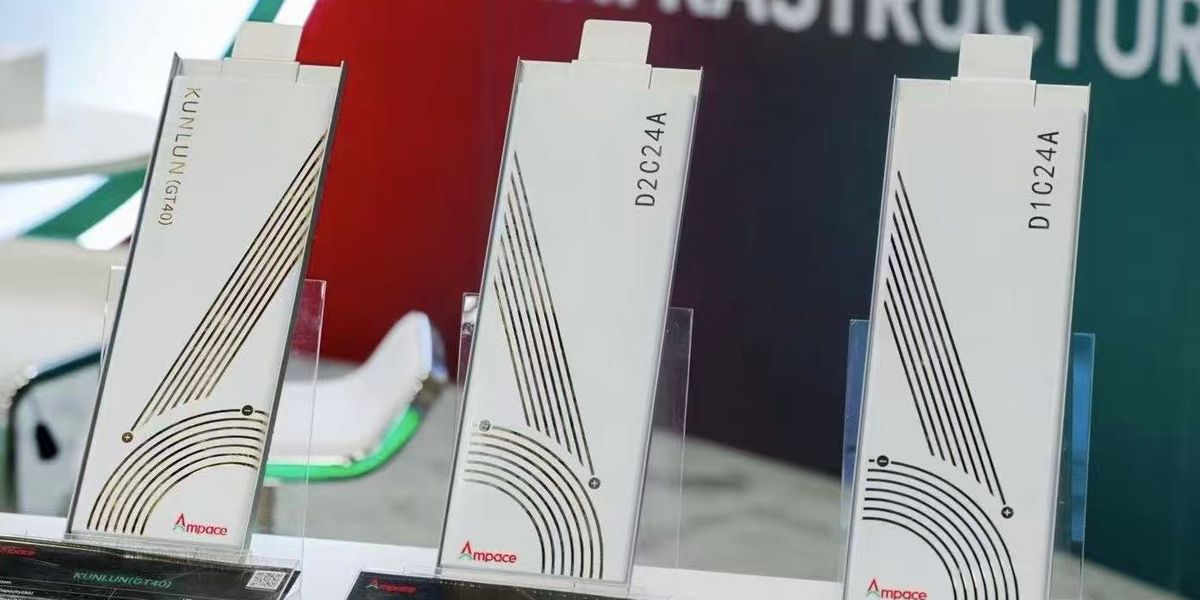
Ampace’s PU Series semi-solid and low-electrolyte cells address this challenge by acting as high-speed “shock absorbers.” Leveraging ultra-low internal resistance (DCR) and high cycle capability, these batteries neutralize millisecond-level power spikes at the source, stabilizing the local power loop before disturbances propagate upstream to the grid or on-site generators. These high-rate cells enable 100 kW+ racks to maintain peak performance without transmitting instability across the power chain.
This capability aligns closely with Eaton’s matured UPS architectures, such as double-conversion topologies and advanced power electronics upgrades, which have long prioritized rapid load responsiveness and high system stability.
Together, these approaches embody a shared industry philosophy: AI infrastructure requires energy systems capable of instantaneous response while safeguarding continuity and reliability.
 Ampace’s semi-solid state chemistry minimizes liquid electrolyte, greatly reducing the risk of leakage and thermal runaway under continuous AI high-load conditions.Ampace
Algorithmic intelligence: synchronizing energy and control
Hardware alone cannot solve the AI power paradox; the system also requires intelligent coordination between energy storage and power management. Sophisticated battery management systems (BMS) like Ampace’s high-precision design track state-of-charge (SOC) with high-speed sampling, even during rapid, shallow cycling typical in AI workloads.
Complementary algorithmic approaches in modern UPS platforms — such as ramp-rate control and average power management — effectively suppress sub-synchronous oscillations and optimize load smoothing. In large-scale AI training environments, where thousands of GPUs can trigger millisecond-level power pulses, these intelligent layers ensure that batteries buffer high-frequency fluctuations without compromising the mandatory emergency backup reserves.
By transforming energy storage from passive “standby insurance” into active, schedulable assets, the system simultaneously safeguards continuous AI training and maintains the long-term health of the data center infrastructure. In practical terms, this means that even during peak compute bursts, the infrastructure remains stable, training cycles continue uninterrupted, and operators avoid costly oversizing or grid stress.
Eaton’s dual-layer algorithms serve as a valuable benchmark in this space, demonstrating how advanced control logic can achieve similar objectives, reinforcing Ampace’s approach and philosophy within the broader data center power ecosystem.
Economic scalability: optimizing AI infrastructure efficiently
One of the largest costs in deploying AI infrastructure is “oversizing”: procuring transformers, generators, and UPS systems to handle brief peak spikes. This traditional approach inflates the Total Cost of Ownership (TCO) and leads to wasted capital on underutilized hardware.
Ampace’s turn-key cabinet design developed by its independent R&D is engineered for seamless compatibility with mature, high volume UPS systems. By leveraging Eaton’s double-conversion UPS topologies alongside intelligent ramp-rate and average power management algorithms, AI data centers can scale dynamically without requiring costly infrastructure redesigns. This approach allows the UPS and batteries to act as active load-shapers, smoothing AI-driven pulses while strictly maintaining mandatory emergency backup capacity.
By utilizing energy storage as an active, schedulable asset, operators can right-size their infrastructure, avoid unnecessary grid upgrades, and deploy gigascale AI clusters with unprecedented efficiency.
Safety First: Protecting AI Infrastructure While Enabling Innovation
In high-density AI facilities, safety is non-negotiable. Ampace’s semi-solid state chemistry minimizes liquid electrolyte, greatly reducing the risk of leakage and thermal runaway under continuous AI high-load conditions.
 Ampace’s turn-key cabinet design developed by its independent R&D is engineered for seamless compatibility with mature, high volume UPS systems. Ampace
At the same time, Eaton’s UPS design emphasizes system-level energy scheduling that never sacrifices mandatory emergency backup reserves, ensuring thermal safety and uninterrupted operation.
This “safety-first” approach ensures that infrastructure can sustain aggressive performance targets without compromising the physical integrity of the facility. Coupled with over a decade of proven high-cycle life operation and design under shallow pulse conditions, these systems can extend operational lifespan, reduce replacement requirements, and provide operators with confidence that safety and reliability remain uncompromised as compute density continues to grow.
To remain the scalable backbone of AI data centers
As AI computing scales over the next two to three years, the industry will face stricter grid requirements and even more demanding pulse load characteristics. This evolution demands a forward-looking design philosophy that harmonizes UPS, battery, and grid compatibility.
Ampace views current low-electrolyte semi-solid technologies as the optimal transitional step toward a fully solid-state future — one that promises ultimate safety and performance.
Ampace remains committed to this long-term technological roadmap. We view current low-electrolyte semi-solid technologies as the optimal transitional step toward a fully solid-state future — one that promises ultimate safety and performance. Whether through rack-level BBU, integrated UPS systems, or containerized storage, the universal core of the AI era remains constant: high-speed response, long shallow-cycle life, and refined energy management.
By engaging in deep technical exchanges with Eaton and leading energy innovators, Ampace ensures that its solutions not only meet today’s AI pulse challenges but also harmonize with broader infrastructure strategies and shared industry best practices.
Ultimately, as traditional diesel generators gradually give way to diversified alternatives, the integrated UPS-plus-energy-storage system will become the fundamental infrastructure standard.
The dialogue has just begun. Ampace will continue to engage in strategic exchanges with global industrial automation leaders and digital energy pioneers, co-authoring the playbook for a safer, more efficient, and more resilient AI-ready world.