
Close Menu
    Trending
    • Fears for people deported from US to Venezuela hours before earthquakes hit | Earthquakes News
    • Grizzlies complete roster teardown with Ja Morant deal
    • The unbearable emptiness of the Great American State Fair
    • Childbirth for many primate species is even harder than for humans
    • Market Talk – June 29, 2026
    • Inside Taylor Swift & Travis Kelce’s Wedding Strict Measures
    • Commentary: Despite its best efforts, Iran won’t be able to toll the Strait of Hormuz
    • Australian football legend Sam Kerr signs with Gotham FC after Chelsea exit | Football News
    Benjamin Franklin Institute
    Tuesday, June 30
    • Home
    • Politics
    • Business
    • Science
    • Technology
    • Arts & Entertainment
    • International
    Benjamin Franklin Institute
    Home»Science»Slow breathing can calm the mind without any need for mindfulness
    Science

    Slow breathing can calm the mind without any need for mindfulness

    Team_Benjamin Franklin InstituteBy Team_Benjamin Franklin InstituteMay 9, 2026No Comments3 Mins Read
    Share Facebook Twitter Pinterest Copy Link LinkedIn Tumblr Email VKontakte Telegram
    Share
    Facebook Twitter Pinterest Email Copy Link


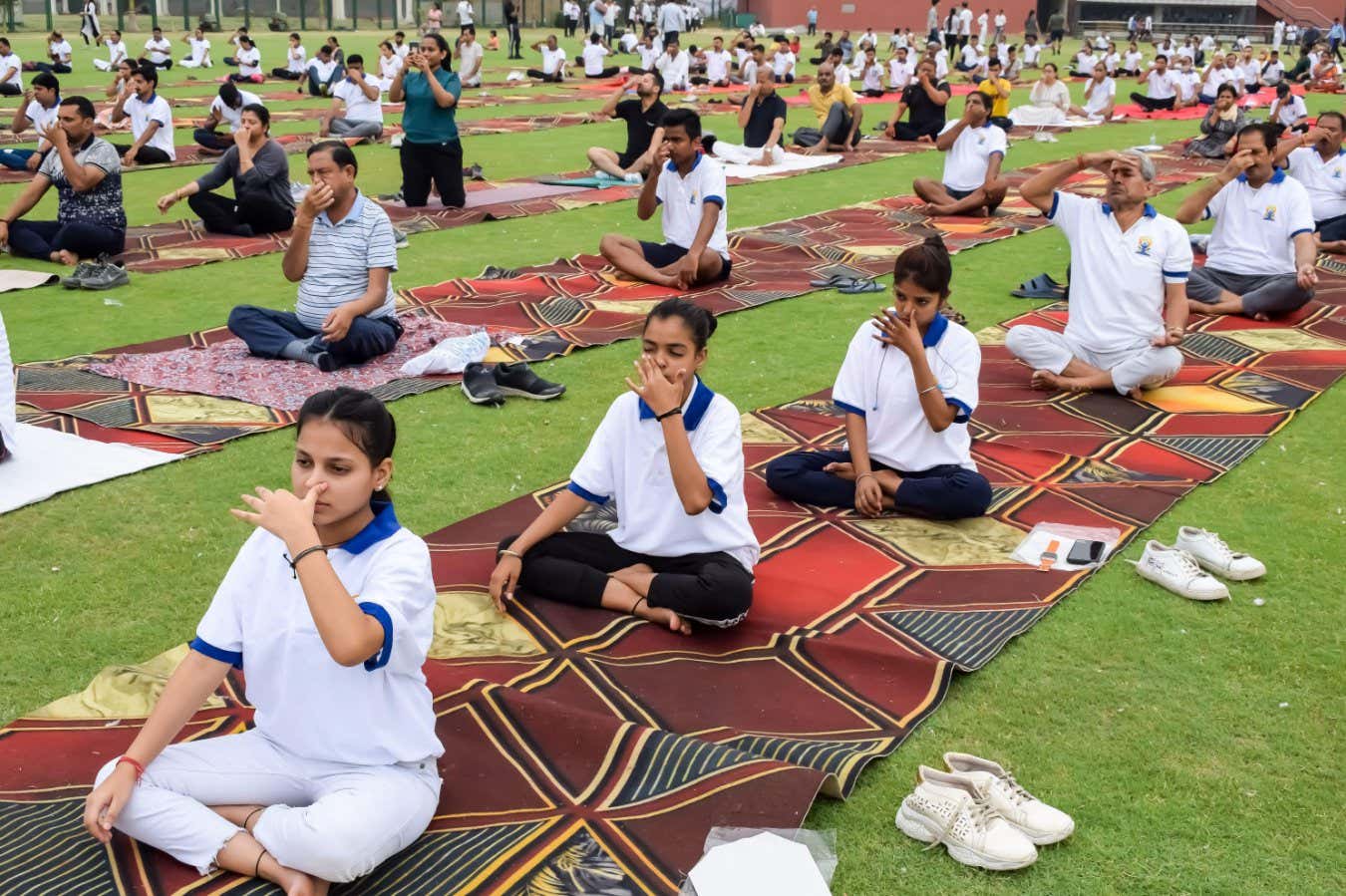
    Slow breathing can calm the mind without thinking about it – but conscious breathwork probably helps

    Rahul Sapra/Alamy

    You don’t need to be a scientist to know that taking slow, deep breaths will calm you down. What’s less easy to explain, though, is how and why it works. The widespread expectation that a deep breath will calm you down raises the possibility that it’s at least partly a placebo effect – that it works because we expect it to, not because of any change in the body’s physiology.

    Now, a study presented at the Embodied Minds Summit in Los Angeles on 3 May, has provided an answer. Jack Feldman, a neuroscientist at UCLA, showed that mice trained to slow their breathing rate displayed less fear-related behaviours in standard tests of mouse anxiety. This, says Feldman, shows that you don’t need to believe in the power of breathwork to get the benefits. “It’s not a placebo effect because the mice don’t know it’s supposed to calm them down,” he says.

    The study built on Feldman’s 1991 discovery that a small region of the brainstem, the pre-Bötzinger Complex (preBötC) is the master pacemaker of breathing rate in mammals. The preBötC mostly operates automatically, speeding and slowing the rate of breathing depending on the body’s needs. In humans, though, this region is connected to cortical brain regions involved in decision-making, allowing us to intentionally override the pacemaker to change the rhythm of our own breathing – a skill that enables us to talk, laugh and sing.

    Mice don’t share the same skill set, so to manipulate their breathing rate, Feldman and his team used a technique called optogenetics, in which a light-sensitive protein is inserted into a specific set of neurons so that they can be activated with pulses of light. By targeting neurons in the preBötC that inhibit inhalation and lengthen exhalation, it was possible to use pulses of light to slow the mice’s breathing rate up to 70 per cent.

    Slower breathing, less anxiety

    After four weeks of daily optogenetic stimulation, the mice’s breathing rates slowed not only during the sessions but also between them, suggesting that they had been trained to breathe more slowly.

    Three days after their last training bout, the mice were put through a series of experiments to measure anxiety-like behaviour. The results showed that trained mice were significantly less likely to freeze in a stressful situation than control mice. They also spent more time exploring open spaces while controls stuck to the dark corners for safety. This, says Feldman, demonstrates that slow breathing doesn’t have to be a deliberate choice to induce calm – it’s a happy side effect of the way the brain is wired.

    The finding is important, says Andrea Zaccaro, a neuroscientist at the “G. d’Annunzio” University of Chieti-Pescara, in Italy because “it isolates a low-level or bottom-up component of the breathing–emotion relationship.” But, he adds, that doesn’t mean that mindful attention to the breath is a waste of time. “While slow breathing itself may have physiological effects, mindful attention to the breath could plausibly amplify, stabilize, or contextualize those effects,” he says.

    So, while you don’t have to believe the meditating hype to get the benefits of slow breathing, you might find your inner calm a little faster if you do.

    Topics:


    Source link

    Share. Facebook Twitter Pinterest LinkedIn Tumblr Email Telegram Copy Link

    Related Posts

    Science

    Childbirth for many primate species is even harder than for humans

    June 30, 2026
    Science

    US government wants to have a useful quantum computer by 2028

    June 29, 2026
    Science

    Your menstrual cycle may affect how well vaccines work

    June 29, 2026
    Science

    Remote-controlled cockroach swarm can now breathe underwater

    June 29, 2026
    Science

    The first ticking ‘nuclear clocks’ are here

    June 29, 2026
    Science

    How underappreciated mathematician Emmy Noether helped prove physics’ most fundamental theories

    June 29, 2026
    Editors Picks

    Videos: Humanoid Robot Martial Arts, Perseverance, More

    February 20, 2026

    Australia heatwave stokes risk of catastrophic bushfires

    January 8, 2026

    UN chief says ‘get serious’ in grim New Year message

    December 29, 2025

    Why focusing on business priorities defines lasting success

    December 11, 2025

    Test your brain on these mind-bending scientific riddles

    December 13, 2025
    About Us
    About Us

    Welcome to Benjamin Franklin Institute, your premier destination for insightful, engaging, and diverse Political News and Opinions.

    The Benjamin Franklin Institute supports free speech, the U.S. Constitution and political candidates and organizations that promote and protect both of these important features of the American Experiment.

    We are passionate about delivering high-quality, accurate, and engaging content that resonates with our readers. Sign up for our text alerts and email newsletter to stay informed.

    Latest Posts

    Fears for people deported from US to Venezuela hours before earthquakes hit | Earthquakes News

    June 30, 2026

    Grizzlies complete roster teardown with Ja Morant deal

    June 30, 2026

    The unbearable emptiness of the Great American State Fair

    June 30, 2026

    Subscribe for Updates

    Stay informed by signing up for our free news alerts.

    Paid for by the Benjamin Franklin Institute. Not authorized by any candidate or candidate’s committee.
    • Privacy Policy
    • About us
    • Contact us

    Type above and press Enter to search. Press Esc to cancel.