

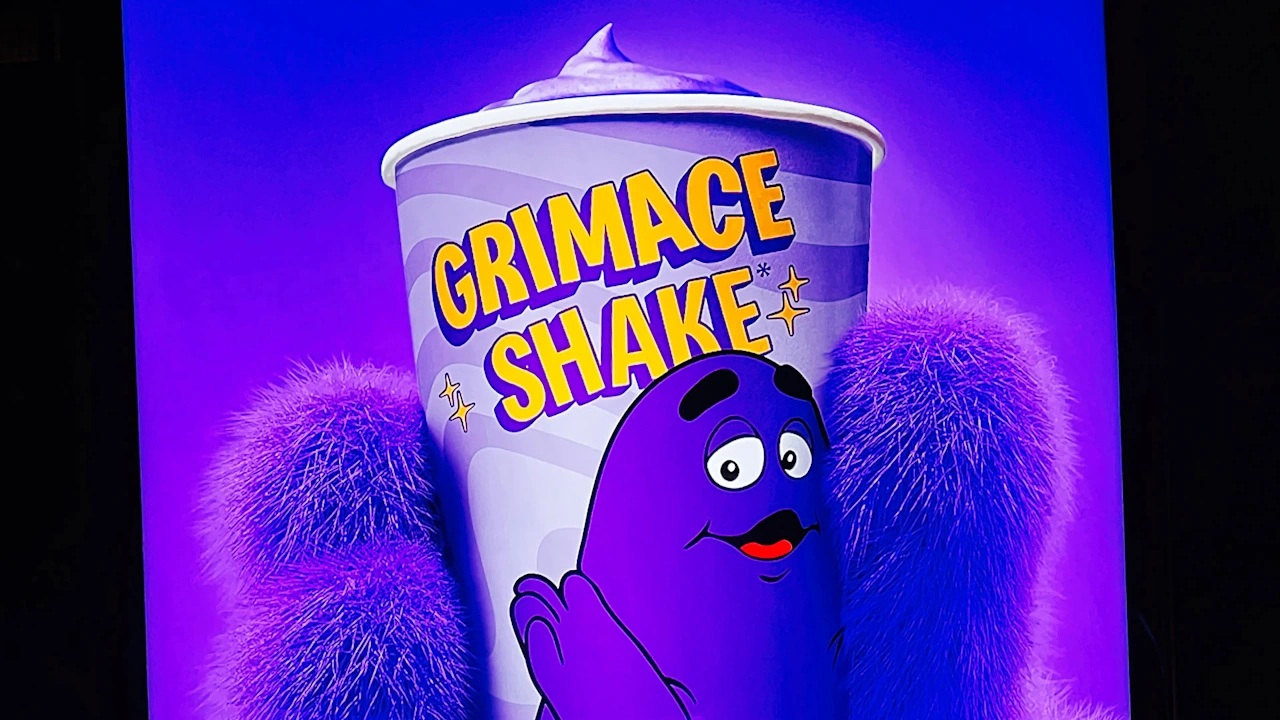
For those who don’t remember what life on the internet looked like in 2023, here’s a refresher: girl dinner, the Roman Empire, and a TikTok algorithm painted purple from the McDonald’s Grimace Shake.
The trend was simple, albeit strange: Users would film themselves trying out the purple McDonald’s beverage and then immediately cut to a horror-movie scene of their staged death.
The purple vanilla-berry-flavored milkshake was rolled out by the fast-food chain in June of that year as a limited-edition menu item in honor of one of the chain’s mascots, Grimace.
While the fake death trend garnered over 2.9 billion views on TikTok, and reportedly boosted McDonald’s sales by 10% that quarter, it was not planned to unfold like it did.
“If you think we planted the Grimace Shake trend … thank you. So much. But you think way too highly of us,” Guillaume Huin, senior marketing director at McDonald’s, wrote on X. “If you thought we would never acknowledge the trend … well, I thought so too at first, so I don’t blame you.”
“Pure Gen Z humor”
On Thursday, almost three years after the trend, Huin took to X to share how the team at McDonald’s and its agency partners reacted to going viral. (Grimace is now apparently taking over German social media after the shake recently launched there.)
Huin’s post offers a rare glimpse into how large companies treat viral moments, often dealing with them from a full-fledged situation room.
The executive says he first encountered the trend at home, scrolling on social media and coming across one video after another of users “losing control” after trying a Grimace Shake.
He decided to tell management and leadership of the phenomenon, not quite sure what it meant just yet. “At first, I won’t lie, this felt like telling your parents about a massive mistake you made that would ruin all your hard work,” he said.
The first text he sent, which was attached to the X post, explained the situation as “a very unexpected trend taking over TikTok with Grimace Shakes.”
He then assured the recipients, saying “it’s pure Gen Z humor, so do not take it badly even though it might be disturbing.”
He initially believed that McDonald’s, as a large legacy brand, would steer away from getting involved in the trend. In fairness, people acting like they are dying from a product might not be the marketing that a fast-food chain is looking for.
But still, the team was awarded time to connect with other teams across the company and monitor the situation before arriving at a plan. One email, for instance, was titled “what to do?”
“Boom, we posted”
Ultimately the team decided to respond, but it had to be subtle as to not feel “self-serving.”
“We never explored or entertained the idea of doing the trend ourselves . . . it just didn’t feel right in the moment,” Huin wrote, revealing social media posts that the entire team came up with in the thread.
“We got alignment from leadership, comms, legal plus some owner operators partners involved in our marketing plans, and then, boom, we posted,” Huin added.
One said, “TFW when u see the grimace shake trend,” all in lowercase letters, as Gen Z does. And another post said: “13 more daysss of me pretending I don’t see this grimace trendd,” with typos included.
The company’s series of posts, despite reading like it was out of a Gen Z group chat, proved effective, reaching 100,000 likes on X, 450,000 on Instagram, and 230,000 on TikTok.
But beyond social metrics, Huin’s retelling pushes back against a large misconception about social media management. No, it’s not a rogue intern behind an account. Instead, many experts are indeed involved.
“So cool to see how much thought goes into these types of things,” one X user responded to Huin’s thread.
Some may not entirely like the bureaucratic structure of the social media response. As one user shared on X: “I’m physically exhausted and emotionally drained knowing how handicapped the McDonald’s social media team is in responding quickly to social media trends without layers of organizational approvals.”
Discourse aside, Huin also shared how tense yet exciting it is, on a human level, to try to react to a moment of cultural relevance.
“Pressing the button on that post . . . was an exhilarating moment. This weird sensation when fear and excitement melt into one feeling of supreme adrenaline,” he wrote. “People who lead social media for brands will know what I am talking about—being always one post away from glory or chaos.”