

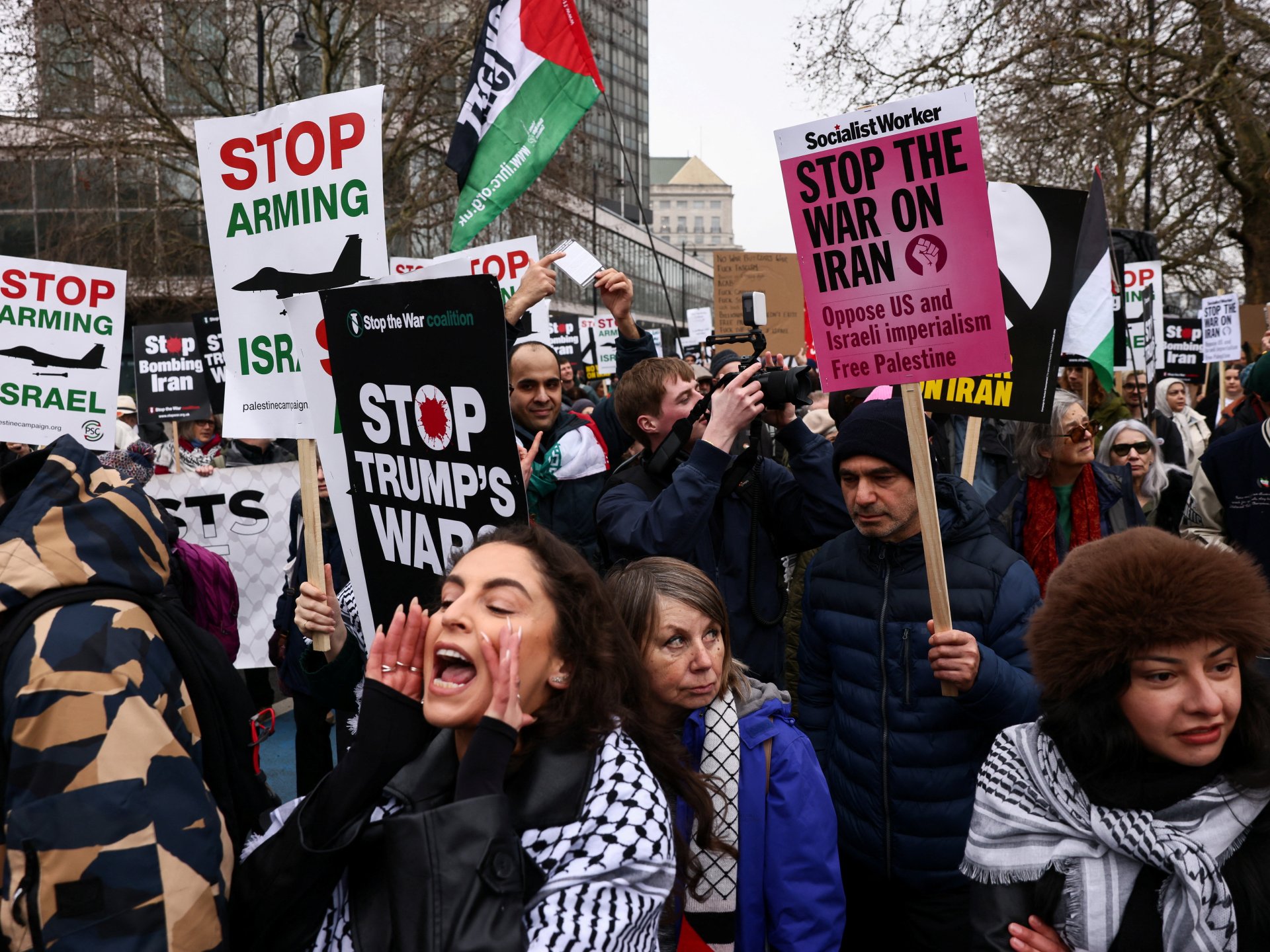
London, United Kingdom – Recent headlines from British newspapers speak to different areas of tension in the UK due to the United States-Israel war on Iran: economic woes, political friction and worries about the country’s readiness for the future, strategically and militarily, if the conflict persists.
On Thursday, the Financial Times blared, “Consumer confidence slumps to two-year low,” as The Guardian reported, “UK braces for price rises driven by Iran war as economic confidence plummets” and “UK prepared to deploy RAF Typhoons to keep Strait of Hormuz open after Iran war.” Earlier this month, The Independent reported that Prime Minister Keir Starmer risked US President Donald Trump’s wrath as he “refuses to let US use UK bases” for strikes on Iran’s infrastructure. And on Sunday, quoting a minister, The Times said the “economic fallout from the Iran war” would last at least eight months.
Recommended Stories
list of 4 itemsend of list
Beyond the headlines is real public angst about what the war in Iran means on a human level and what the economic and political fallout may be.
For Iranians living in the UK, there is a whole other level of worry.
Omid Habibinia, a man in his 50s who was born in Tehran but moved to the UK 25 years ago, described the impact on him personally.
“Since the first day of the war, connection has been cut off. I am witnessing the pain and suffering of those close to me, many of whom have no news of their families. Beyond the fact that around 90 million people inside Iran have effectively been imprisoned by the internet shutdown and millions more have been deprived of contact with their loved ones, the attacks on the country’s critical infrastructure – alongside the killing and injury of thousands of civilians and the displacement of many – are deeply distressing to me,” he told Al Jazeera.
It seems clear that the impact will last long after the conflict has ended or at least a long-term ceasefire is agreed. There are worries of higher mortgage costs and higher food and fuel prices amid a continued cost-of-living crisis.
Luke Bartholomew, deputy chief economist at fund manager Aberdeen, said the UK economy is “particularly badly exposed to the Iran shock as a big energy importer with weakly anchored inflation expectations and an already soft labour market”.
For many people still recovering from the energy inflation shock that followed Russia’s invasion of Ukraine in 2022, this is a hit to their household finances that is hard to manage.
Although the government has urged people not to worry, sporadic queues at petrol stations and talk of a return to panic shopping seen during the start of the COVID-19 pandemic are commonplace.
‘We will stand by working people’: Starmer
Starmer formed an Iran crisis committee that met on Tuesday to persuade people that “you can be sure we will stand by working people in this crisis”.
He hinted that people might change their holiday plans and might already be cutting back on food.
“I think we’ll see how long the conflict goes on. I can see that, if there’s more impact, people might change their habits, … where they go on holiday this year, what they’re buying in the supermarket, that sort of thing,” he said.
Critics said the government’s stretched finances mean it cannot afford the energy subsidy that may be needed. They have also lamented the government’s reluctance to exploit the nation’s untapped oil reserves in the North Sea. Experts disagreed on whether this would make any significant difference.
Before the Iran war began, the UK economy was turning a corner. Inflation and fuel costs were falling, government borrowing was down and unemployment was falling.
The hits to the UK population range from the relatively trivial to the potentially terrifying.
London house prices have tumbled as sellers become nervous and buyers sit tight, but some observers have noted that they were overpriced in the first place.
Flights being cancelled due to a lack of jet fuel might be an inconvenience. Higher prices for fuel and food and then everything else are a major problem for those whose incomes are already stretched.
Then there is the genuine fear of what a prolonged war could mean, such as a serious recession or military involvement.
Thomas Pugh, chief economist at the consulting firm RSM UK, said: “The Strait of Hormuz has effectively been shut since early March. The International Energy Agency called it the largest supply disruption in the history of the global oil market. Oil prices have spiked, gas prices are climbing and inflation fears are back. But the bigger risk is ‘demand destruction’.
“Demand destruction happens when high prices force people and businesses to buy less. We’re seeing it already in fuel rationing in emerging market economies. It means fewer cars sold, fewer homes bought, fewer restaurant meals, fewer business investments and eventually fewer jobs. Because this crisis is about more than oil, demand destruction appears across the whole economy.”
The Iran war arrived at a time when the UK population was already unhappy.
A survey by the polling company IPSOS in December reported: “Three quarters of Britons expect large-scale public unrest in 2026. 59 percent think there will be protests against the way their country is being run, highest in Peru (80%) and South Africa (76%). In Great Britain, 74% predict large scale unrest. Since 2019, three of the G7 countries – Great Britain, Japan (both+11pp [percentage points]) and United States (+10pp) – have seen a double-digit increase in the proportion that think there will be large-scale public unrest.”
Bartholomew added: “With inflation rising and wage growth sluggish after a sustained period of very weak employment activity, real wages are likely to turn negative in coming months, adding a further headwind to the economy. So it’s probably just too early for the full effects of the war to be felt or show up in the data yet. But one place the impact of the war is very clearly showing up is around the path of interest rates.
“It is very likely that were it not for the war, the Bank of England would be cutting rates at its April meeting. Instead, the market is pricing in a series of rate hikes this year. For households that were hoping for mortgage rate cuts this year, the prospect of rates staying on hold is almost as painful as renewed hikes.”