

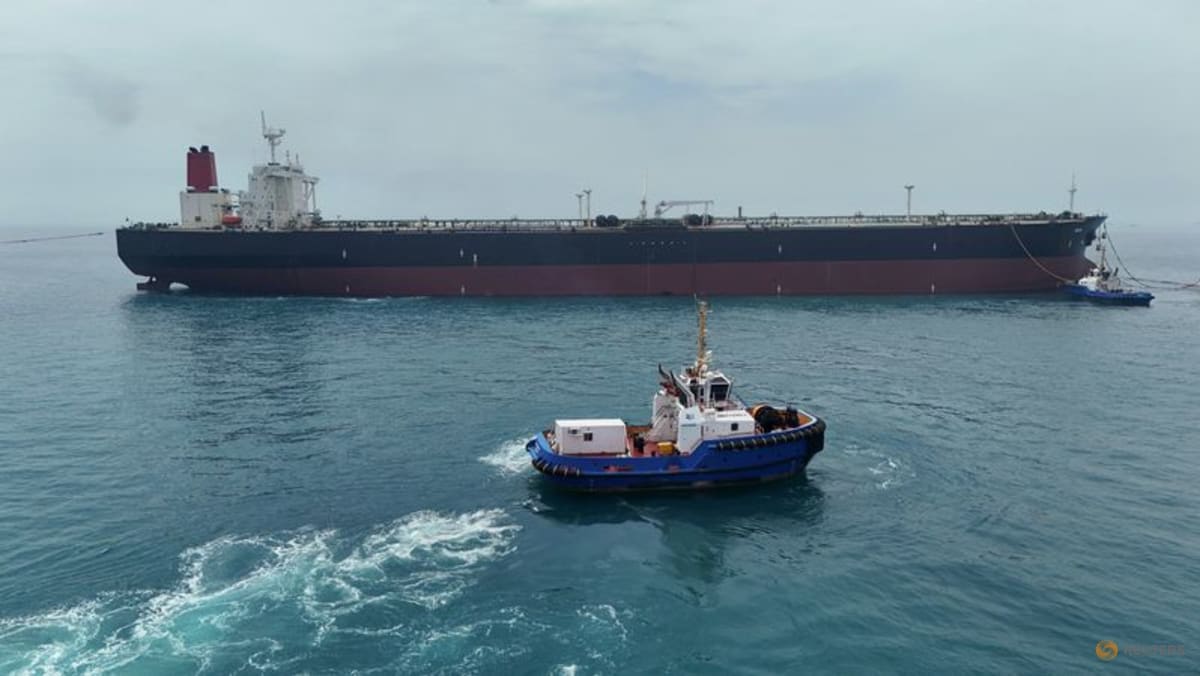
SINGAPORE: Soon after the Middle East conflict broke out in late February, Iran started restricting shipping through the Strait of Hormuz, effectively imposing a naval blockade on a critical chokepoint where around 25 per cent of the world’s seaborne oil passes through.
As the conflict dragged on, the United States also imposed its own blockade of Iran’s commercial ships. In recent weeks, commercial ships belonging to countries not involved in the conflict have been seized, and there were suggestions from both Iran and the US to levy taxes on ships that ply the waterway, which is less than 40km wide at its narrowest point.
Elsewhere, the idea of charging tolls for passage through narrow straits became a topic of discussion.
Indonesia’s finance minister Purbaya Yudhi Sadewa last week suggested that ships passing through the Strait of Malacca could be levied, although the country later affirmed that it has no plans to impose tolls in the strait, which is less than 4km wide at its narrowest point. Commentators and Chinese netizens are also discussing the possibility of “toll booths” in the Taiwan Strait, drawing inspiration from how the Strait of Hormuz has been weaponised by warring parties.
Amid the growing threats to navigational rights and freedoms, countries are now shining a spotlight on a critical piece of international law that governs maritime activities – the United Nations Convention on the Law of the Sea (UNCLOS), and on why the rule of law needs to be upheld.
Underscoring these concerns, the United Nations Security Council on Monday (Apr 27) is also set to meet in New York for a debate on the safety and protection of waterways.
CNA looks at what UNCLOS covers and whether it has been effective as a check against unfettered unilateral actions by large maritime powers.
How did the United Nations Convention on the Law of the Sea come about?
UNCLOS is a set of rules governing the world’s oceans. It allocates rights and legal authority to states, and establishes regulations for the peaceful use of the sea and its resources.
The international law took effect in 1994 after being adopted in 1982, and was the result of a 15-year process beginning with a speech by Malta’s then-Ambassador to the United Nations Arvid Pardo.
In the decades before, oil exploration, fishing and mining activities were taking people far beyond their native shores, and countries were making conflicting claims to parts of the sea.
For example, in 1945, then US President Harry Truman unilaterally extended the country’s jurisdiction over all natural resources on its continental shelf in a challenge to the freedom-of-the-seas doctrine, which limited national rights to a narrow belt of sea surrounding a country’s coastline.
Other countries followed suit, with Argentina claiming its shelf, and Chile, Peru and Ecuador asserting sovereign rights over a larger area, hoping to limit the access for fishing fleets that were operating outside their own borders.
Speaking at the United Nations General Assembly in 1976, Mr Pardo said countries might be tempted to use their technical competence to competitively extend their jurisdiction over selected areas of the ocean floor.
“The consequences will be very grave,” he said then. “At the very least, a dramatic escalation of the arms race and sharply increasing world tensions.”
In the following years, the United Nations Seabed Committee was set up, and a global diplomatic effort was made to regulate and write rules to govern the ocean.
Singapore was one of the architects of the UNCLOS, playing an important role in shaping the provisions on transit passage in straits used for international navigation.
Today, 172 parties have ratified UNCLOS. Countries such as Iran and the US have signed UNCLOS, but have not ratified it.
What does UNCLOS cover?
From protecting the marine environment to determining the territorial jurisdiction of coastal states, UNCLOS was adopted as a “package deal”, which means that the law is to be accepted as a whole in all its parts, without reservation on any aspect.
The Middle East conflict has highlighted one of its key clauses – the right of transit passage in international straits.
This is different from freedom of navigation in the high seas, where ships should not face interference from any states, and the right of innocent passage in territorial seas, where states may have sovereignty, but ships should be allowed to transit as long as they do not affect the coastal state’s peace, good order and security.
Under UNCLOS right of transit passage, ships of all nations have the right to pass through straits used for international navigation continuously and without interference.
This means that states located next to straits can only regulate passage for specific reasons, such as safety of navigation and prevention of pollution.
They are not allowed to stop ships from passing, and cannot charge tolls for the right of transit.
That is why countries objected to Iran’s suggestion that it could charge ships that pass through the Strait of Hormuz.
Does UNCLOS apply to countries that don’t ratify it?
The right of transit through the Strait of Hormuz has become “firmly entrenched” in customary international law, Singapore’s Permanent Representative to the UN Burhan Gafoor said on Apr 16.
On that basis, UNCLOS applies even to countries that have not ratified it, including the US and Iran.
“It is an inherent right of ships and aircraft to traverse without prior authorisation. As reflected in Article 44 of UNCLOS, the rule is unequivocal: States bordering such straits shall not hamper or suspend transit passage. There are no exceptions to this inherent right,” he said.
But Iran has argued that it is not customary international law, and hence it is not bound by the transit passage regime.
Dr Tara Davenport of the National University of Singapore’s (NUS) Centre for International Law said that even if Iran is not bound by UNCLOS, the customary international law that existed before UNCLOS also does not allow strait states to prohibit, hamper or suspend innocent passage of ships through straits used for international navigation.
She added that the fact that Iran, Israel and the US are at war does not affect this right of transit passage.
Countries that are not involved in the fighting still have the right to move their commercial ships through the straits. Those involved in the conflict can only restrict enemy vessels belonging to each other or ships actively assisting the enemy, she said.
Why is UNCLOS important to Singapore and its neighbours?
Singapore and its neighbours sit along the Straits of Malacca and Singapore, and more maritime oil flows through these straits than the Strait of Hormuz.
As an open economy, Singapore relies on the free flow of trade and goods, including those carried by ships moving through international seas.
Hence, freedom of navigation is of “profound importance” to Singapore, said Singapore Foreign Affairs Minister Vivian Balakrishnan in an Apr 7 parliament speech.
That is why Singapore has to take a “categorical position” that international law and UNCLOS are the constitution of the oceans, and will not negotiate for safe passage through the Strait of Hormuz.
“There is a right of transit passage,” he said. “It is not a privilege to be granted by the bordering state, it’s not a licence to be supplicated for, it is not a toll to be paid.”
“As a matter of principle, and not because we are taking sides, I cannot engage in negotiations for safe passage of ships or negotiate on toll rates, because to do so would be implicitly eroding this legal principle,” said Dr Balakrishnan.
For Indonesia, it gained sovereignty over all waters enclosed in its archipelagic baselines because of UNCLOS, which enshrined the concept of an archipelagic state.
“In other words, UNCLOS transformed a collection of islands separated by open international waters into the unified archipelagic state that Indonesia is today,” wrote Ms Dita Liliansa, a maritime researcher at the University of New South Wales, in The Interpreter.
Imposing a toll on the Malacca Strait would therefore violate UNCLOS and ultimately put Indonesia’s own legal foundations at risk, she argued.
How effective is UNCLOS?
Dr Davenport said the limitations of UNCLOS are a general problem that all international laws have. International laws are upheld by states, and each state has different national interests that impact how it interprets and implements UNCLOS, she said.
However, she said it has been largely effective, and that UNCLOS has a dispute settlement mechanism that is compulsory.
One state can unilaterally commence proceedings against another state, and both states can choose between the International Court of Justice, the International Tribunal for the Law of the Sea or arbitration.
Many cases have been successfully resolved, including a land reclamation dispute between Singapore and Malaysia, she said.
“We only hear about the times that UNCLOS is being breached, but in reality it has operated for more than 30 years as the foundational legal order for the oceans, facilitating a wide range of state activities conducted in a peaceful manner,” she told CNA.
Mr Bazul Ashhab, who leads litigation and international arbitration at law firm Oon & Bazul, said UNCLOS works better as a framework for setting norms, but is less strong when it comes to enforcement.
“It does function as a mechanism for compliance, but falls short of ensuring full compliance,” he said, adding that outcomes can be shaped by broader geopolitical considerations.
He similarly said UNCLOS has remained central to the stability and predictability of global trade for decades, and that it is not perfect, but is a foundation to work on.
Dismissing it entirely would be risking “throwing the baby out with the bathwater”, he said.
Dr Davenport, in a past commentary for CNA, wrote that countries should speak up in support of UNCLOS and what it stands for.
“At a moment when foundational principles of international law are under pressure on multiple fronts, the collective willingness of states to speak in international law’s defence is not a diplomatic nicety – it is what keeps the rules alive.”