

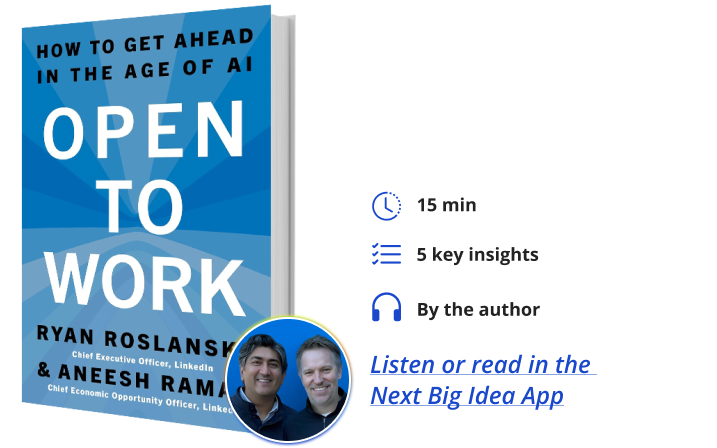
Below, Aneesh Raman and Ryan Roslansky share five key insights from their new book, Open to Work: How to Get Ahead in the Age of AI.
Raman is LinkedIn’s chief economic opportunity officer. He previously served as senior adviser on economic strategy to the state of California and led economic impact at Facebook. Roslansky, who is CEO of LinkedIn, is also EVP of Microsoft Office and Copilot.
What’s the big idea?
AI’s impact on work is unfolding in real time—rapidly—and individuals have more agency than they think. By understanding how skills, roles, and industries are evolving, anyone can actively shape their career and stay ahead in the age of AI.
Listen to the audio version of this Book Bite—read by Raman—in the Next Big Idea app, or buy the book.
1. Jobs are tasks, not titles.
Most of us define ourselves and what we do based on our job titles: I’m an accountant, I’m a nurse, I’m a marketer, or I’m an engineer. And it makes sense, given that for decades our titles told our companies where to put us. But titles are not the most useful way to think about work anymore because AI is not coming for titles, it’s coming for tasks. When you start seeing your job not as a title but as a set of tasks, it makes it easier to understand what’s changing and what to do about it.
Go grab a piece of paper. Now write down the top dozen tasks that take up most of your time at work. Not your job title, job description, or your goals. The actual things you do day-to-day. Then, sort all those tasks into three buckets:
- Bucket 1: Tasks AI can do alone. Think of this as data entry. Basic research. Scheduling that doesn’t require conversation.
- Bucket 2: Tasks you’ll do with AI. Think of this as strategy with AI analysis. Creative work with AI tools. Problem-solving aided by market research. This is where most of your work will start to live.
- Bucket 3: Tasks that remain uniquely human. Think of this as building relationships. Leading through uncertainty. Making hard judgment calls. Ask yourself: Does this require reading emotions or building trust? Would a human touch make a crucial difference? If yes, it belongs here.
Now, think of these three buckets like a conveyor belt: Bucket 1 tasks will increasingly disappear as AI gets more advanced. But as they do, new opportunities emerge in Bucket 2, allowing you to use AI to do things that weren’t possible before. And as you master Bucket 2, you create space and ideas for deeper Bucket 3 work that no machine can touch.
Over time, success is about moving tasks across your buckets. Start deliberately moving tasks from Bucket 1 to Bucket 2 by adding human judgment to routine work. Start using AI tools in Bucket 2 to free up time for more Bucket 3 tasks. And start expanding your Bucket 3 capabilities, because that’s where durable value lives.
It’s not just about sorting tasks into buckets but developing the meta-skill of actively curating them over time. This is not a one-time exercise, but something you’ll continue to work at as your job evolves.
2. Soft skills are survival skills.
Certain skills set us apart from AI, and we call them the 5Cs:
- Curiosity
- Courage
- Creativity
- Compassion
- Communication
These skills are core to how we come up with new ideas and solutions. For decades, the 5Cs have been dismissed as soft skills, meaning “nice-to-haves” that took a back seat to the hard skills our economy valued most. In the coming years, it will become clear that soft skills are anything but soft. They are key to our survival at work.
Think about how these 5Cs show up in your own work today:
- Curiosity. AI can process patterns. Only you ask, “What if we tried something completely different?”
- Courage. AI can calculate risk. Only you decide what risk is worth taking.
- Creativity. AI remixes what exists. Only you reimagine what’s possible.
- Compassion. AI can simulate concern. Only you can empathize from lived experience.
- Communication. AI translates language. Only you turn language into meaning.
Don’t think of these skills in isolation. As neuroscientist Vivienne Ming points out, “These aren’t five separate items on a checklist. They feed each other. Curiosity without courage leads to inaction. Creativity without communication remains a private hobby. Compassion gives our work purpose.”
While everyone’s racing to out-code AI, you should be honing the things that AI can never replace. The 5Cs are your competitive edge.
3. Careers aren’t ladders; they’re climbing walls.
The career ladder is a relic of the industrial age, and it’s coming undone. For generations, the playbook was clear and unchanging: By and large, you joined a company after graduating from school, climbed steadily for decades, and retired with a pension and a gold watch. One path. One employer. One direction—up.
But ladders only work when the world is stable. When skills last decades. When jobs stay the same. That world has been on the way out, but now AI is accelerating the pace. Professionals entering the workforce today will hold twice as many jobs over their careers as those in the previous generation. The ladder doesn’t work when your job changes faster than you can get promoted. Or when your industry shifts faster than you can figure out what to pivot into next.
So, think of your career path less like a ladder and more like a climbing wall. Multiple routes up. Sideways motions that build new skills. Sometimes, even going down to find stronger positions. The best climbers won’t follow someone else’s path: They’ll design their own.
You’re already on the wall, whether you realize it or not. To guide your climb, ask yourself three big questions:
- Why do you work? Whether it’s financial security or a sense of purpose, what’s driving you to show up every day?
- What do you uniquely do? What’s the combination of skills only you bring?
- Where are you going? What problems do you want to solve and who do you want to solve them with?
4. Our brains aren’t wired to handle exponential change.
The S curve of change is a helpful way to understand how big shifts, like new technologies or major trends, tend to unfold over time. At first, progress is slow and almost invisible—that’s the bottom of the S, and that’s when most people feel comfortable ignoring it. Like the internet in 1993, social media in 2004, and AI in 2020. Then, momentum builds and adoption accelerates rapidly—that’s the steep middle of the S. Finally, growth levels off as the change becomes mainstream and widely accepted—that’s the top of the S.
AI isn’t at the bottom of the S curve anymore. ChatGPT hit 100 million users faster than any technology in history. We’re entering the steep part where adoption stops being optional. The question is: Are you engaging with this change as it starts to speed up?
Our brains are wired to fear change and not process exponential change. That’s why managing S curves is so hard. And while we have had decades and years to manage past ones, we don’t have as much time with AI. Change will never be this slow again. AI will never be this basic again. The time to experiment is now. Adapting beats predicting.
5. Nobody beats you at being you.
There are well over three billion people in the global workforce. More than a billion of them are on LinkedIn. Only one of them is you.
That might sound obvious, but it’s easy to forget when you’re at work, trying to fit in. We often spend our careers molding ourselves to job descriptions, industry standards, and the “proven path.” We’re asked to demonstrate the right competencies to show we can do what others have already done. The entire machinery of work, from résumés to reviews, is designed to make us comparable, categorizable, and measurable against others.
But when AI handles the standard, things start to flip. Suddenly, your differences become your competitive advantage. The specific combination of failures and triumphs that taught you resilience in ways no curriculum could capture. The childhood spent between cultures that lets you see patterns others miss. The decade you “wasted” in the wrong career that gave you insights no straight path could provide. The quirks in how you approach problems. The unconventional connections you make between ideas.
For your entire career, you’ve probably been told to smooth over these edges to make yourself more marketable. In a world where AI can replicate the standard approach, those edges are going to make you irreplaceable.
Enjoy our full library of Book Bites—read by the authors!—in the Next Big Idea app.
This article originally appeared in Next Big Idea Club magazine and is reprinted with permission.