

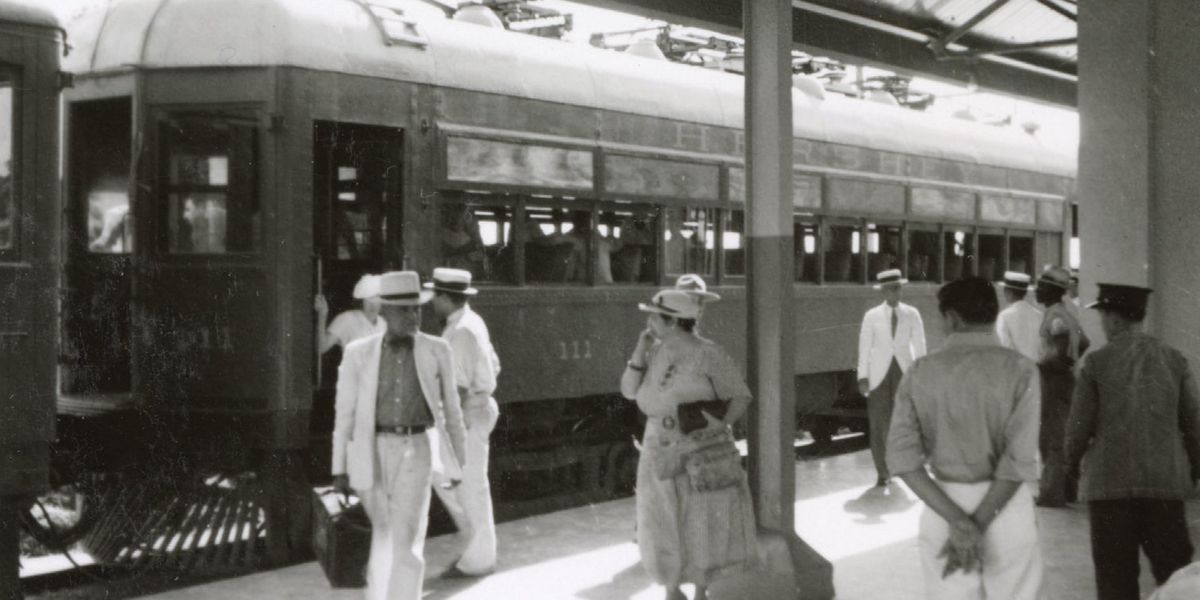
Why does a chocolatier build a railroad? For Milton S. Hershey, it was a logical response to a sugar shortage brought on by World War I. The Hershey Chocolate Co. was by then a chocolate-making powerhouse, having refined the automation and mass production of its products, including the eponymous Hershey’s Milk Chocolate Bar and the bite-size Hershey’s Kiss. To satisfy its many customers, the company needed a steady supply of sugar. Plus, it wanted a way to circumvent the American Sugar Refining Co., also known as the Sugar Trust, which had a virtual monopoly on sugar processing in the United States.
Why Did Hershey Build an Electric Railroad in Cuba?
Beginning in 1916, Hershey looked to Cuba to secure his sugar supply. According to historian Thomas R. Winpenny, the chocolate magnate had a “personal infatuation” with the lush, beautiful island. What’s more, U.S. business interests there were protected by a treaty known as the Platt Amendment, which made Cuba a satellite state of the United States.
Like many industrialists of the day, Hershey believed in vertical integration, and the company’s Cuban operation eventually expanded to include five sugar plantations, five modern sugar mills, a refinery, several company towns, and an oil-fired power plant with three substations to run it all.
A 1943 rail pass entitled the holder to travel on all ordinary passenger trains of the Hershey Electric Railway. Hershey Community Archives
The company also built a railroad. To maximize the sugar yield, the cane needed to be ground promptly after being cut, and the rail system offered an efficient means of transporting the cane to the mills, and ensured that the mills operated around the clock during the harvest. By 1920, one of Hershey’s three main sites was processing 135,000 tonnes of cane, yielding 14.4 million kilograms of sugar.
Initially, the Hershey Cuban Railway consisted of a single 56-kilometer-long standard gauge track on which ran seven steam locomotives that burned coal or oil. But due to the high cost of the imported fuel and the inefficiency of the locomotives, Hershey began electrifying the line in 1920. Although it was the first electrified train in Cuba, rail lines in Europe and the United States were already being electrified.
In addition to powering the various Hershey entities, the generating station supplied Matanzas and the smaller towns with electricity. F.W. Peters of General Electric’s Railway and Traction Engineering Department published a detailed account of the system in the April 1920 General Electric Review.
Hershey’s Company Towns
The company town of Central Hershey became the headquarters for Hershey’s Cuba operations. (“Central” is the Cuban term for a mill and the surrounding settlement.) It sat on a plateau overlooking the port of Santa Cruz del Norte, about halfway between Havana and Matanzas in the heart of Cuba’s sugarcane region.
Hershey imported the industrial utopian model he had established in Hershey, Penn., which was itself inspired by Richard and George Cadbury’s Bournville Village outside Birmingham, England.
 The chocolate magnate Milton S. Hershey had a “personal infatuation” with Cuba.Underwood Archives/Getty Images
In Cuba as in Pennsylvania, Hershey’s factory complex was complemented by comfortable homes for his workers and their families, as well as swimming pools, baseball fields, and affordable medical clinics staffed with doctors, nurses, and dentists. Managers had access to a golf course and country club in Central Hershey. Schools provided free education for workers’ children.
Milton Hershey himself had very little formal education, and so in 1909 he and his wife, Catherine, established the Hershey Industrial School in Hershey, Penn. There, white, male orphans received an education until they were 18 years old. Now known as the Milton Hershey School, the school has broadened its admission criteria considerably over the years.
Hershey duplicated this concept in the Cuban company town of Central Rosario, founding the Hershey Agricultural School. The first students were children whose parents had died in a horrific 1923 train accident on the Hershey Electric Railway. The high-speed, head-on collision between two trains killed 25 people and injured 50 more.
Milton Hershey was a generous philanthropist, and by most accounts he truly cared for his employees and their welfare, and yet his early 20th-century paternalism was not without fault. He was a fierce opponent of union activity, and any hard-won pay increases for workers often came at the expense of profit-sharing benefits. Like other U.S. businessmen in Cuba, Hershey employed migrant seasonal labor from neighboring Caribbean islands, undercutting the wages of local workers. Historians are still wrangling with how to capture the long-lasting effects of U.S. economic imperialism on Cuba.
Can the Hershey Electric Railway Be Revived?
Hershey continued to acquire new sugar plantations in Cuba throughout the 1920s, eventually owning about 24,300 hectares and leasing another 12,000 hectares. In 1946, a year after Milton Hershey’s death and amid growing political uncertainty on the island, the company sold its Cuban interests to the Cuban Atlantic Sugar Co. In addition to Hershey’s sugar operations, the sale included a peanut oil plant, four electric plants, and 404 km of railroad track plus locomotives and train cars.
 Service on the Hershey Electric Railway in Cuba continued into at least the 2010s but became increasingly sporadic, with aging equipment like this car at the Central Hershey station. Hershey Community Archives
The Central Hershey sugar refinery continued to operate even after the Cuban Revolution but eventually closed in 2002. Passenger service, meanwhile, continued on the Hershey Electric Railway, albeit sporadically: By 2012, there were only two trips a day between Havana and Matanzas. This video, from 2013, gives a good sense of the route:
A colleague of mine who studies Cuban history told me that in his travels to the country over almost 30 years, he has never been able to ride the Hershey electric train. It was always out of service or had restricted service due to the island’s chronic electricity shortages, which have only gotten worse in recent years. I’ve been trying to find out if any part of the line is still operating. If you happen to know, please add a comment below.
 Cuba’s frequent power outages make it difficult to operate the Hershey Electric Railway. In this 2009 photo, passengers await the restoration of electricity so they can continue their journey.Adalberto Roque/AFP/Getty Images
A 2024 analysis of the economic potential and challenges of reactivating Cuba’s Hershey Electric Railway noted that an electric railway could be a hedge against climate change and geopolitical factors. But it also acknowledged that frequent power outages and damaged infrastructure argue against reactivating the electrified railway, and it favored the diesel engines used on most of Cuba’s rail network.
Cuba has been mostly off-limits to U.S. tourists for my entire life, but it was one of my grandmother’s favorite vacation spots. I would love to imagine a future where political ties are restored, the power grid is stabilized, and the Hershey Electric Railway is reopened to the Cuban public and to curious visitors like me.
Part of a continuing series looking at historical artifacts that embrace the boundless potential of technology.
An abridged version of this article appears in the May 2026 print issue as “This Chocolate Empire Ran on Electric Rails.”
From Your Site Articles
Related Articles Around the Web