

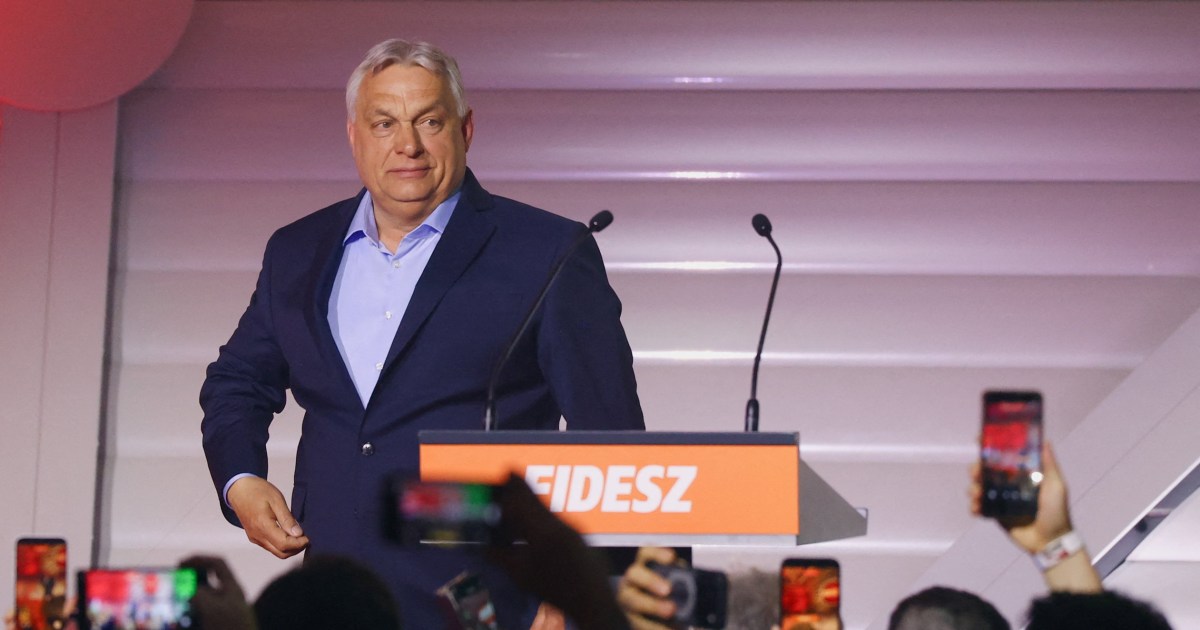
On Sunday, Hungarian Prime Minister Viktor Orban suffered a major defeat in the legislative election after 16 years in power. For all the talk of him being an authoritarian or even a dictator, he quickly conceded defeat in a tearful speech to his supporters.
Amid all the doom and gloom in the European Union, Orban’s political demise is certainly a cause for celebration. But it is a Pyrrhic victory for the EU’s current leaders and the centrist, liberal-democratic cause they claim they represent. Orban’s political career might be dead-ended, but Orbanism is very much alive and kicking.
The EU is going through its worst geopolitical crisis in its history. Its inept, visionless leadership thinks in outdated 20th-century cliches and strives to outperform its openly illiberal rivals in jingoistic tough talk, especially when it comes to Russia. But on top of failing to deliver on their promises to suffocate Russian President Vladimir Putin’s regime economically and defeat it militarily in Ukraine, they are now facing the real prospect of a political breakup with the United States and a large-scale economic crisis caused by US President Donald Trump’s decision to go to war with Iran.
The victory of an ostensibly pro-Brussels Hungarian party, led by Peter Magyar, has provided a rare opportunity for EU Commission President Ursula von der Leyen to rejoice. She wrote on X that Hungary “has chosen Europe” and that it “returns to its European path”.
Framing everything in messianic, civilisational terms that smack of Western supremacism is the current EU commission’s signature style, even as it defies history.
Hungary didn’t “choose Europe” – it is a country in the heart of Europe which has helped shape European politics for centuries. Under Orban, it did so disproportionally to its size and economic weight.
It was Orban’s first government that brought Hungary into NATO in 1999 and that successfully conducted negotiations on Hungary’s accession to the EU. Orban’s subsequent political slide towards illiberalism, which eventually led him to embrace Trump, Putin, and Israeli Prime Minister Benjamin Netanyahu, might seem radical, but it aligns with the continent’s overall shift to the hardcore right. Von der Leyen’s presidency of the European Commission reflects the same shift, even more grotesquely than Orban when it comes to militarism.
It is important to note here that the winner of Sunday’s elections, Peter Magyar, head of the Tisza party, is Orban’s former ally who displays much the same set of political values (or the lack thereof), especially when it comes to the issue of immigration and even of geopolitics.
Like the majority of Hungarians, Magyar is a Ukraine-sceptic who doesn’t want his country to aid Kyiv financially or militarily, even though his government is expected to unblock the EU’s 90-billion-euro ($105bn) loan to Ukraine, crucial for sustaining the war with Russia in the next couple of years.
In an interview published on the eve of elections, Magyar said that “nobody wants a pro-Ukrainian government in Hungary” and that Hungary’s dependence on Russian gas will compel him to sit down for talks with Putin, even though the two are not going to become friends.
If the new Hungarian government lifts its veto on the loan, other EU members – countries that previously welcomed Orban torpedoing the EU’s pro-Ukraine initiatives in silence – may step in.
Even before Orban’s defeat, Belgian Prime Minister Bart De Wever emerged as a new Ukraine-sceptic leader in the EU. He successfully derailed the European Commission’s plan to tap into Russia’s assets, which is why the EU had to come up with the 90-billion-euro ($105bn) loan.
There are other like-minded political forces, particularly in the EU’s east. Slovakia is now ruled by Prime Minister Robert Fico, who aligned with Orban on most issues, especially when it came to Ukraine. In Czechia, a Ukraine-sceptic coalition under Prime Minister Andrej Babis is now in charge, but yet to show its teeth in the European arena. In Poland, the Ukraine-sceptic President Karol Nawrocki has been clashing with the pro-Ukrainian government of Prime Minister Donald Tusk.
Meanwhile, a worrying trend is emerging within the EU. Ahead of the Hungarian elections, taped conversations between Orban’s Foreign Minister Peter Szijjarto and Russian Foreign Minister Sergey Lavrov were leaked, likely by foreign intelligence outfits. This allowed major anti-Orban voices in the West to accuse Szijjarto of being a Russian asset.
In 2024, another EU country, Romania, also saw the involvement of intelligence agencies in its elections. After a Russia-friendly far-right candidate won the first round of the country’s presidential elections, the Supreme Court annulled the vote based in part on intelligence records of “Russian meddling”.
The greatest danger of framing all political issues exclusively in the context of Europe’s conflict with Russia, as the current European Commission tends to do, is that it is ushering in Russian-style securocratic state capture. Political forces that have invested their future in defeating Russia in Ukraine may sincerely think that foul play in a variety of EU member and candidate countries is justified by the Russian threat. The main result, though, is that European politics is starting to look a lot like Putin’s Russia instead of truly promoting liberal values the EU purports to uphold.
The defeat of such a major Ukraine sceptic as Orban doesn’t change the equation. The delusions and falsehoods of the European mainstream will naturally keep breeding political forces that will sound like the voice of reason by simply exposing them. That was the secret of Orban’s 16-year-long success.
The views expressed in this article are the author’s own and do not necessarily reflect Al Jazeera’s editorial stance.