

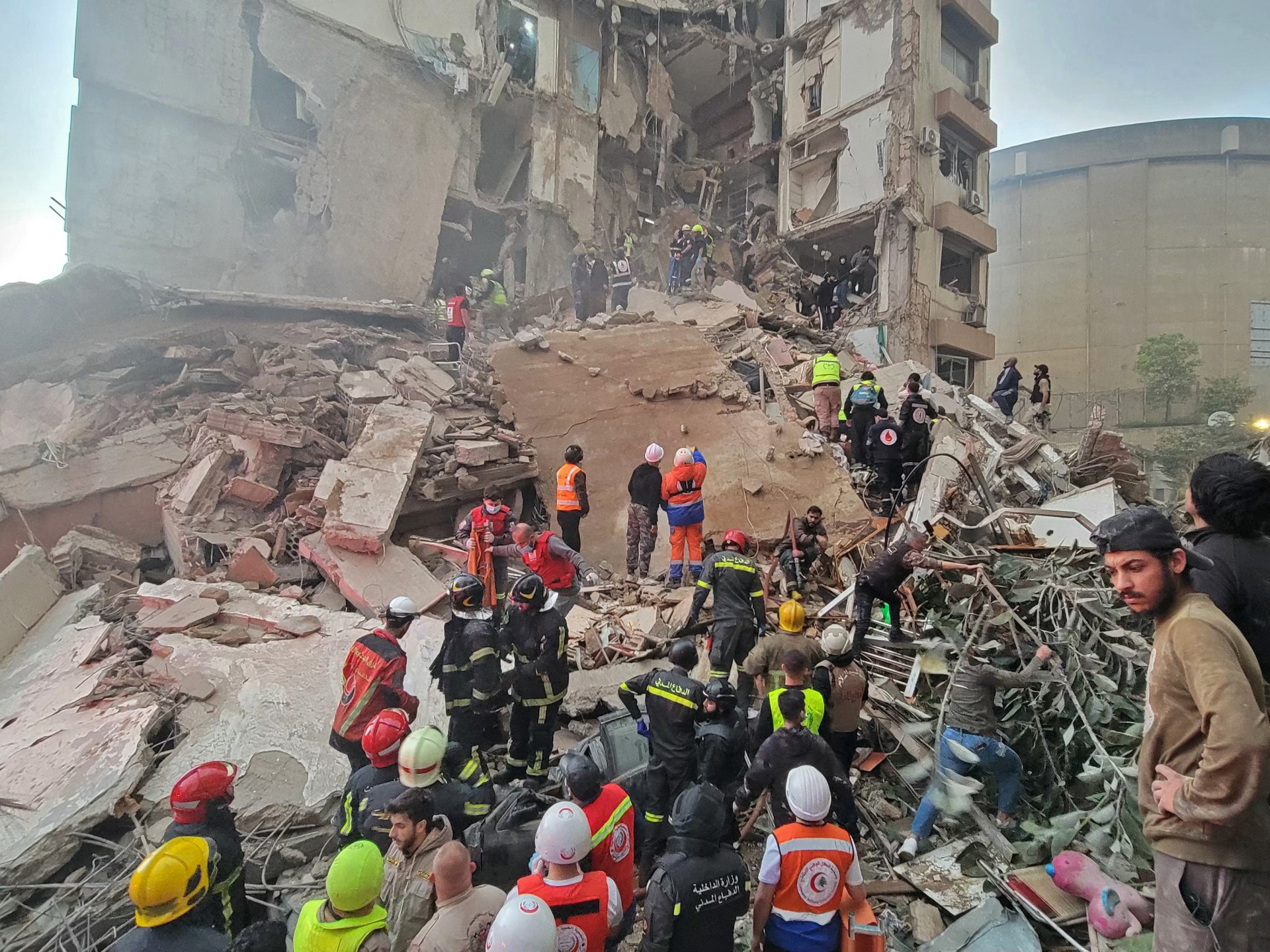
The Israeli army carried out a wave of air attacks on Lebanon, killing more than 250 people, on Wednesday, the bloodiest day since the US-Israel war on Iran began nearly six weeks ago.
On Thursday, Israel said it had also killed an aide to Hezbollah’s chief, Naim Qassem, in the attacks.
Recommended Stories
list of 3 itemsend of list
The attacks came just hours after the announcement of a two-week United States-Iran ceasefire raised hopes of a de-escalation on all fronts in the war on Iran, which has spread across the region.
On Wednesday, Pakistani Prime Minister Shehbaz Sharif, whose government helped broker the deal, said the ceasefire deal included the halting of attacks on all fronts, specifically mentioning Lebanon, where Israel says it is targeting the Iran-backed group, Hezbollah.
Israel, however, together with the US, disputes this, claiming that the cessation of hostilities relates only to attacks between the US, Israel, and Iran. On Wednesday, US President Donald Trump said the Israeli attacks on Lebanon were separate.
The latest violence has exposed major disagreements and confusion about the scope of the ceasefire and raised fears that it could unravel even before negotiations for a permanent settlement begin. Talks are due to commence in Islamabad on Saturday.
What attacks has Israel carried out in Lebanon since the ceasefire was announced?
On Wednesday, hours after the ceasefire was announced, Israel launched its most widespread attacks since March 2, when fighting with Hezbollah began, striking more than 100 targets across the country.
Lebanon’s civil defence said at least 254 people were killed and 1,165 wounded in air attacks on Beirut, the Bekaa Valley and southern Lebanon, including densely populated areas.
In a written statement, the head of Lebanon’s syndicate of doctors, Elias Chlela, urgently called for “all physicians from all specialities” to head to any hospital they could to offer help, with one of Beirut’s biggest hospitals saying it needed donations of all blood types.
The United Nations described the casualty figures as “appalling”, with its human rights chief Volker Turk calling the destruction “horrific”.
Israel claimed, without providing evidence, that it was targeting Hezbollah military infrastructure. But Lebanese officials and aid groups said entire neighbourhoods were devastated, with hospitals overwhelmed and emergency services struggling to cope.
Parliament Speaker Nabih Berri called the attacks on densely populated areas a “full-fledged war crime”.
“Today’s crime, coinciding with the ceasefire agreement declared in the region – an agreement that Israel and its political and security apparatus have failed to uphold,” he said.
How have countries involved in the ceasefire reacted?
The key diplomatic dispute, for the time being, is whether Lebanon is included in the ceasefire, as US, Iranian, Israeli and Pakistani officials have offered differing interpretations of what was agreed.
In an X post on Wednesday, Pakistan PM Sharif wrote: “I am pleased to announce that the Islamic Republic of Iran and the United States of America, along with their allies, have agreed to an immediate ceasefire everywhere, including Lebanon and elsewhere, EFFECTIVE IMMEDIATELY.” His country has acted as the central mediator in achieving the fragile ceasefire.
Iran also stated that the truce extends to Lebanon and called on the US to enforce the ceasefire accordingly.
Citing Sharif’s ceasefire announcement, Foreign Minister Abbas Araghchi said the “US must choose between a ceasefire or continued war via Israel”.
“It cannot have both. The world sees the massacres in Lebanon. The ball is in the US’ court,” he wrote on X.
Iran’s Parliament Speaker Mohammad Bagher Ghalibaf warned that continued Israeli attacks on Lebanon would undermine the agreement and risk further escalation.
By contrast, US officials have stated that the fragile truce excludes Lebanon.
When US President Donald Trump announced the two-week ceasefire with Iran, he said it included “a complete and total cessation of hostilities” between Washington and Tehran. However, he later clarified that Lebanon was “a separate skirmish”.
That position has been reinforced by senior US officials. “I think the Iranians thought that the ceasefire included Lebanon, and it just didn’t,” US Vice President JD Vance, who has been selected to lead the US in talks with Iran in Islamabad on Saturday, told reporters in Budapest, Hungary.
Israel has taken the same stance. Prime Minister Benjamin Netanyahu claimed the ceasefire “does not bind Israel in Lebanon” and that military operations against Hezbollah would continue.
Why is Iran insisting that Lebanon be included in the ceasefire talks?
Speaking in Budapest, Vance also said it would be “dumb” for Iran to jeopardise the proposed talks with the US over Lebanon.
“If Iran wants to let this negotiation fall apart in a conflict where they were getting hammered, over Lebanon, which has nothing to do with them, and which the United States never once said was part of the ceasefire, that’s ultimately their choice. We think that’s dumb, but it’s their choice,” he said.
But contrary to Vance’s claims, Lebanon has a lot to do with Iran.
Hezbollah is Tehran’s most powerful regional ally and a central part of the “axis of resistance”, a network of armed groups across the Middle East aligned with Iran against Israel, including Yemen’s Houthis and a collection of armed groups in Iraq.
The group entered the conflict after the Israeli army killed Iran’s Supreme Leader Ayatollah Ali Khamenei in its first attacks on Tehran on February 28. Before that, Hezbollah had not attacked Israel since a ceasefire came into effect in November 2024, despite near-daily Israeli breaches of the deal.
Among the demands issued by the US for ending the war on Iran is that Tehran end its support for its regional allies, such as Hezbollah.
A ceasefire which excludes Lebanon risks weakening Iran’s decades-old defence strategy. If Hezbollah continues to be targeted while attacks on Iran remain paused, Tehran could lose both its leverage – a weakened ally – and credibility within its network of resistance groups.
Furthermore, by allowing a critical ally to be pummelled without coming to its assistance, especially after it came to Tehran’s defence, Iran would in effect be doing what the US demanded of it: weakening ties with Hezbollah.
That is why the continuation of Israeli attacks in Lebanon, say analysts, poses the biggest threat to the prospects for the ceasefire between the US and Iran.
Andreas Krieg, a professor at King’s College London, called Lebanon the “Achilles’ heel” of the ceasefire. “[It] might force Iran to retaliate against Israel to keep the balance of deterrence and show that Iran is a reliable security partner for Hezbollah,” Krieg told Al Jazeera.
“Israel will try to probe Iran where it can to test its resolve.”
What have other world powers said?
International reaction has largely focused on condemning the scale of the Israeli attacks on Lebanon and calling for Lebanon’s inclusion in the ceasefire.
Several countries described the attacks as a “dangerous escalation”. Qatar condemned what it called a “brutal series” of attacks and urged the international community to act.
Egypt said the attacks demonstrated a “premeditated intent” by Israel to undermine efforts at de-escalation in the region, while Turkiye warned Israel’s attacks were worsening the humanitarian situation in Lebanon and called for immediate action to protect civilians.
In a post on X, Spanish Prime Minister Pedro Sanchez said Netanyahu’s “contempt for life and international law is intolerable” in light of the attacks.
France also condemned Israel’s attacks, while calling for Lebanon’s inclusion in the ceasefire.
UK Foreign Secretary Yvette Cooper has told the BBC that Lebanon must also be included in the ceasefire – a stance she is expected to reiterate in a speech at the Mansion House later on Thursday. She described Israel’s continued assaults on Lebanon as “completely wrong”.
UN chief Antonio Guterres, in a statement, said the “ongoing military activity in Lebanon” poses a “grave risk” to the ceasefire between the US and Iran.
More than 1.2 million people have been displaced in the war-battered country since Israeli attacks on Lebanon began.