

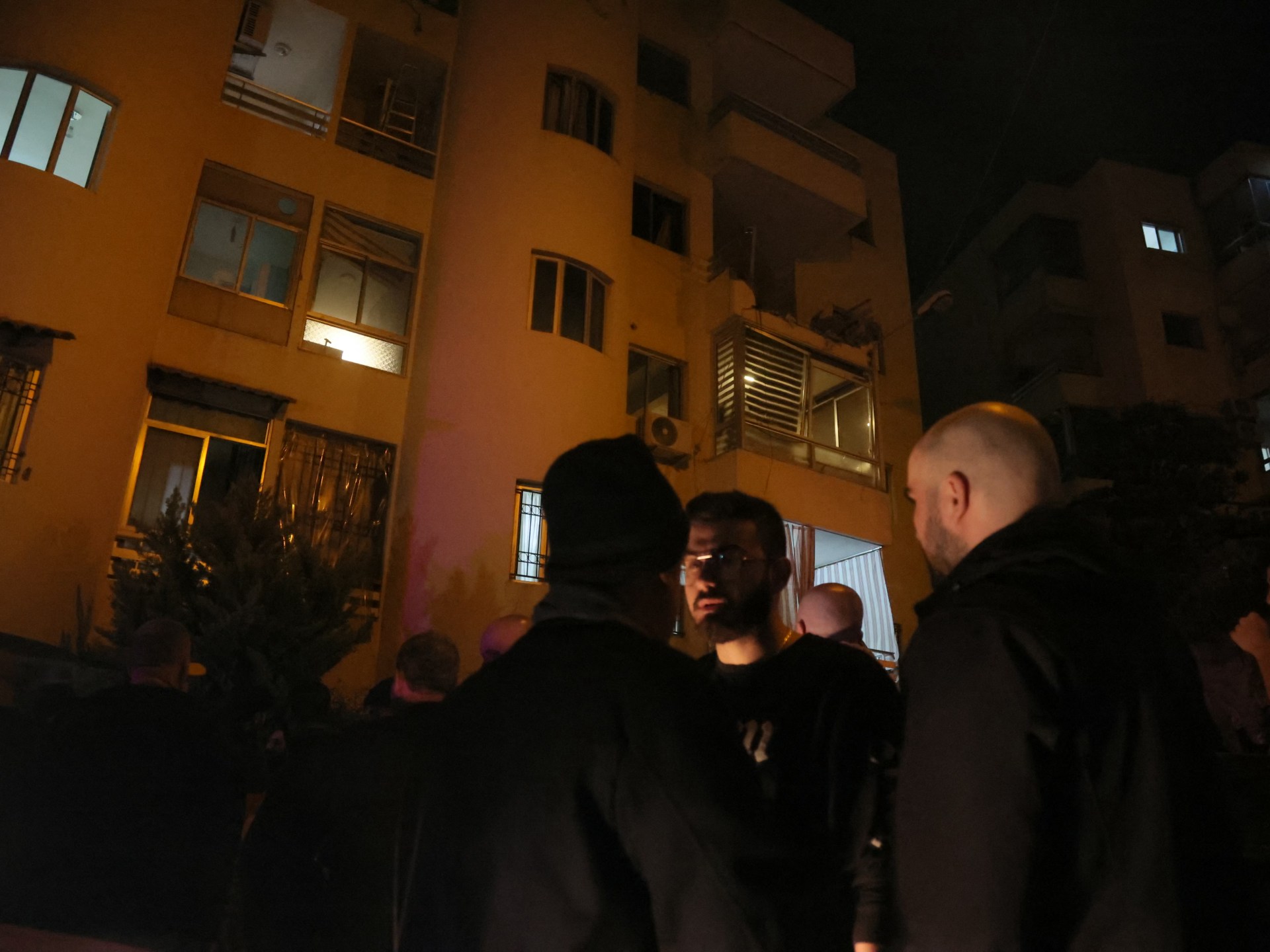
Beirut, Lebanon – On Sunday evening, Georges, 44, was sitting on his balcony in Ain Saadeh, a predominantly Christian area east of Beirut, when his phone rang in his kitchen. He walked over to answer it, and just as he picked up, a loud explosion shook the building behind him.
Two US-made GBU-39 bombs crashed through the roof of the building directly facing his balcony, killing three people, according to the Lebanese Ministry of Health. The deceased were Pierre Moawad, a member of the anti-Hezbollah, Christian party the Lebanese Forces, his wife, Flavia, and a visiting friend named Roula Mattar.
Recommended Stories
list of 3 itemsend of list
The victims of Israel’s bombardment and invasion of Lebanon have been overwhelmingly from the Shia Muslim community, including many who are not fighters of the Iran-backed Hezbollah group. On Sunday, the victims also included Christians, as well as Sudanese in a different attack, as Lebanon experienced one of its most brutal days since widespread Israeli attacks started in early March amid the US-Israel war on Iran.
Overall, Israeli attacks have killed some 1,500 people, including 130 children, in Lebanon, while more than 1.2 million have been forced from their homes.
As the attacks expand, so too do the fissures in Lebanese society. The country is becoming increasingly divided between those who blame Israel for relentlessly attacking Lebanon since October 2023, and those who blame Hezbollah for drawing Israeli wrath.
The latter have often taken out their anger on members of the internally displaced community. Many displaced people have said they are being discriminated against, regardless of whether they support Hezbollah.
“Even if [the attack in Ain Saadeh] was a mistake, the Israelis are not likely going to clarify why they struck there,” Michael Young, a Lebanon expert at the Carnegie Middle East Center, told Al Jazeera.
“The Israelis want to create a rift between the Lebanese communities and isolate the Shia community, and something like what happened yesterday is only going to reinforce that.”
‘Not precise… at all’
On March 2, Israel again intensified its war on Lebanon after Hezbollah responded to Israeli attacks for the first time in more than a year.
Hezbollah claimed that its attack was retaliation for the US and Israeli assassination of Iran’s Supreme Leader Ayatollah Ali Khamenei two days earlier. A ceasefire between Israel and Hezbollah had ostensibly been in place since November 27, 2024, despite more than 10,000 recorded Israeli ceasefire violations by the United Nations, and the killing of hundreds of Lebanese.
Still, Israel used Hezbollah’s attack as justification to expand its strikes across Lebanon and issue mass forced evacuation threats for the country’s south and Beirut’s southern suburbs, traditionally areas where Hezbollah enjoys strong support. As displacement grows, Israeli forces continue to battle Hezbollah in southern villages, and Israeli officials have declared their intention to expand their buffer zone and occupy southern Lebanon.
On Sunday, the Israeli military released videos of systematic demolitions in the southern villages of Naqoura and Taybeh. It also carried out attacks across the country, devastating large swaths of the south and attacking Beirut’s southern suburbs at least eight times.
One of these attacks took place close to Lebanon’s biggest health facility, the Rafik Hariri University Hospital in the Jnah neighbourhood, just metres from the site of another raid in 2024. It killed four people, including two Sudanese nationals, and wounded 39 others.
Outside the hospital, a group of Sudanese people stood waiting for the bodies of their recently killed compatriots to be released and transported for burial. Saeed, a 40-year-old friend of one of the deceased, who also lives near him, said: “The attacks are not precise. Not at all.”
Panic ‘part of their game plan’
When the attack in Ain Saadeh took place, Georges said he only heard one explosion, despite the two holes visible in the roof of the building facing his balcony. The force of the blast caved in the aluminium frame to his sliding glass balcony door and shattered the glass in his kitchen window. Luckily, he said, no one in his family was badly hurt from the attack.
Stories are still circulating over who was the target of the attack, with Israel denying that it had meant to kill Moawad, the Lebanese Forces member.
Still, the attack has had a devastating impact on the local community. One neighbour to the deceased, who declined to give his name but said he works as a guard for a neighbouring municipality, said locals had expelled two displaced families that had taken refuge in the area.
The man, in his 20s, added: “They say they don’t hit Christians, but look. This is the result.”
“We’re afraid,” said another man in his 40s, who asked that his name be withheld.
Elias Hankash, an MP from the Kataeb Party, a predominantly Christian party, called on security forces to establish checkpoints. Locals told Al Jazeera that they wanted guards present at night to monitor who is coming and going.
“There is very much a psychological element to the war in Lebanon to create a situation of overall uncertainty, panic, and fear,” Young said. “This is part of their game plan.”
‘We are dying, little by little’
Georges swept his finger over his balcony shelf, covered in dark soot. “Look at the dust from the blast,” he said, holding up his finger grey with residue.
“They wouldn’t strike if someone wasn’t there,” Georges said about the Israeli attack. Still, he maintained, “we can’t stop Shia people from coming and going”.
Some Lebanese believe that Israel typically only targets Hezbollah. Human Rights Watch has accused Israel of committing “apparently deliberate or indiscriminate attacks” on people in Lebanon, including on civilians.
Israel has claimed that its attacks target Hezbollah operatives and infrastructure, and that it “does everything possible to limit civilian casualties”.
Chris, who works in finance, lives in the building next to the attacked building. “People generally, and me, personally, call to help others, but not at the expense of ourselves,” he said. “Everyone has the right to a home, and we are one people and one country, but this war is not our war.”
Nearby, an older woman named Huda was visibly shaken. Standing next to her husband, she said she had been in a village up north when the attack happened. She was now home just to pick up some things and go north again, to an area she hoped was safer.
She said her goodbyes, but before she left, Huda turned back and said: “We are dying, little by little.”