

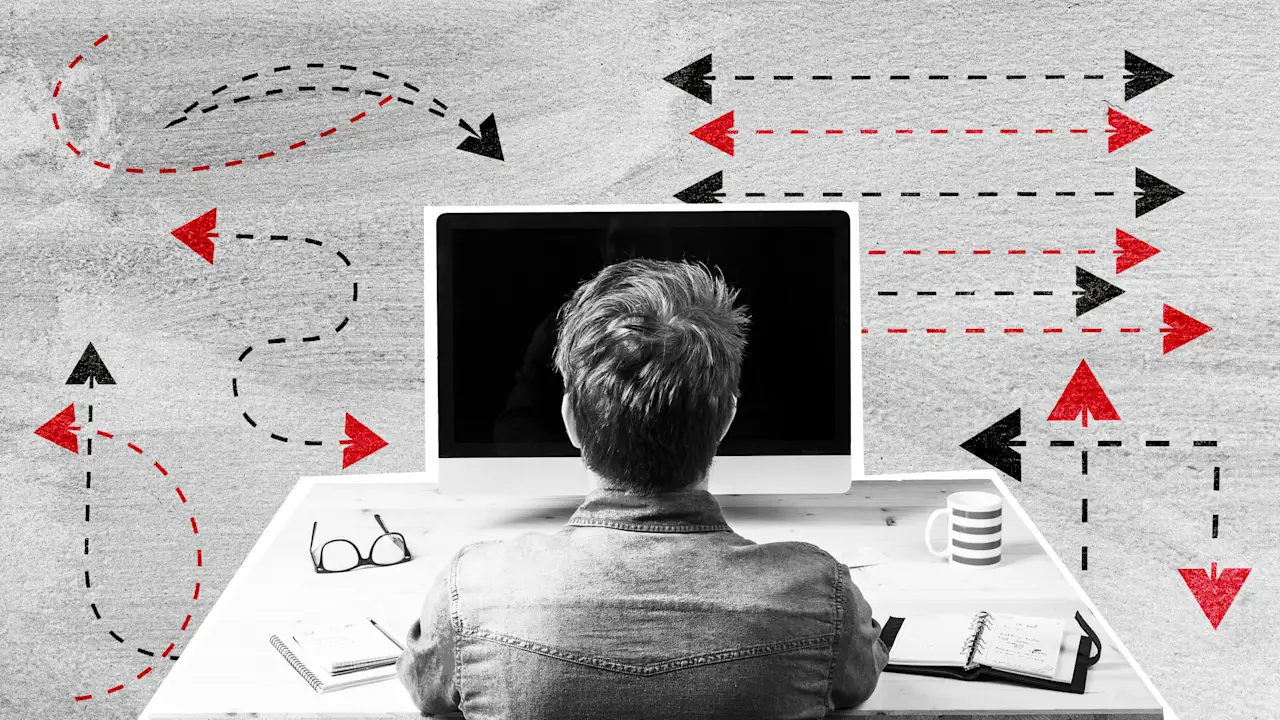
When professionals hit their cognitive limit, most people assume the problem is lack of time or energy. But in reality, overwhelmed people are taking more action than ever. When overwhelm hits, they start doing even more: more lists, more reorganizing, more inbox management, more clicking between tabs. They are busy, visibly productive, heads down for hours, yet at the end of the day the most important work still hasn’t moved.
The productivity mistake almost everyone makes when they’re overwhelmed comes down to taking the wrong action while feeling certain the whole time that they’re taking the right one.
A 2025 managerial study found that digital fatigue and cognitive overload are strongly linked to reduced performance, especially when work demands exceed capacity. Research in cognitive psychology adds to that picture. When the brain is overloaded, it doesn’t reach for its best tools. It reaches for its most familiar ones, the ones that have historically felt like productivity even when they produce very little of it. At the same time, employers are increasingly seeing cognitive load management as a core managerial responsibility rather than an individual burden.
Understanding the difference between organizing and progressing is one of the most important skills a professional can develop, and most people never make that distinction clearly enough to change their behavior because of it.
The action that feels productive but isn’t
When we’re overwhelmed, the brain reaches for something familiar, something that has, in the past, been associated with success. For most professionals, making lists and getting organized has always come right before getting things done, so under pressure that’s what we reach for. We make the list. We sort the inbox. We color-code the calendar, and it feels like progress because it always used to come right before progress. (Turns out, those two things are definitely not the same.)
Stephanie Davis, a business consultant who helps companies identify what’s actually driving growth, calls this pattern “pigeon syndrome,” rooted in B.F. Skinner’s famous experiments: pigeons in cages where food dropped randomly, with no connection to their behavior, would repeat whatever they happened to be doing when the food appeared, obsessively, because the association felt real even though it wasn’t. “I see this in companies all the time,” Davis says. “We are plagued by the illusion of control.”
The to-do list is the perfect professional example. Making the list feels like doing the work, which is a very convincing feeling that produces no actual output. “The to-do list was a ramp, not the destination,” Davis says. Organization is preparation for the work, and conflating the two is where the day disappears.
Why the brain defaults to the ramp
This pattern has more to do with neuroscience than it does with willpower (which means you’re not totally to blame if you’re feeling singled out).
When cognitive load exceeds capacity, the prefrontal cortex, the part of the brain responsible for judgment and strategic thinking, is taken over by our fast-thinking, emotionally-driven lizard brain designed for survival. Rather than asking “what is the highest-value action I can take right now?”, it asks “what have I done before that felt like it worked?” and then answers that question with great confidence, whether or not the answer applies to the current situation.
The brain under stress also has a deep aversion to inaction. Research on decision-making shows that people will consistently choose a familiar action over a better one because doing nothing feels irresponsible, even when staying still would produce better results. Soccer goalies facing a penalty kick almost always dive left or right, despite data showing they’d stop more goals by staying in the center, because standing still feels passive in a way that moving never does. Most overwhelmed professionals are in exactly that mode: working extremely hard, diving in all directions, and rarely stopping to ask whether any of it is landing.
Organization is a tool, not the work
At Lifehack Method, we work with professionals around a framework we call the Massive Action Triangle. It’s three tools, used together, that create the conditions for action that moves you forward. The tools are your calendar, your to-do list, and your Life Map, a running list of leveraged priorities that bridges where you are to where you need to be. The critical word there is “conditions.” These tools exist to create radical clarity about what to do next, and then get out of the way so you can go do the thing. Organization should happen fast, as a launchpad, and the moment you’re spending more time organizing than absolutely necessary, you’ve crossed a line into ineffective motion without progress.
The sequence matters enormously here. Michelle Hart, Senior Director at Salesforce and an executive coach, uses the analogy of a glass jar to make the point. “If you have a jar, you put the big rocks in first and the sand fills in around them — but if you fill it with sand first, you can’t get the big rocks in,” she says. The rocks represent your top priorities, and the sand represents everything else.
This goes against natural instinct when we’re under pressure, because scooping sand is considerably easier than lifting rocks. But high performers resist that urge, and instead put their big rocks first. Not after the inbox is clean, not after the project tracker is updated, not after one more quick thing that somehow takes forty minutes. It’s a true skill to let the small fires burn, but it’s the skill that sets knowledge workers apart in the age of the infinite workday.
When organizations manufacture the problem
Cognitive overload isn’t only an individual challenge. Organizations generate more of it by accident, usually while congratulating themselves on how hard everyone is working.
Wendy Woolfork, an executive advisor focused on leadership development and workplace culture, is frequently brought into organizations where people are exhausted, performing below their potential, and defaulting to busywork, not because they’re unmotivated but because the organization has made doing meaningful work tricky. Unclear expectations, meeting overload, last-minute escalations, poor change communication aren’t inconveniences. They are direct withdrawals from the cognitive capacity your people need to do real work, and the cumulative cost is staggering. A 2007 study published in the Journal of Occupational and Environmental Medicine found that worker fatigue costs employers $136.4 billion annually in health-related lost productivity, a figure the National Safety Council continues to cite today.
To counteract this lost productivity, Woolfork stresses that leadership needs to be “in the business of shrinking friction.” Every unnecessary meeting, every unclear directive, every sand-filling task the organization drops into someone’s day creates distance between your team and the work that actually matters. Even technology like AI should be evaluated to make sure it’s producing outsized value for team members, since generating inputs without more bandwidth to process them accelerates overload rather than relieving it.
What to do instead
Getting out of this pattern requires a deliberate recalibration of what you’re actually doing and why.
Before touching anything else, identify your rocks. These top priorities are not what’s loudest in your inbox, but the one or two things that actually move the needle. Write those down and do them first, purposefully pushing off other work that pulls on your attention. Treat your productivity tools as a launchpad, orient yourself quickly, and then do the work. When getting organized consistently takes more than 30 minutes before you start, preparation may have become avoidance.
If overwhelm is severe, stepping away from your screen is more effective than it sounds. When the thinking brain is struggling, the solution is rarely to think harder in the same environment. A change of physical space, a walk, even switching from coffee to water, gives your nervous system a chance to settle and your prefrontal cortex a chance to come back online. It feels unproductive but it’s actually the opposite.
For managers, protecting bandwidth before it’s gone is the job. Give teams genuine recovery time after high-demand sprints. Audit your meeting cadence with fresh eyes. Ask honestly whether the friction in your organization is making it easier or harder for people to reach the work that actually matters, and then do something about the answer.
The question worth asking
At the end of a full, busy, exhausting day, one question is worth sitting with: was I working on the right things, or did I let the busy work take over?
Both involve action, and both feel productive, but only one of them represents progress. Organization is a good tool, to be sure, but it’s not the work itself. The goal was never a perfectly color-coded list. The goal was always progress, and the fastest path there starts with being ruthlessly clear about which actions actually lead to it and which ones just feel like they do.