

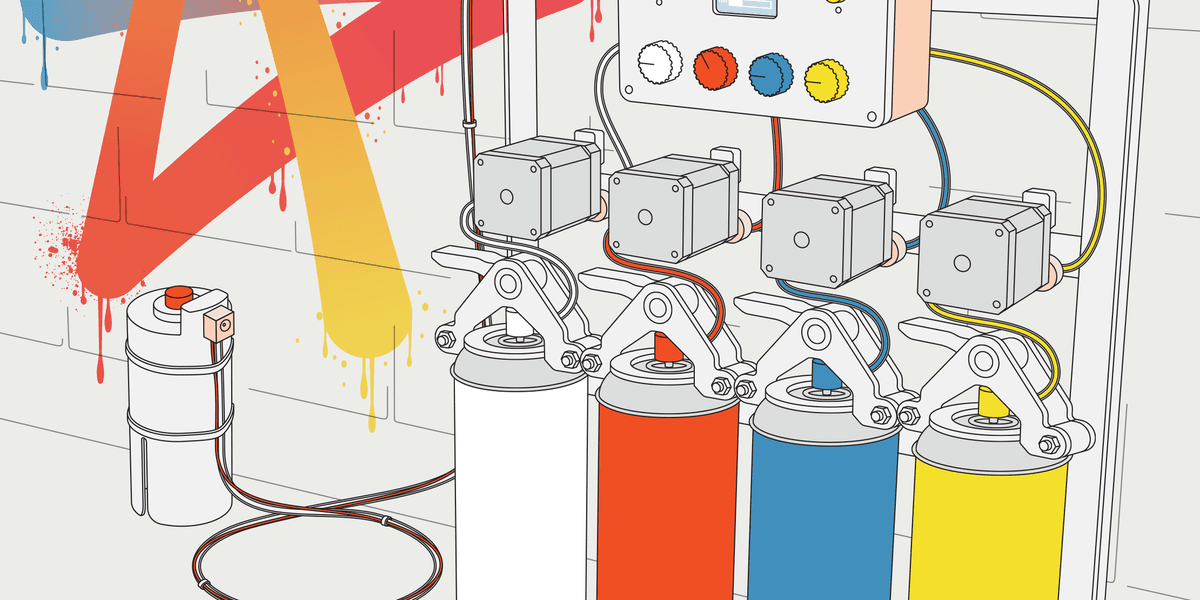
We’re all familiar with mixing red, yellow, and blue paint in various ratios to instantly make all kinds of colors. This works great for oils or watercolors, but fails when it comes to cans of spray paint. The paint droplets can’t be blended once they are aerosolized. Consequently, although spray cans are great for applying even coats of paint to large areas very quickly, spray-paint artists need a separate can for every color they want to use—until now.
Back in 2018, when I first saw professional spray artists lugging dozens to hundreds of cans to their work sites, I was inspired to start noodling on a solution. I’ve worked at Google X, Alphabet’s “moonshot factory,” as a hardware engineer, and I’m now building a startup in mechanical-design software. I’m no painter, but I know my way around mechatronics.
I wanted my solution to be inexpensive and simple enough to build as a DIY project and functional enough for an artist to use, without breaking their flow. So I began prototyping a system that combines base colors while they are still in pressurized form from off-the-shelf cans.
This new rotary pinch valve can be opened and closed in tens of milliseconds and prevents backpressure from clogging lines.James Provost
I tried a few approaches where pres-surized paint from the base-color cansfed through tubes into a mixing channel, before emerging from a spray head. To control the ratios, I decided to borrow a trick that would be familiar to anyone who’s ever had to control the bright-ness of an LED using a microcontroller: pulse-width modulation. Initially, I used electronically controlled solenoid valves to release the paint from the cans. The paint would flow into a mixing channel for a relative duration that corresponded to the ratio of the base colors required to make a given hue. However, this failed because different cans never have the same internal pressure. Whenever two valves were open at the same time, the pressure difference would make paint flow backward into the lower-pressure can.
As an alternative, I removed the mixing channel and tried making the paint pulses from each can sequentially converge into a tube so that no more than one valve would ever be open at a time. Surprisingly, this worked perfectly. The backflow was eliminated, and it turned out that the natural turbulence of the flow was sufficient to mix the paints. Let’s say you want to produce a clementine orange color. This requires yellow and red paint in a ratio of 1:2, so the yellow valve opens for a period of time, and then the red valve opens for twice as long. The system then keeps repeating this cycle of pulses in a rapid pace to instantly create the spray-paint color you want.
The theory is straightforward, but making this work in practice took quite a bit of experimentation. First, I had to determine the actual durations of pulses that would produce evenly mixed colors, not just their ratios. I also needed to work out the size of the tubing (too narrow and you’d get low spray force; too wide and you’d have paint accumulating in the tubes). Eventually I settled on a maximum pulse duration of 250 milliseconds and a tube diameter of 1 millimeter.
Inventing A New Valve
Even though the system worked, the solenoid valves I used constantly clogged up. Designed for water purifiers, the valves didn’t prevent paint from entering the mechanism, where the paint would harden. Moreover, when the valves were turned off, they could stop backflow only if the inlet remained pressurized. So disconnecting a paint can from the system would cause instant leaking. Other off-the-shelf valves I tried couldn’t cycle fast enough and were too expensive.
I had some spectacular failures along the way of the sort that only pressurized paint can provide.
So I created my own mechanism: a high-speed, electronically controlled, rotary pinch valve. It has a stepper motor that rotates a lever with a rolling bearing to constrict fluid flow inside a flexible tube. This concept isn’t new—there’s something like them in every peristaltic pump. But I added a spring to firmly hold the lever in the closed position against any back pressure when the motor isn’t powered, making it a normally closed valve that isolates the attached can. Additionally, the valve is fast enough to be open for as little as 30 milliseconds.
I went through four major prototypes of the system before reaching a working version, and I had some spectacular failures along the way of the sort that only pressurized paint can provide. The final version uses four base colors—red, yellow, blue, and white—with the color mix controlled by four knobs attached to an Arduino Nano and a small display. The flow of paint is triggered by a push button placed above the spray head, similar to a spray can’s nozzle.
 Cans holding base colors (A) are attached to valves (B). An Arduino-based control panel (C) opens and closes valves to mix paint before it is aerosolized (E). By quickly opening and closing valves with varying durations in sequence (D), you can mix paint in specific ratios to create desired colors.James Provost
The length of time a base color’s paint valve can be open is one of eight values between 30 and 250 ms. This means that the entire system—which I coincidentally dubbed Spectrum—can create hundreds of distinct spray-paint colors instantly. It produces less than 84 (or 4,096) colors because duration ratios that are a multiple of each other will produce the same color—for example, 2:3 and 4:6. I added a force sensor to the push button, which allows for a gradient: Two color mixes can be dialed in, and as I increase my thumb’s pressure on the button, the paint mix shifts from one color to the other.
Spectrum’s various fixtures are 3D-printed, and project files and videos are available through my website at https://www.sandeshmanik.com/projects/spectrum. Preprints of technical descriptions of the rotary pinch valve and mixing methodology are available on TechRxiv. The total cost for the bill of materials is less than US $150.
Working on and off on the side for about seven years, I finally finished developing my system and writing the documentation in late 2025. After I posted a video to social media, I was heartened by the immediate positive response from spray-paint artists around the world. I’m now creating step-by-step instructions so that nontechnical people can build their own Spectrum paint sprayer. I look forward to seeing what creations artists out in the wild make!
From Your Site Articles
Related Articles Around the Web