

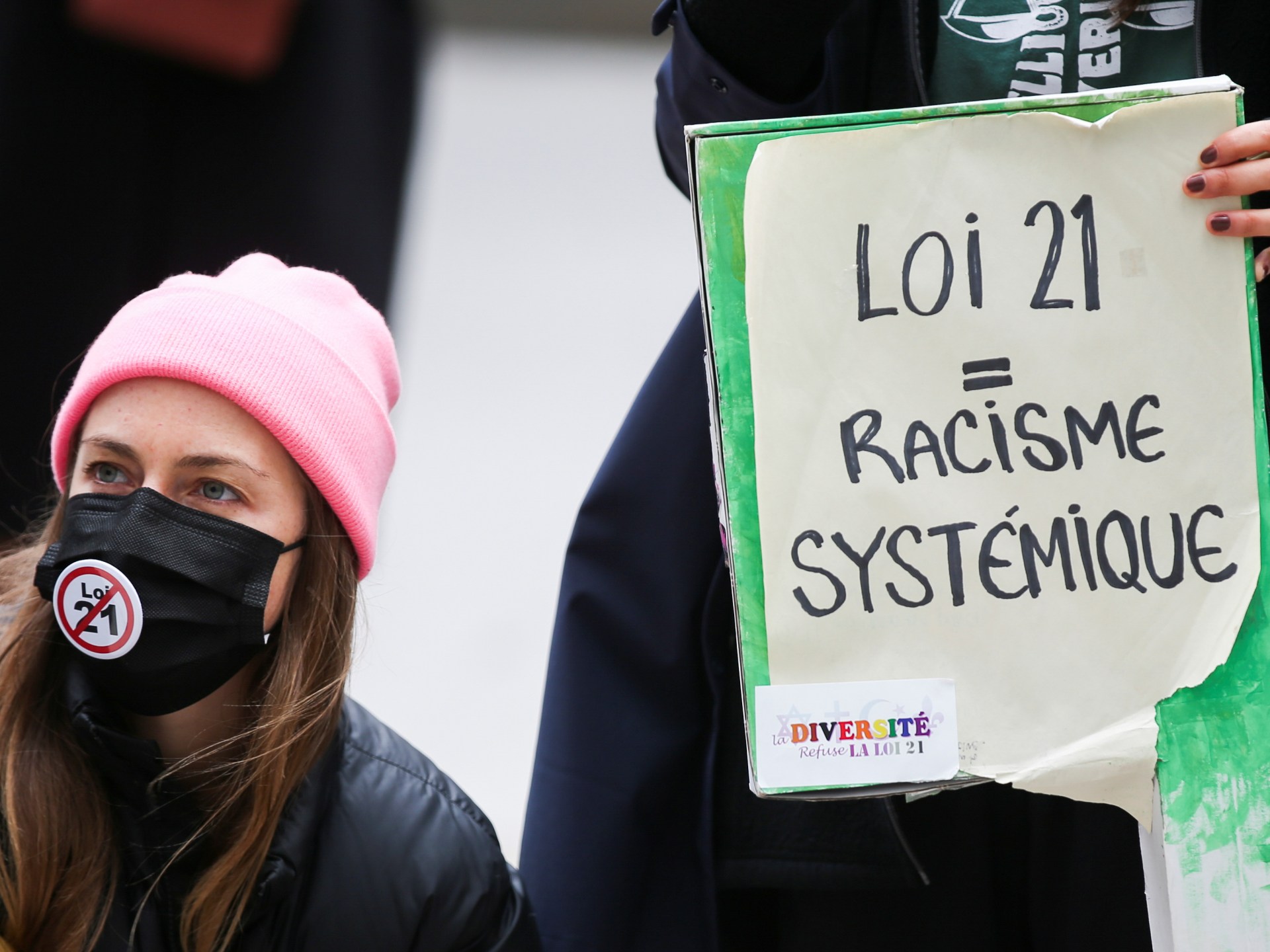
Under the guise of preserving secularism, this law allows the exclusion of people based on their religious identity.
On Monday, the Supreme Court of Canada will begin a four-day hearing for one of the most consequential constitutional cases in the country’s recent history. At issue is Quebec’s so-called “secularism law”, known as Bill 21 – a law enacted in 2019 that prohibits certain public sector workers from wearing visible religious symbols at work.
It bars many public sector employees, including teachers, prosecutors, police officers, and judges, from wearing religious symbols such as hijabs, turbans, kippahs, and other visible expressions of faith while at work.
There is much at stake in this case that raises fundamental questions about religious freedom, equality, and the limits of state power in a constitutional democracy. In addition, another significant issue is that to get the bill passed, Quebec’s government had used the “notwithstanding clause”, a unique provision in Canadian law that allows it to override fundamental rights and freedoms. No other constitutional democracy in the world has a similar blanket override of fundamental rights and freedoms.
The Quebec government claims that the law is necessary to preserve the religious neutrality of the state. Yet Bill 21 does the opposite: by forcing some individuals to choose between their profession and their religious identity, the Quebec government is not remaining neutral – it is effectively excluding people of faith from public sector employment.
The use of this extraordinary, and until recently rarely used, constitutional mechanism has turned the spotlight on Bill 21 beyond the borders of Quebec and the debate over secularism and religious freedoms. It has become a test of how far a democratic government can go in limiting fundamental rights and freedoms.
Evidence before the courts shows that Bill 21 affects religious people of many faiths, including Jewish men who wear kippahs and Sikh men and women who wear turbans; but its impact falls particularly heavily on Muslim women who wear the hijab. For many Muslim women who wear headscarves, teaching and other public service careers have effectively been closed off.
The message of exclusion that this law sends to young people is especially troubling. Generations of young people in Quebec are being told that their full participation in public life requires abandoning visible aspects of their identity.
This is why the National Council of Canadian Muslims and the Canadian Civil Liberties Association launched the constitutional challenge against Bill 21. The Supreme Court of Canada must consider the implications, and possible limitations, of allowing governments to sidestep rights protections through pre-emptive use of constitutional override powers. The court’s decision will help determine whether constitutional rights in Canada remain meaningful constraints on government power, or whether they can be suspended whenever politically convenient.
These questions extend far beyond Canada. Across Europe and elsewhere, debates about secularism have increasingly centred on restrictions targeting religious expression, often impacting Muslim women in particular.
Canada often prides itself on being a model of multicultural democracy, one that accommodates diversity. Bill 21 challenges that reputation by testing whether neutrality can coexist with policies that effectively exclude people of visible faith from public service.
True secularism does not demand the erasure of religious identity. A neutral state does not require citizens to shed visible expressions of belief in order to participate fully in public life.
The Supreme Court of Canada now has the opportunity to reaffirm these principles and clarify that constitutional rights cannot be easily set aside. At a time when countries around the world are grappling with questions of belonging, pluralism, and the rights of minorities, the Canadian court’s ruling will send an important signal about whether liberal democracies are willing to uphold their commitments to freedom and equality.
We say this is not an abstract idea, but an imperative to demonstrate that commitments to freedom and equality are more than mere words.
The views expressed in this article are the author’s own and do not necessarily reflect Al Jazeera’s editorial stance.