

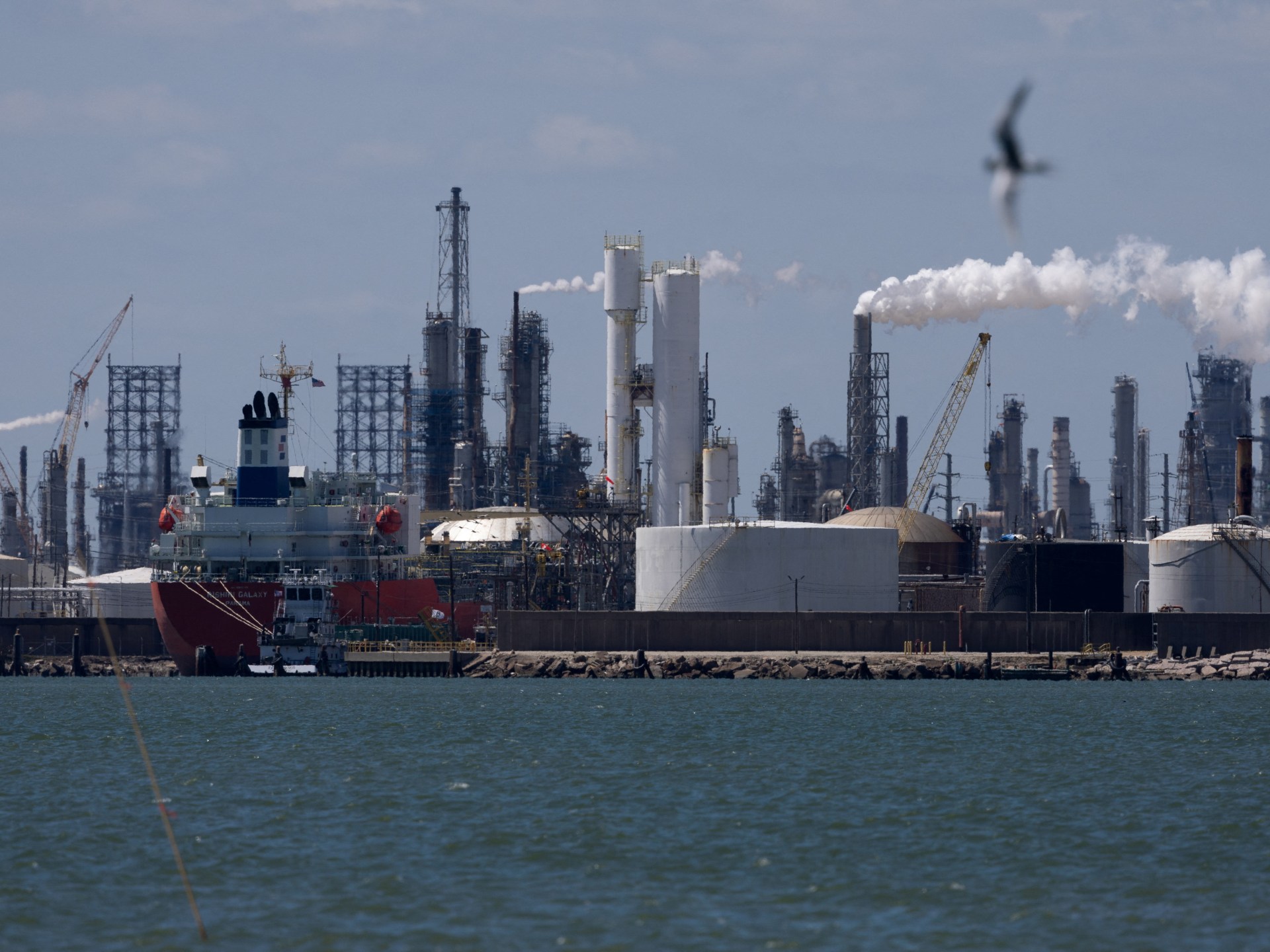
United States President Donald Trump has temporarily waived a century-old shipping law to help ease the cost of transporting oil, gas and other commodities within the US.
The move allows foreign-flagged vessels to transport goods between US ports for the next 60 days, a step taken to ease the movement of energy supplies across the country.
Recommended Stories
list of 2 itemsend of list
“This action will allow vital resources like oil, natural gas, fertilizer, and coal to flow freely to US ports for sixty days,” White House press secretary Karoline Leavitt wrote on X.
Here is what we know:
What is the Jones Act?
The Jones Act, formally known as the Merchant Marine Act of 1920, was passed by Congress to rebuild the United States’s shipping industry after German U-boats devastated the country’s merchant fleet during World War I. The law was sponsored by Senator Wesley Jones of Washington state.
At its core, the act requires that any ship transporting goods or passengers between US ports must be built in the US, owned by US citizens and crewed primarily by Americans. This in effect bars foreign-flagged vessels from participating in domestic maritime trade.
The law allows for temporary waivers in the “interest of national defense,” according to the US Maritime Administration, typically granted by the Department of Homeland Security or the Department of Defense.
The Jones Act was also designed to ensure the US could rely on its own merchant fleet during times of war. It continues to be strongly backed by some shipping companies, labour unions and national security advocates.
Critics, however, argue that restricting foreign competition has driven up shipping costs.
Why is Trump waiving Jones Act requirements now?
Oil markets have been volatile since the start of the US-Israel war on Iran. Tanker traffic through the Strait of Hormuz, a key global chokepoint, has been severely disrupted, affecting exports from major Middle Eastern producers. Commercial vessels carrying everything from fuel to pharmaceuticals and computer chips have also been delayed or have come under attack.
That disruption has pushed up prices worldwide. Brent crude, the global benchmark, was trading near $109 a barrel on Wednesday, up from about $70 before the war. US crude has climbed to roughly $98 a barrel. At the pump, prices have surged, with the US national average for regular gasoline reaching $3.84 a gallon, according to the American Autombile Association, about 86 cents — more than 25 percent — higher than pre-war levels.
With supplies under strain and shipping routes disrupted, countries are scrambling for alternatives.
By allowing foreign-flagged vessels to move energy products between US ports, the administration hopes to reduce transport costs and increase supply. The waiver also applies to fertilisers, which are in high demand during the current spring planting season.
But the decision has drawn criticism. The American Maritime Partnership, a coalition representing US vessel owners, operators and maritime unions, said it was “deeply concerned” the 60-day waiver could be misused, displacing American workers and companies.
The group also argued the measure would have little effect on lowering fuel prices for consumers.
How could suspending Jones Act requirements affect US petrol prices?
A range of factors shape fuel prices, and analysts say easing domestic shipping restrictions is unlikely to be a sweeping solution.
“The waiver will simplify logistics, making it slightly cheaper and easier for products to flow,” said Patrick De Haan, the head of petroleum analysis at GasBuddy, an app that tracks fuel costs.
But De Haan warned not to expect steep price drops from the waiver.
“It won’t have a ‘visible’ impact in reducing prices at the pump as of now; it will merely offset rising retail prices. I estimate it may offset 3 to 10 cents per gallon ($0.007 to $0.02 per litre) of price increases,” he said.
The waiver is part of a broader effort by Washington to boost supply. The Treasury Department has eased sanctions to allow US companies to do business with Venezuela’s state oil firm, while also temporarily opening the door for Russian oil to re-enter global markets.
At the same time, the International Energy Agency (IEA) has pledged to release 400 million barrels of oil from emergency reserves, the largest coordinated release in its history, with the US contributing 172 million barrels from its Strategic Petroleum Reserve.
Even so, analysts say these measures offer only short-term relief. Oil markets remain constrained by global supply disruptions, and it can take time for additional crude to reach refineries and filter through to consumers.