

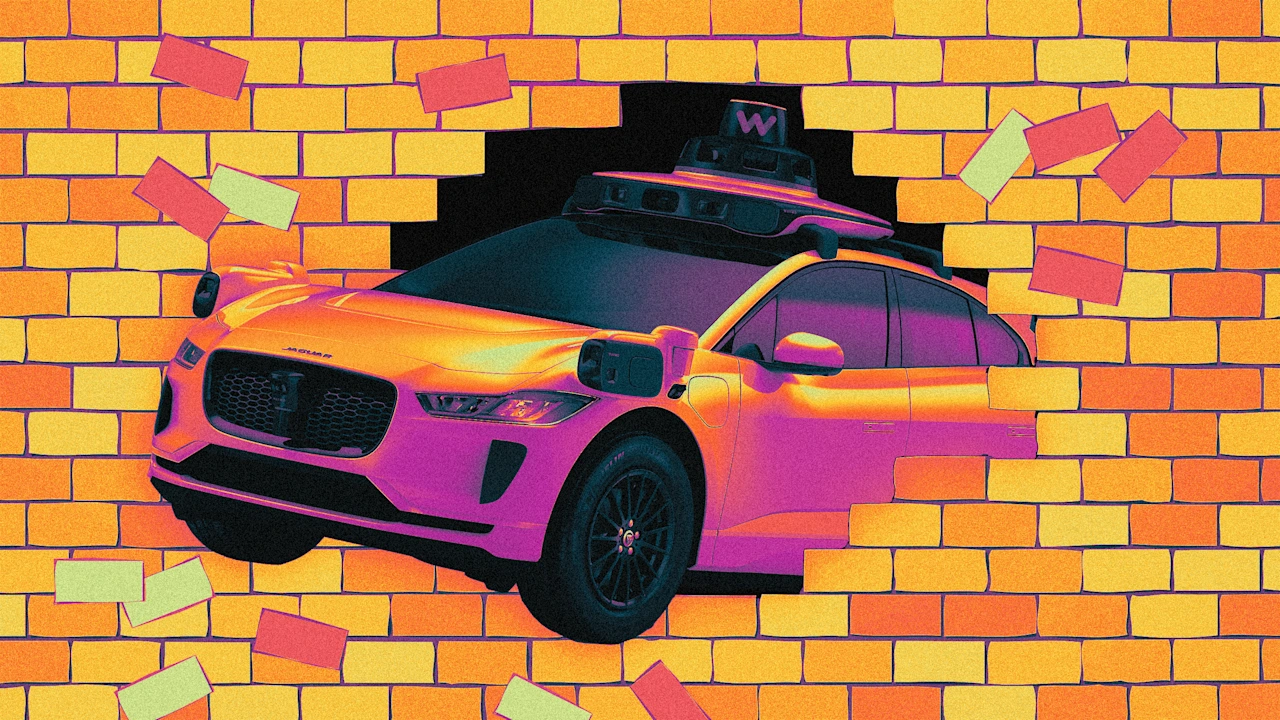
A new research note just named Waymo the “Kool-Aid Man” of the ride-hail economy.
And it might leave Uber, Lyft, and Tesla playing catch-up.
The study, published on March 16 by Wall Street research firm MoffettNathanson, is a 21-page exploration into how Alphabet’s self-driving car company is poised to disrupt the existing ride-booking landscape as it continues to aggressively scale.
“Waymo’s incursion into the U.S. ride-share narrative reminds us of the Kool-Aid commercials from our childhood,” the analysis begins. “The Kool-Aid Man kicks down walls, causes havoc, screams ‘oh yeah,’ and runs off into the next scene.”
In the case of Waymo, it continues, “they’re kicking down the walls of an entrenched industry, wreaking terror on the multiples, and then running off to the next city announcement.”
The analysts demonstrate that Waymo has amassed a major head start against other players in the autonomous vehicle (AV) space, and it is beginning to pose a competitive threat to Uber and Lyft, which currently corner the market on ride-hailing in the United States.
Meanwhile, the researchers argue, Waymo’s expansion in multiple major cities is leaving Tesla’s self-driving efforts in the dust, casting doubt on whether Elon Musk’s EV company will ever be able to compete in an industry it’s been desperate to enter.
What’s next for Waymo?
Waymo had a big year in 2025, and MoffettNathanson’s researchers believe that the company’s upward trajectory is only getting started.
In early 2025, Waymo was fully operational in five U.S. cities. By early 2026, the company had expanded its reach to active operations in 10 U.S. cities and was testing its services in at least 19 other locations.
According to MoffettNathanson’s analysis, the company expanded its total share of the ride-hailing economy from 0.2% to 0.8% over the course of 2025, reaching a total of 450,000 weekly rides by the end of the year.
While those numbers are still relatively small, they forecast an upcoming shift in the industry as driverless tech expands.
MoffettNathanson predicts that Waymo’s total rides will grow by over 100% in 2026, to 34 million, in line with the company’s stated goal to end 2025 with a rate of 1 million trips per week.
If those estimates prove accurate, Waymo could snag 1.2% of the ride-hail market by the end of 2026 and 4% by the end of 2028—an outlook that MoffettNathanson’s analysts say they “do not consider to be overly optimistic.”
What this means for Uber and Lyft
Waymo’s projected expansion leaves competitors like Uber and Lyft in a bit of a tricky position.
Waymo and Uber have partnered together to bring Waymo’s robotaxi services to Austin, Atlanta, and Phoenix. MoffettNathanson notes that the partnership has been promising, but the researchers said “we would be surprised” if it were to keep expanding, given Waymo’s head start in self-driving and its success in San Francisco.
Essentially, Waymo is in a unique position as one of the only current players in the AV industry that’s scaling broadly—aside, perhaps, from Amazon’s Zoox, which is growing on a much smaller scale—leaving Uber with limited chips to bargain with.
Further, MoffettNathanson’s analysis notes that Waymo announced its plans to independently test in new locations.
Where Tesla stands in the AV race
Meanwhile, MoffettNathanson’s analysis essentially writes Tesla out of the AV ride-booking competition.
Tesla first launched its own robotaxi services in Austin in June 2025 and in the San Francisco Bay Area in July.
For years, CEO Elon Musk has been touting the company’s autonomous driving goals as an inevitable future—and those goals became even more important to the company amid a catastrophically difficult year for Tesla in 2025 and Waymo’s expanding success in the market.
However, as Fast Company has reported, Tesla’s robotaxi aspirations currently seem more like a pipe dream than a reality. Whereas Waymo operates driverless vehicles in multiple major cities, almost all of Tesla’s first robotaxis launched with human drivers at the wheel, presumably as an added safety measure.
“We acknowledge the potential of the company’s [full self-driving] technology, but until Tesla is consistently operating at scale without a human in the car and without accident rates above humans, we believe robotaxis’ market share impact will be limited,” MoffettNathanson’s analysis reads.