

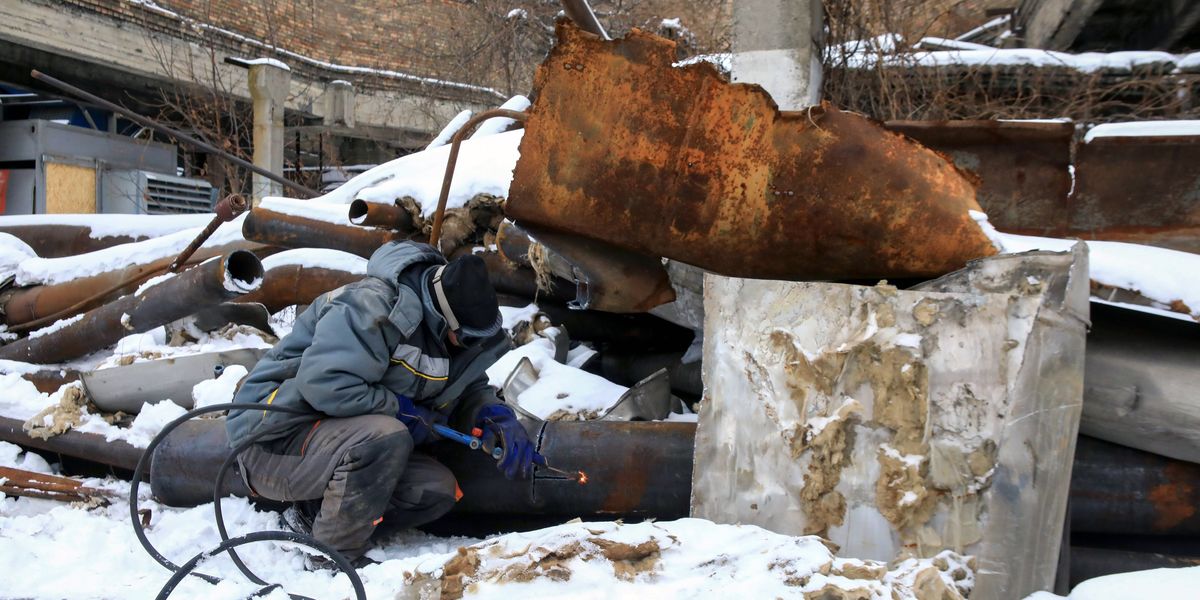
Every time Russia attacks Ukraine’s power infrastructure, Ukrainian engineers risk their lives in the scramble to get electricity flowing again. It’s a dangerous job at best, and a lethal one at worst. It also requires creativity. Time pressure and equipment shortages make it nearly impossible to rebuild things exactly as they were, so engineers must redesign on the fly.
These dangerous, stressful conditions have led to more engineers being hurt or killed. The rate of injuries among Ukrainian workers in electricity generation, transmission, and distribution jumped nearly 50 percent after Russia’s full-scale invasion began four years ago, according to data provided by Antonina Nagorna, who leads the Department of Epidemiology and Physiology of Work at the Kundiiev Institute of Occupational Health, in Kiev. By her count at least 48 people had died on the job through the end of 2025, either while repairing damage or during the bombardment itself.
Transmission mastermind Oleksiy Brecht joined that grim count in January. Brecht, who was director for network operations and development at the Ukrainian grid operator Ukrenergo, died while coordinating work at Ukraine’s most attacked electrical switchyard, Kyivska, west of the capital. He was 47 years old.
Brecht’s life and death are a window into the realities of thousands of Ukrainian engineers who face conditions beyond what most engineers could imagine. “The war completely transformed the professional life of a top-manager engineer,” says Mariia Tsaturian, an energy analyst and chief communication officer at the think tank Ukraine Facility Platform, who previously worked with Brecht at Ukrenergo. “As for junior staff, their world was turned upside down entirely. A substation engineer working under shelling is something no one had ever seen or experienced before,” she says.
How Russia Attacks Ukraine’s Grid
Over the course of the war, Russia has increasingly focused on destroying Ukraine’s energy infrastructure. It sends attack drones almost daily during the winter there, when heat and electricity is needed most to survive the bitter cold. Every 10 days or so it barrages Ukraine’s power system with combinations of missiles and hundreds of drones, repeatedly mangling equipment and cutting off power. The cold imposed on Ukrainian homes is especially hard on former prisoners of war held in Russia, where cold is routinely employed as a form of torture.
In the first two years of the war, keeping the grid flowing was a 24/7 job. But Ukrenergo has adapted to the impossible since then, says Vitaliy Zaychenko, Ukrenergo’s CEO, who somehow found a moment to speak with IEEE Spectrum via video call. Now, “we are more prepared for each attack. We have well-trained teams. We have support from Europe,” he says.
But the risk involved in repairing the grid remains unnerving. Last month a crew from DTEK, Ukraine’s biggest private-sector energy firm, was traveling between locations when it was targeted by a Russian drone. They heard the drone coming and escaped before their bucket truck was destroyed. Russian forces have employed “double tap” attacks against DTEK’s crews, targeting their power infrastructure with a follow-up strike designed to kill first responders—a practice confirmed by the U.N.
When Russia began targeting power infrastructure in October 2022, Brecht’s job shifted from high-level direction of grid planning and maintenance to near-constant triage and real-time system reengineering. Most weeks, Brecht spent several days in the field, crisscrossing the country to coordinate work at smashed substations. Brecht would often be found on site figuring out how to restart power using whatever equipment was available. “It was a unique decision every time,” says Zaychenko.
Oleksiy Brecht died in January while overseeing repairs to a bombed-out substation near Kyiv. He called his employees at Ukrenergo “my fighters. They called him “our general.”Ukrenergo
Zaychenko noted Brecht’s “genius” for finding creative grid fixes, his passion and leadership skills, and his credibility with power brokers in Ukraine and abroad. Brecht scoured the globe sourcing critical replacement parts, including stockpiled or older equipment from international utilities. Transformers, which can take a year or more to source, are especially precious.
When the right equipment wasn’t forthcoming, Brecht figured out how to make do. For example, he would deploy transformers from Western Europe rated for 400 kilovolts to restart a 330-kV circuit. He would adapt transformers designed for 60-hertz alternating current for emergency use on Ukraine’s 50-Hz grid. “He would find a way,” says Zaychenko, who worked closely with Brecht for over 20 years.
Brecht’s assistant at Ukrenergo, Svitlana Dubas-Veremiienko, says he also contributed to the teams’ morale and confidence. She shared on Facebook that he smoked “like a locomotive” at the worst times, and yet exuded calm: “In his presence, chaos subsided,” she wrote. Brecht was not easy to intimidate. “He was someone who never feared anything or anyone,” adds Tsaturian.
Brecht’s work proved so essential that Ukrenergo’s former Deputy CEO Andrii Nemyrovskyi recalls telling Ukraine’s Ministry of Defense in 2022 that the military must protect two people: Zaychenko, because he ran grid operations, and Brecht because “system operations requires that the system exists.” Last week, President Zelenskyy posthumously named Brecht a “Hero of Ukraine” for “strengthening the energy security of Ukraine under martial law.”
Ukraine’s Power Infrastructure Under Fire
Brecht joined Ukrenergo in 2002 after earning his degree in power engineering from Igor Sikorsky Kyiv Polytechnic Institute. Over the next 20 years, he held leadership positions in dispatching and grid planning and development. He joined Ukrenergo’s management board in June 2022 and served as its interim leader in 2024.
Brecht’s contributions to Ukraine’s wartime survival began with several key upgrades to Ukrenergo’s technical capabilities ahead of the February 2022 invasion. He reintroduced “live line” techniques, providing training and equipment that enable crews to work on circuits while they continue to carry power to homes and to sustain critical needs.
Brecht also led preparations for Ukraine’s disconnection from the Russian grid and synchronization with Europe’s. When the invasion began, Ukraine’s Minister of Energy at the time, Herman Halushchenko, had argued that switching from Russia’s grid to Europe’s was too risky, according to Tsaturian and Nemyrovskyi. But Brecht insisted—correctly, as hindsight has shown—that synchronizing with Europe would provide crucial stability and backup power. At his urging, the switch was completed in daring fashion during the first weeks of the invasion.
(Halushchenko was dismissed last year following longstanding allegations of corruption and Russian influence in Ukraine’s energy sector that gave way to indictments in November 2025 that have rocked President Zelenskyy’s government. In January, Halushchenko was detained while attempting to leave the country and charged with money laundering.)
 DTEK workers conduct repairs on 26 January following a Russian attack in Kyiv.Danylo Antoniuk/Cover Images/AP
A Ukrainian Electrical Engineer’s Final Day
Brecht’s final act of service followed the mass destruction of January 19—a day when Kyiv’s high temperature was –10° C. That night, Russian forces targeted Ukraine’s energy infrastructure with 18 ballistic missiles, a hypersonic cruise missile, 15 conventional cruise missiles, and 339 drones.
The impact included catastrophic damage at the 750-kV Kyivska substation, which feeds electricity to the capital and ensures cooling power for two nuclear power plants.
Brecht was leading a team of about 100 people who were undoing the damage when he made a deadly choice. He picked up a section of busbar—solid conduits that connect circuits within substations. It had been blasted to the ground and, unbeknownst to Brecht, was carrying lethal voltage. It’s unclear whether its circuit was still connected, or if it had picked up voltage from another circuit.
Zaychenko says an investigation is ongoing to provide answers. “I don’t know why he touched this busbar. Maybe because of tiredness. Maybe something else,” he says. “He was trying to help the team to do this job quickly. It was a huge mistake and a huge loss for us.”
From Your Site Articles
Related Articles Around the Web