

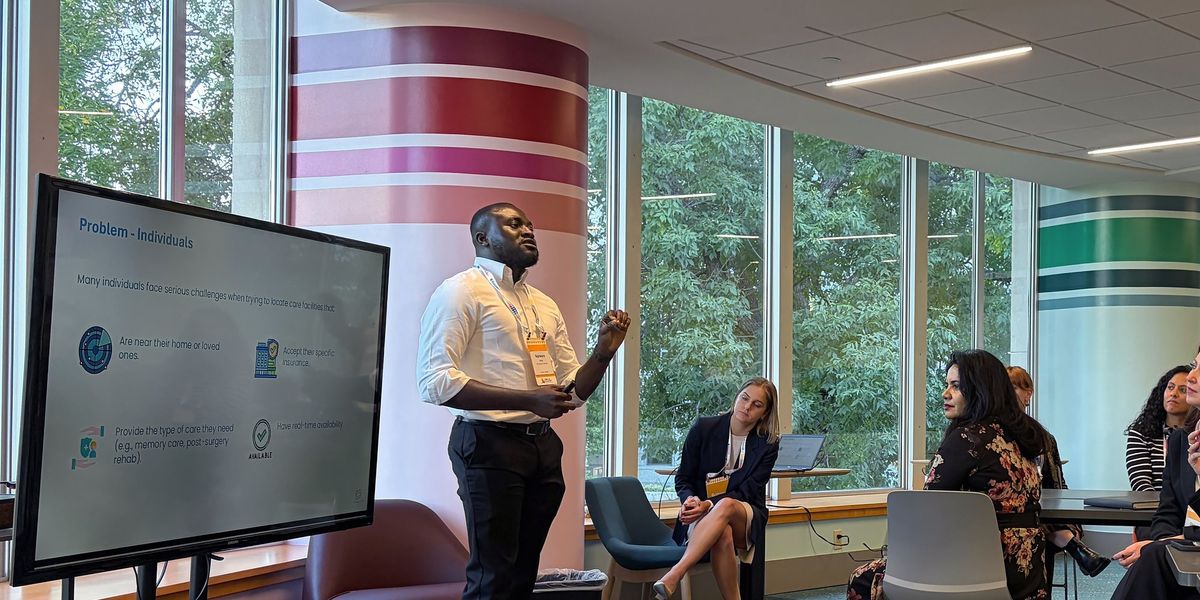
When doctors in the United States refer patients to specialty or post-acute medical care such as physical therapy or long-term nursing care, nearly half never complete the process of finding help. Referrals stall in part because provider directories are outdated, insurance coverage is unclear, and much coordination still relies on phone calls and faxes.
Carenector, a Denver-based startup launched in 2024, is working to improve the process with software that quickly connects patients with appropriate care providers while protecting their personal data. Instead of presenting a long list of providers, many of whom would not be a good match, the company’s referral platform uses AI to eliminate facilities that don’t meet the patient’s rehabilitation needs, don’t accept the patient’s insurance, or are not conveniently located.
Carenector
Cofounder:
Naheem Noah
Founded:
2024
Headquarters:
Denver
Employees:
5
The startup’s platform serves individuals seeking care as well as health care organizations and care coordination teams that manage patient referrals. The company aims to help patients while reducing the administrative burden on clinicians and discharge planners, says cofounder Naheem Noah. As of now, Carenector works with patients and facilities only in Colorado, but it plans to expand coverage nationwide.
Noah, a Ph.D. candidate who joined IEEE in 2022 as a student member, encountered the referral problem firsthand after tearing an anterior cruciate ligament in a knee while playing soccer. Finding a physical therapist who accepted his insurance, specialized in ACL rehabilitation, had appointments available, and was near his home required hours of phone calls and searches through inaccurate provider lists, he says.
That experience helped shape the company’s direction, but Carenector is aimed at a broader, persistent failure in U.S. health care coordination.
A broken referral system
The company took shape when Noah connected with his cofounder, licensed social worker Aminata Diarra, a social director at a nursing facility. Her role included discharge planning: placing patients in post-acute-care facilities that bridge the gap between hospital discharge and the patient’s ability to independently manage life’s daily activities.
For a single patient, Diarra says, that often meant she made 10 to 15 phone calls over the course of a week to find a facility with a bed available, that accepted the patient’s insurance, and that could meet the care requirements.
She and Noah soon realized they were dealing with the same broken system from opposite sides. Existing research on referral lapses supported their experience. Primary care physicians often send referral notes—analogous to prescriptions—that list the patient’s medical history and describe the needed treatment.
Noah discovered that only about one-third of the notes are transmitted in a way that allows providers at nursing homes and rehab facilities to access the information.
Physicians often post their suggestions for ongoing treatment in sections of a patient’s electronic health records, but providers at post-acute facilities don’t have access to those because of medical privacy laws. What gets shared is a pared-down document that omits progress notes and discharge summaries.
Engineering a research-driven startup
Noah is currently a researcher in the University of Denver computer science department, where his academic work focuses on privacy and security in digital systems.
He is Carenector’s chief executive and technical lead, overseeing the system’s design, making technical decisions, and meeting with investors.
Although the startup is separate from his dissertation research, the company reflects his broader interest in building secure systems that work in real-world conditions.
Beginning a company while a student, he has access to university resources that many early-stage startups lack. He has participated in the university’s BaseCamp accelerator and received mentorship and business planning support.
The Carenector team was assembled with the plan to scale up in the future with health care compliance in mind. The group includes professionals from regulatory, legal, and data engineering fields.
Replacing phone calls with digital matching
By using standardized digital information shared among medical facilities, Carenector eliminates the need for staff to make phone calls or send faxes. At the core of the platform is a structured database that links care providers—including post-acute, specialty, and rehabilitation facilities—with insurance plan criteria and facility attributes such as accessibility and service capabilities.
One of the biggest challenges for Noah is getting accurate data on which services facilities offer, which insurance they accept, and whether a patient’s insurance plan covers the treatment proposed by the referring physician.
“Health care information in the United States is not centralized,” he says, “and insurance provider directories are often wrong or out of date.”
To address that, Carenector incorporates publicly available datasets from the U.S. Centers for Medicare & Medicaid Services (CMS), including plan attributes, service areas, quality ratings, and issuer-level transparency data. These public-use files provide plan-level and provider-level information that help standardize coverage criteria, geographic availability, and performance indicators. Carenector integrates this structured public data with facility-supplied information and referral outcome analytics to improve matching accuracy.
“By replacing manual coordination with clear rules, accurate data, and built-in privacy protections, we hope to make accessing care a routine step in recovery—not another obstacle.”
This structured data helps Carenector evaluate plan criteria, provider capabilities, geographic availability, and quality indicators to support referral decision-making. The company standardizes and organizes the information within its own system architecture and uses mapping and geolocation APIs to integrate location-based filtering and workflow functionality for patients, providers, and care coordinators.
Because CMS data is updated periodically, Carenector supplements it with additional structured data sources and referral outcome analytics to better understand plan acceptance patterns. Room availability information comes directly from participating facilities, which are responsible for updating their status within Carenector’s system.
Whether referrals succeed or fail provides critical feedback, Noah says. When referrals to specific facilities repeatedly go uncompleted—meaning the patient does not receive the recommended care from the provider—Carenector’s AI-driven matching algorithm adjusts to that pattern and reduces the likelihood of that facility being considered for similar cases. Facilities that consistently accept and complete referrals are ranked preferentially.
Apps for patients and facilities
The company has poured its data management wizardry and AI smarts into apps for patients and clinicians.
The patient app helps users locate appropriate health care services at no cost. Users can search for care by service type, ZIP code, or insurance company without creating an account. They receive a list of matching facilities that can be shared via clipboard or sent by email to themselves or family members..
In the facility app, clinicians enter the diagnosis, rehabilitation needs, equipment requirements, insurance type, and location without sharing personally identifiable patient information. Organizations can communicate using secure messages that disappear after a set period. Files and images are shown only once and deleted after viewing.
Facilities that use the app pay Carenector a flat fee for each successful referral. The patient app is free.
The startup does not sell or share data with third parties, Noah says.
“Privacy is a central design requirement for Carenector’s system, not a last-minute add-on to the finished product,” he says.
The company minimizes the collection of personal data to avoid becoming a data repository. Although its role is limited to coordinating referrals, Carenector is working with independent security auditors to validate that its operational and data-handling practices align with Health Insurance Portability and Accountability Act (HIPAA) requirements. The HIPAA law sets standards meant to protect sensitive patient information from unauthorized disclosure.
Noah says he is confident that Carenector will achieve that rating because the app is designed to reduce the collection and exposure of sensitive information wherever possible.
Business model and measured expansion
Carenector’s growth plan, Noah says, is strategic. Rather than scaling rapidly, he says, he is looking to enter one region at a time, incorporating feedback from each local deployment before expanding the company further.
He envisions that in five years, Carenector will serve as a core piece of health care referral infrastructure—embedded in the workflows of hospitals, post-acute facilities, insurers, employers, and major electronic health record systems such as Epic and Cerner—while also increasing visibility for care facilities in underserved and remote areas. The plan, he says, is to support thousands of facility recommendations per day, compared with the approximately 200 daily facility recommendations it currently generates. Noah also looks forward to the broader adoption of APIs that allow care coordination and facility discovery to occur directly within clinical workflows.
He says he sees his startup as a way to reduce unnecessary stress from moments when patients are vulnerable.
“By replacing manual coordination with clear rules, accurate data, and built-in privacy protections,” he says, “we hope to make accessing care a routine step in recovery—not another obstacle.”
From Your Site Articles
Related Articles Around the Web