

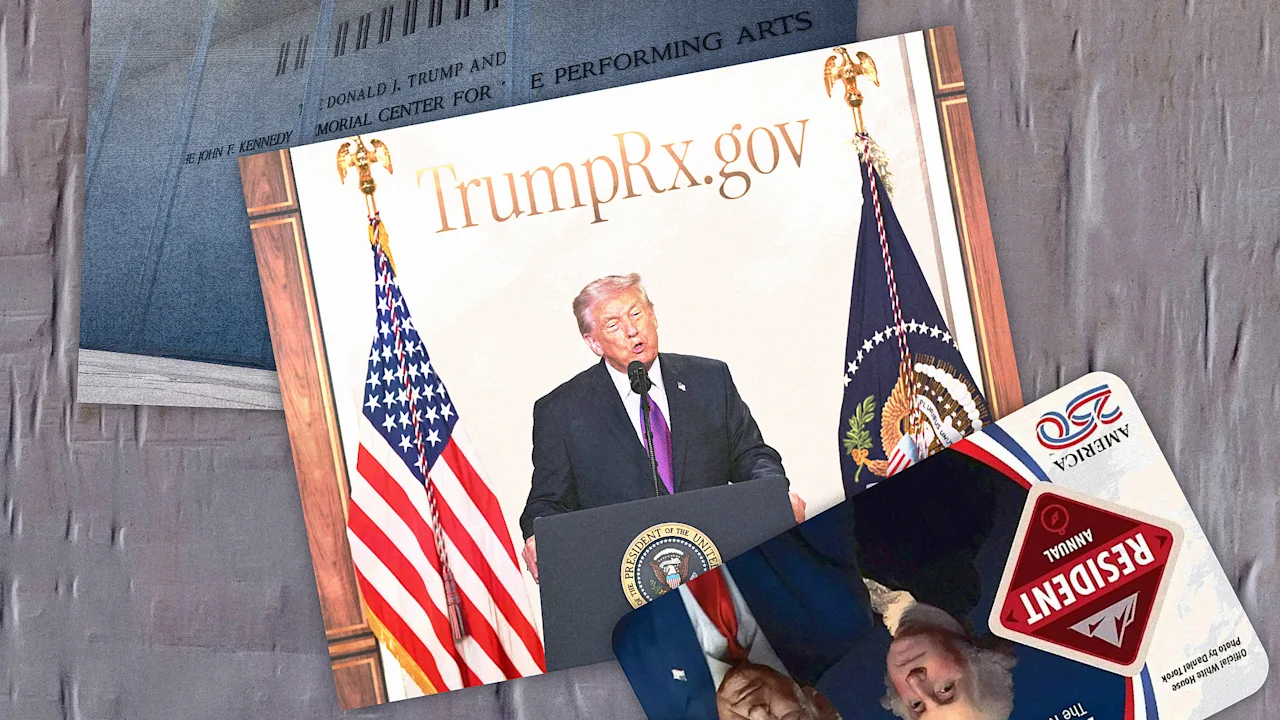
In November 2025, the Trump administration announced a special park pass commemorating the nation’s 250th anniversary that featured images of two presidents: George Washington and Donald Trump.
Featuring the current president—in place of the National Park Service’s usual landscape pictures—triggered both a lawsuit and a social media movement to put stickers over Trump’s face.
As a businessman, Trump has frequently emblazoned buildings and consumer products—shoelaces, an airline, an edition of the Bible, among many others—with his own name.
During his current presidential term, his administration has put his name on numerous government properties—perhaps most famously the Kennedy Center, but also money, monuments, and military equipment. In January 2026, Trump floated the idea Congress would rename both New York’s Penn Station and Washington’s Dulles International Airport after him.
With Florida lawmakers considering renaming the airport near Mar-a-Lago after the president, the Trump Organization has filed an application to trademark his name for use in airports and ancillary activities, although the company said it would not charge a fee in the case of the Palm Beach airport.
As a communication professor who studies the First Amendment, I was intrigued by the federal actions and the protests they’ve triggered.
Citizens certainly have the right to protest these decisions, like any government action. The First Amendment prevents the government from making laws that abridge freedom of speech.
But does the federal government itself have freedom of speech? And can a president put his name and image wherever he wants?
Free speech for government
The answer to the first question has already been answered. In a series of rulings, the Supreme Court has upheld the government speech doctrine, which allows the government as speaker to say whatever it wants.
Moreover, if the forum is governmental, the government may even be able to compel people to express its messages—for example, with public employee speech that is part of job duties. The 2006 Supreme Court decision establishing that principle involved a deputy district attorney who’d questioned the validity of a warrant, but the rule applies to other employees, such as teachers who have to offer instruction in state-mandated curricula.
The court’s decisions in government speech cases imply that if people do not like the government speech, they should change the government with their votes.
However, some scholars and advocates argue that this relatively new constitutional doctrine gives the government too much power to drown out other viewpoints in the marketplace of ideas.
In most instances, the government cannot compel speech or force citizens to express a certain message. Compelled speech is not allowed when the government is forcing a citizen to endorse an ideological message.
For example, the Supreme Court allowed a Jehovah’s Witness to cover the words “or Die” on his license plate, which included the New Hampshire state motto, “Live Free or Die.”
The First Amendment is not absolute, and some government regulations will infringe on speech.
The federal government has strict regulations on how the American flag should be disposed of, but it cannot punish someone who is burning a flag as a form of political protest.
Government control of its own products
What happens when the government itself hosts forums for citizen speech, such as placing monuments in a park or flying flags on government property? Can the government deny certain speech based on the speaker or message?
In such cases, courts have had to decipher whether the forum was purely governmental. To do so, they examine the history of the forum in which the contested speech takes place, who controls the forum, and the public perception of who controls it.
This brings us back to the question of Trump’s name and likeness. As a constitutional matter, the Trump administration can express itself as it sees fit under the government speech doctrine. But in some cases, the administration may be bound by statute or formal contracts, as with the legal battle over the naming of the Kennedy Center, which was named by an act of Congress. The lawsuit over the National Park passes claims that the administration is violating a federal law requiring that the winning entry in a public lands photo contest be used for the passes.
Still, I believe it would be difficult to win a lawsuit claiming that the new passes are a form of compelled speech, with bearers of the pass arguing they are being forced, in effect, to endorse Trump. Most people would likely see the park passes’ artwork as being controlled by the government and therefore a form of government expression, not a form of private expression.
Can people cover up Trump?
But the Trump administration may not be able to defend its policy of declaring passes null and void if the president’s image is covered by a sticker. Citizens protesting Trump’s appearance by covering up the president’s image is protected speech, in my view. The government’s action to void the passes is likely a violation of the First Amendment.
On the face of it, placing stickers on passes would appear to violate the long-standing Interior Department rule that passes are “void if altered.” Those regulations were content neutral and incidental to any particular message or cardholder.
However, the updated policy, voiding the pass if Trump’s image is covered or marred, is more suspect. The new rules seem to be a direct response to the protesters’ political speech and, as applied, primarily aim to affect these stickers and speakers.
With an administration known for its social media savviness, it may not be convincing for officials to argue they did not know about the protest or that the policy was not a direct attempt to chill such speech.
The government will have the right to put Trump’s name and images on more government property in many cases, but most resulting political protests, in my view, will also be protected speech.
Jason Zenor is an associate professor of mass communication at the State University of New York Oswego.
This article is republished from The Conversation under a Creative Commons license. Read the original article.