

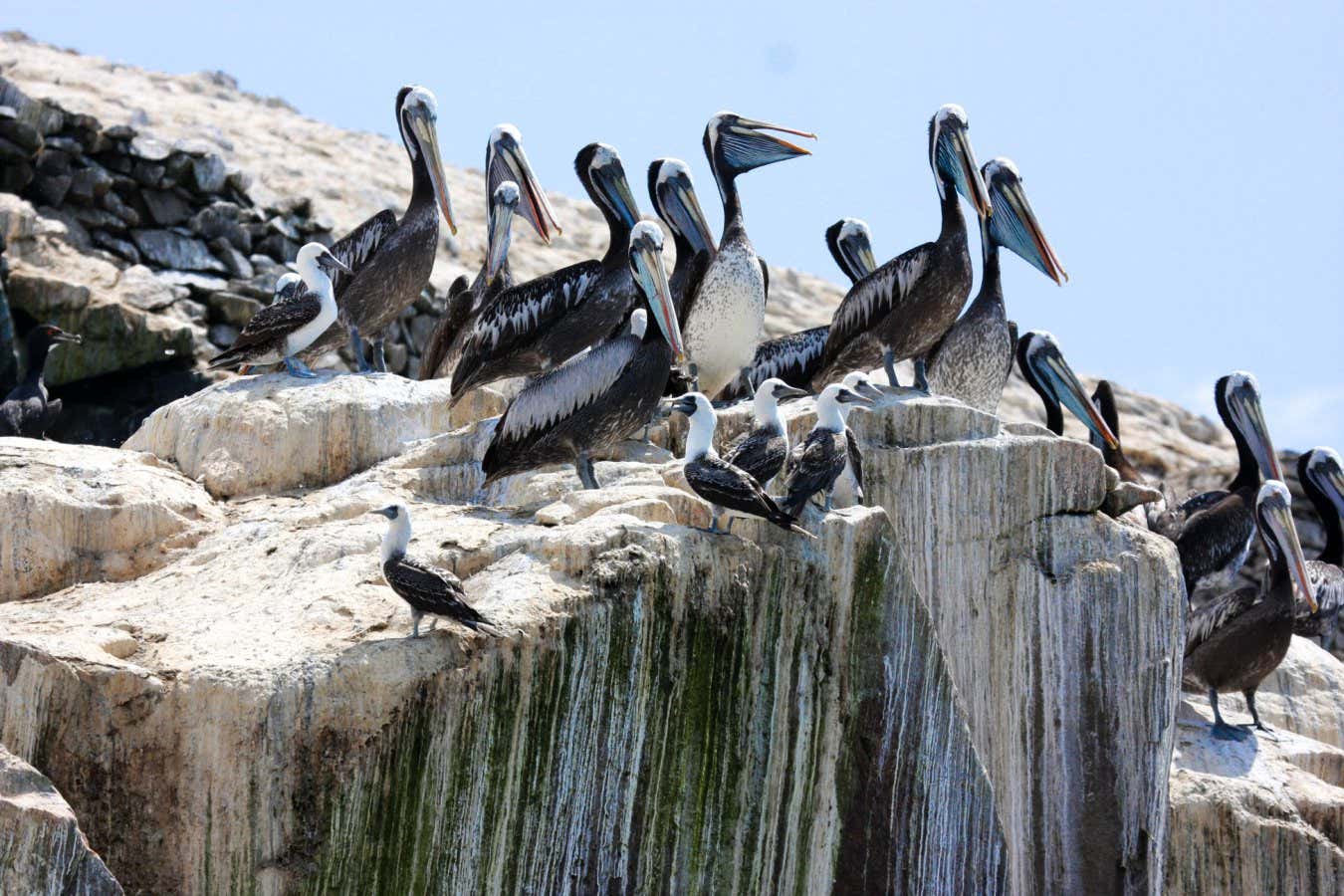
The droppings of Peruvian pelicans and Peruvian boobies have been prized for hundreds of years
Biljana Aljinovic/Alamy
Powerful fertiliser based on seabird droppings may have fuelled the rise of a Peruvian agricultural kingdom 900 years ago and helped drive its eventual takeover by the Incas.
Chemical analyses of ancient maize cobs from southern Peru show unusually high nitrogen isotope levels – substantial signs that the plants were fertilised with a mix of seabird excrement, feathers and carcasses known as guano. The findings provide the strongest evidence yet that indigenous Chincha farmers, fishers and merchants harvested this nutrient-rich fertiliser from nearby islands to enhance inland crop fields – and strengthen their socioeconomic position, says Jacob Bongers at the University of Sydney.
“Privileged access to a crucial resource is a pathway to power – which the Chincha Kingdom had in this case, and the Inca did not,” he says. “Social change may have arisen from a surprising source: bird poop. It’s a fascinating story.”
Between AD 1000 and 1400, the wealthy and densely populated Chincha Kingdom controlled one of Peru’s most productive coastal valleys before being incorporated into the Inca Empire in the 15th century.
The Chincha valley lies just 25 kilometres from the Chincha Islands – home to vast colonies of Peruvian pelicans (Pelecanus thagus), Peruvian boobies (Sula variegata) and guanay cormorants (Leucocarbo bougainvilliorum), along with penguins and gulls. These so-called Guano Islands gained international notoriety in the 19th century for the fertilising power of their bird droppings, largely thanks to their exceptionally high nitrogen content.
The Incas’ use of guano is well documented in early colonial accounts, which describe strict state control over the islands and heavy penalties for harming the birds. But until now, scientists have lacked firm archaeological evidence that their Chincha predecessors were already exploiting the resource. Many historians have long argued that they were – and that access to seabird fertiliser fuelled the kingdom’s economic success, says Bongers. Seabird imagery carved into ceremonial objects and depicted on textiles, ceramics and architectural friezes further suggests the birds held special significance for the Chincha.
Bongers had been collecting dozens of ancient maize cobs – “perhaps food for the dead” – from Chincha tombs and wondered if they could help solve the mystery.
He teamed up with Emily Milton at the Smithsonian Institution in Washington DC to analyse 35 maize cobs from 14 cemeteries in the Chincha valley, measuring their carbon and nitrogen isotope ratios. Bongers, Milton and their colleagues also analysed collagen from 11 ancient seabird bones from the region – including pelicans, boobies, cormorants, a gull and a penguin – to establish a local isotopic baseline for guano.
The ancient seabird bones showed elevated nitrogen-15 values typical of marine birds. Many of the maize cobs showed even more extreme nitrogen isotope ratios, a hallmark of seabird guano fertilisation.
The findings point to the Chinchas’ use of the island resource by at least 1250, says Jo Osborn at Texas A&M University.
Guano may have supported the kingdom’s economic expansion and strengthened its bargaining power when it was later incorporated into the Inca empire – with broader implications for how marine fertilisers shaped social change across the Andes, the researchers say.
“It makes a lot of sense that ancient Peruvians used guano as fertiliser,” says Dan Sandweiss at the University of Maine, who wasn’t involved in the study. “It was a significant expedition to get down there to the islands – but you do that for high-value things!”
The Chincha Island guano is particularly valuable, probably because of the limited rainfall, he says, which allows the nitrogen to stay intact, rather than getting leached out. “This Peruvian guano was the real stuff.”
Topics: