

As the Trump administration doubles down on its energy and AI dominance agenda, U.S. energy companies have found themselves navigating tricky communication strategies. Touting the clean, carbon-free nature of renewable energy no longer carries the clout it did under the Biden administration, and policy has shifted against certain forms of renewables. At the same time, energy companies are being called upon to meet rising power demands of data-center developers, many of which are prioritizing carbon-free options.
This has forced energy companies to shift the way they communicate: They must garner political favor while also positioning themselves as an answer to the coming onslaught of electricity demand.
The wind and solar industries are focusing on electricity affordability and the fact that wind farms and photovoltaics are the cheapest and fastest way to add new energy generation. Battery storage developers are aligning themselves with Trump’s domestic manufacturing push, scaling up efforts to shift supply chains to the United States as they battle uncertainty over tariffs.
Nuclear power companies are touting their ability to go small and modular—theoretically a faster way to get reactors running. Next-generation geothermal developers are staying the course but playing up the industry’s crossovers with oil and gas. Hydrogen, too, is being highlighted as similar to fossil fuels. And the offshore wind industry is mostly preoccupied with using the courts to fight the Trump administration’s repeated attempts to ban development.
It’s not that the renewable technologies themselves have changed, says Samuel Furfari, former European Commission senior energy official and current energy geopolitics professor at ESCP Business School in London. “Mr. Trump has made a communication revolution, not an energy revolution,” he says about the state of the industry in the United States and abroad.
Trump Declares His Energy Darlings
Trump’s affinity for fossil fuels and his disdain for certain renewables, such as wind, have constructed a new federal hierarchy of energy sources. On day one of his second term as U.S. president, Trump issued an executive order listing which energy resources his country should promote. The list mentions fossil fuels, geothermal, and nuclear but excludes solar, wind, and hydrogen.
Then, in July, the One Big Beautiful Bill Act slashed renewable energy incentives for wind and solar while extending the tax credits for geothermal through 2033. On 1 December, Trump’s Department of Energy renamed the National Renewable Energy Laboratory to the National Laboratory of the Rockies—a moniker to demote renewables and reflect the lab’s “expanding mission” under Trump. And in an eleventh-hour move, the Department of the Interior at the end of 2025 halted all offshore wind projects under construction, citing national security risks.
At first, the wind and solar industries attempted to fit into the Trump administration’s agenda by leaning into his energy dominance rhetoric, says clean energy consultant Lloyd Ritter in Washington D.C. But after the government gutted tax incentives for wind and solar, and concerns over high electricity bills became a top election issue, industry players prioritized messaging about affordability for consumers, Ritter says.
“Electricity costs are now a thing in politics, and I don’t think that’s going to change anytime soon,” Ritter says. The cost concerns stem from estimates that electricity use in the United States is projected to increase 32 percent by 2030, mostly from data centers, according to the latest forecast from Grid Strategies.
The solar and storage industries are welcoming these demand projections. That’s because solar is still the “fastest and cheapest form of electronics to get onto the grid,” says Raina Hornaday, cofounder of Austin, Texas–based Caprock Renewables, a solar and storage developer. In her view, meeting the load demands of data centers is going to take care of the political backlash that solar and storage have endured under the Trump administration.
Hornaday sees a particular opening for batteries. “The R&D for battery storage is really the winner across the board, and we don’t consider battery storage renewable. It can utilize renewable energy electrons, but it doesn’t have to,” she says. “It can be power from the grid.”
Sage Geosystems harvests heat from underground water reservoirs. The company has recently shifted from talking about geothermal energy as clean to its ability to get electricity to the grid faster to accommodate data-center growth. Sage Geosystems
Geothermal Inherits Fortuitous Position
The communications framing for next-generation geothermal power has shifted too, despite it being a political favorite. Companies in this sector say they are continuing to emphasize geothermal as a baseload power source—something that can crank out electricity 24/7, like fossil fuels can. But projected increases in power demand have shifted other elements of the conversation.
The leading communication strategies now are less about geothermal’s carbon-free benefits and more about getting energy to the grid faster to address data-center growth, says Cindy Taff, CEO of Houston-based startup Sage Geosystems. Geothermal companies are also talking about how their use of drilling technology, know-how, and other synergies borrowed from the oil and gas industries can fast-track development.
“When we first started Sage four and a half years ago, we were talking about it being clean and renewable, but if you think about it, there’s now a little bit more allergic connotation with clean and renewable,” says Taff, who spent more than 35 years in well construction and project management at Shell before founding Sage.
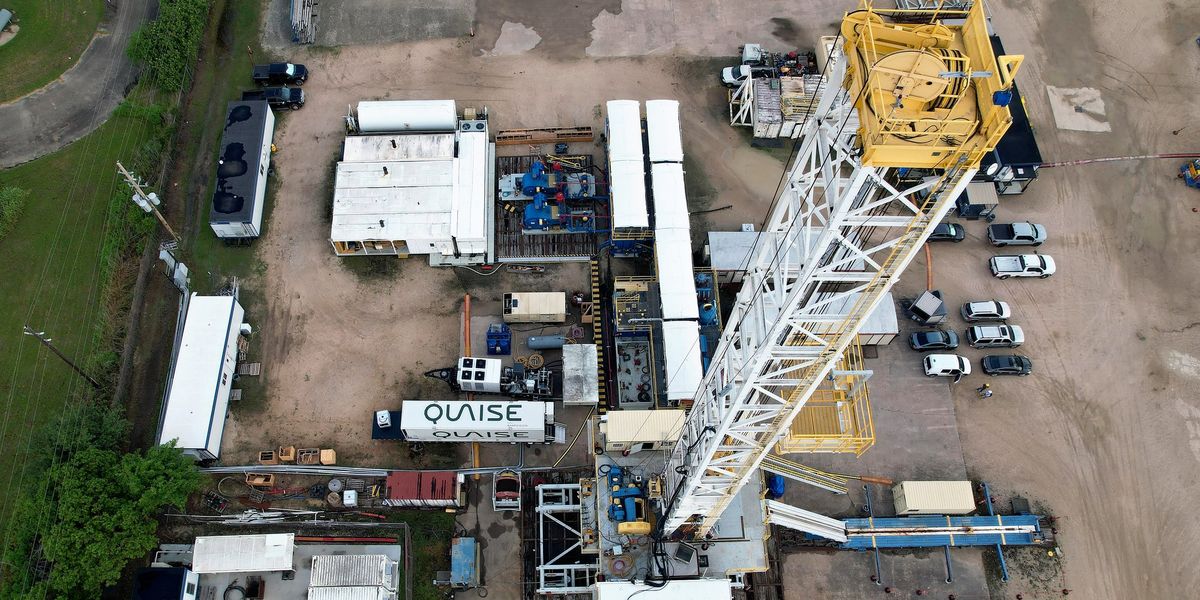
Lessening the use of climate-focused language is something “the whole industry” is doing, adds Geoffrey Garrison, vice president of operations at Quaise Energy, headquartered in Houston. “I think you have to be cognizant of who’s listening and who has got their hands on the lever.… You tailor your message,” he says.
Other Trump administration priorities, like moving industry and manufacturing back to U.S. soil, are top of mind for geothermal companies, says Sarah Jewett, senior vice president of strategy at Fervo Energy, also in Houston. “We are thinking a lot more about localization of [the] supply chain, in large part due to this administration’s focus,” Jewett says.
 In its pitches to investors, Fervo Energy includes talking points about how geothermal energy drilling uses technology from the oil and gas industry. Fervo Energy
Overall, Fervo’s messaging has remained “pretty consistent” between U.S. presidential administrations, Jewett says. In its pitch to investors, Fervo includes talking points about how next-generation geothermal uses drilling technology from the oil and gas industry. But clean energy isn’t completely missing from Fervo’s communications. “Some sides of the aisle like parts of it, and other parts of the aisle like other parts of it,” Jewett says.
Like geothermal, nuclear power has enjoyed support from both political parties in the United States. It too is now focusing on touting its ability to meet rising electricity demand, albeit through the restarting of decommissioned reactors, the building of massive new plants, and experimentation with advanced solutions such as small modular reactors and microreactors.
Countries Adopt ‘Energy Addition’ Tack
It’s not just U.S. companies that are shifting the message. In November at ADIPEC, the world’s largest annual energy conference, held in Abu Dhabi, widely adopted buzzwords such as “energy transition”—a term referring to the shift away from fossil fuels—were being swapped with “energy addition.”
That’s not solely a result in shifting political tides. The surge in energy demand may indeed necessitate more of an addition, rather than a complete transition. It’s a reasonable shift, given the “hockey stick” demand increase the industry is facing, says Taff at Sage. “Energy transition was, in my opinion, when [demand] uptick was very steady. But now that you’ve got the hockey stick, the use of ‘addition’…is much more applicable,” she says.
Abroad, Trump’s impact reverberates, Furfari says. “We were shy to mention fossil fuel. Mr. Trump does not care, and says, ‘No, we need fossil fuel.’ This is changing the world.”