

Feedback is New Scientist’s popular sideways look at the latest science and technology news. You can submit items you believe may amuse readers to Feedback by emailing feedback@newscientist.com
Even stranger things
In common, it seems, with a substantial fraction of the human species, Feedback spent part of our holiday watching the final episodes of Stranger Things. We laughed, we cried, we wondered if it would have even more endings than The Return of the King (it did).
As is almost inevitable these days, a group of fans vocally disliked the finale, and went so far as to create a conspiracy theory about it. According to “Conformity Gate” (don’t blame us, we didn’t name it), the finale wasn’t the real finale – despite lasting more than 2 hours, costing an enormous amount of money and being shown in cinemas. No, a super-secret final episode was going to air in January, which would reveal the true ending. The evidence for this principally consisted of some minor continuity errors, all supposedly hints that everything we saw was an illusion created by the mind-controlling villain Vecna.
Feedback was confident that this was silly even before the supposed extra episode failed to emerge. Not least because the people critiquing the finale were making the wrong critiques. Who cares about the school’s graduation gowns being the wrong colour, when the show’s entire set-up defies physics?
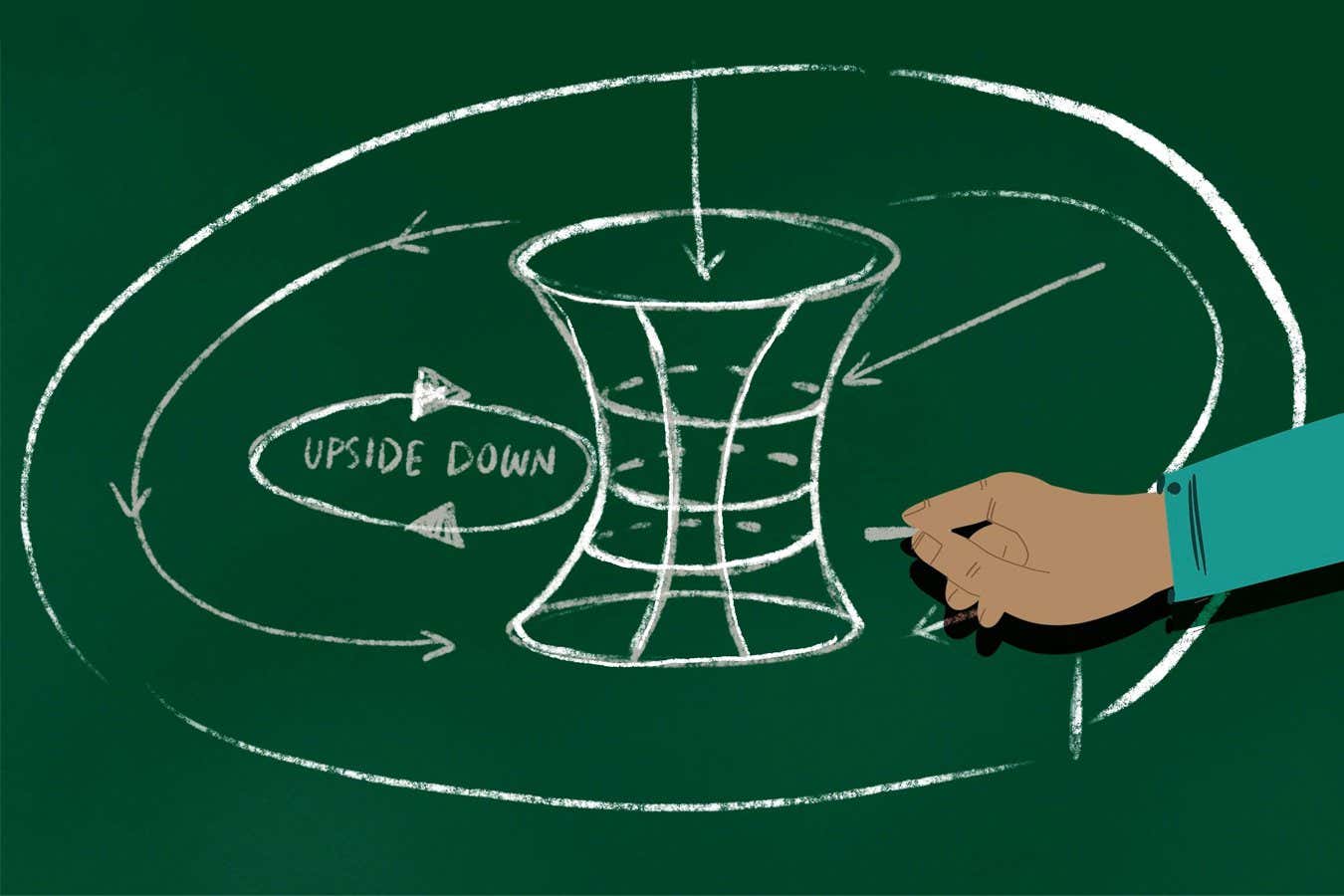
For those who didn’t watch, Stranger Things is set in a town in Indiana, where a government lab has been doing dodgy experiments. This – and there are spoilers ahead, so consider this your warning – has opened gateways to “the Upside Down”, a sort of nasty parallel dimension where another version of the town exists, but everything is mouldy. It eventually transpires that the Upside Down is a wormhole: a gateway to yet another dimension called the Abyss.
So if the Upside Down is a wormhole, what is the red wibbly-wobbly swirly thing hovering in the sky? This gets described as a wormhole, and someone says it contains “exotic matter”, which is the hypothetical substance that would have to exist to stabilise a real wormhole (and which probably doesn’t exist). This is doubly odd, because the passage to the Abyss is in the sky of the Upside Down.
Feedback has been thinking about this for weeks and we cannot work out what the wibbly-wobbly swirly thing is doing there. We also cannot work out why shooting it with a gun causes all nearby matter to liquefy, but blowing it up with explosives destroys the entirety of the Upside Down. And we also cannot work out why destroying this huge wormhole doesn’t release enough energy to wipe out most of the eastern seaboard.
Perhaps the Conformity Gate theorists could turn their attention to solving the physics of the Upside Down. A Nobel prize, or at least an Ig Nobel, could be in the offing.
Sparkle sports
What could be more fun than going to a sports match: being part of a crowd, cheering your players along? Well, what if you were part of a crowd, cheering your players along, while drinking sparkling water? That might be more fun.
Reporter Alice Klein spotted a study about an experiment showing that spectators at a collegiate women’s basketball game enjoyed the game more, and felt greater “perceived unity” with the crowd, if they had drunk some sparkling water, as opposed to still water. “Co-consuming sparkling water serves as an alcohol-free, low-burden ritual to enhance social connection during and after live sport events,” the authors said.
Alice described this as “ridiculous”, to which news editor Jacob Aron retorted: “They studied a whole 40 people, what more do you want?” Readers can make their own judgement as to whether this evidence is convincing. However, Feedback does want to draw readers’ attention to the “Competing interests” statement on the paper, on which we will make no comment whatsoever, and which reads as follows:
“This study was funded by the Asahi Soft Drinks Co., Ltd. W.K. and S.M. are employees of Asahi Soft Drinks Co., Ltd. The authors declare that this has not influenced the research design, methodology, analysis, or interpretation of the results of this study. The sponsor had no control over the interpretation, writing, or publication of this work.”
Prime bloopers
Reader Peter Brooker wrote in to ask if Feedback could start a new section called “AI Bloopers”. He was moved to suggest this after checking a puzzle entry on “a popular search engine”, only for its AI tool to confidently inform him that the first six prime numbers were 2, 3, 5, 7, 9 and 11.
Feedback feels that we have been running this section for some time already, just without an official title. In fact (and here we can give you a little glimpse behind the curtain), we have a recurring conversation with our editor about how often to feature AIs messing up like this. We could fill the whole column with AI bloopers every week, but we worry it would get repetitive.
Still, in the spirit of Peter’s request, we must tell you that the new chancellor of Ghent University, Petra De Sutter, used a generative AI to write her first speech in the role. It contained quotes from Albert Einstein, which the AI had hallucinated.
To quote The Brussels Times: “What’s striking is that De Sutter herself referred to the dangers of AI in her speech. She warned that we should ‘not blindly trust’ the output of AI tools and that AI-generated texts ‘are not always easy to distinguish from original works.’”
Got a story for Feedback?
You can send stories to Feedback by email at feedback@newscientist.com. Please include your home address. This week’s and past Feedbacks can be seen on our website.