

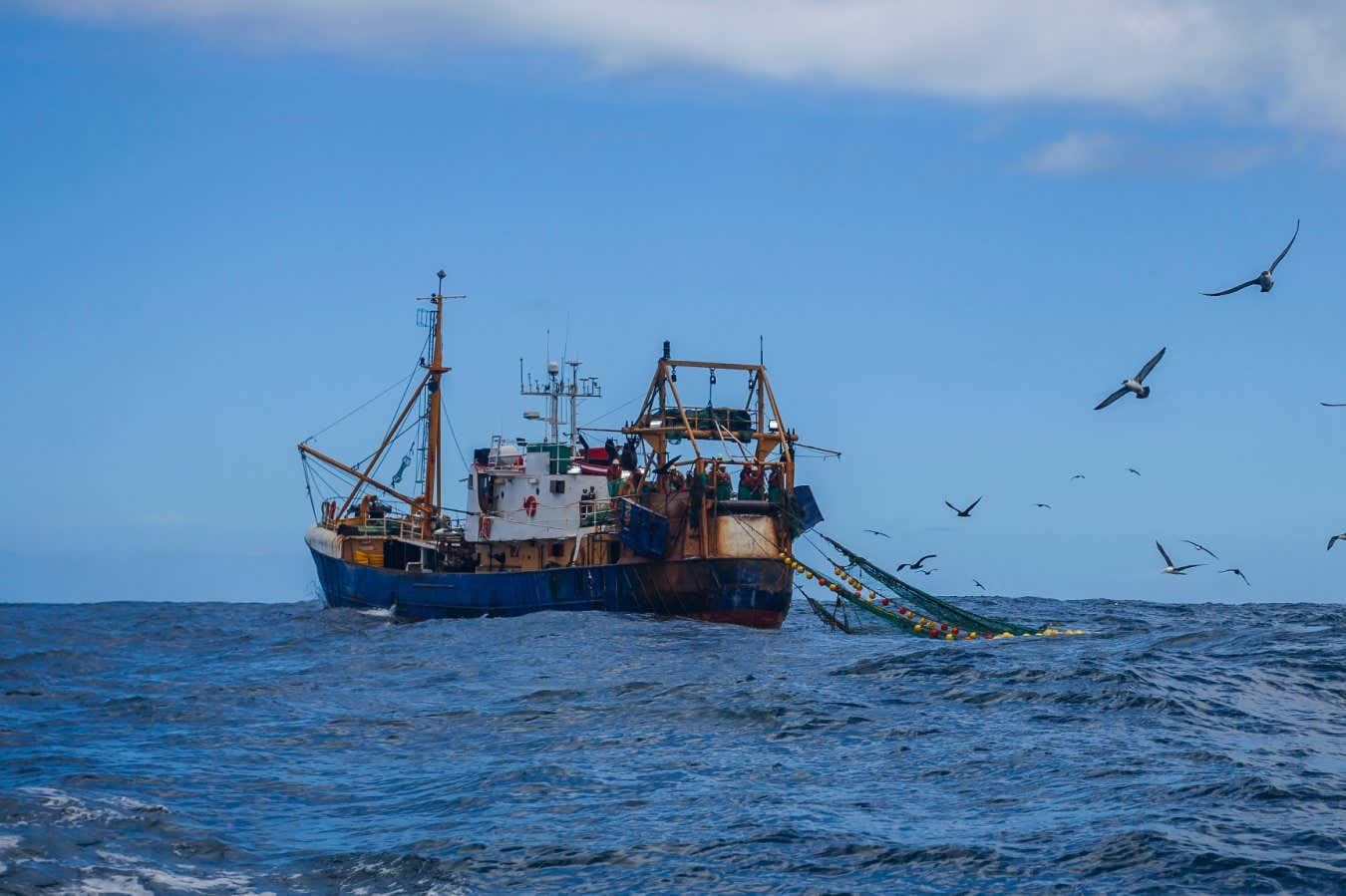
A trawler in the Southern Ocean
Shutterstock
A treaty that will protect areas of the largely lawless high seas from fishing has come into force, marking a “turning point” for ocean conservation.
International waters outside the exclusive economic zones that stretch 370 kilometres from countries’ coasts are sometimes known as a “wild west” where there are few limits on fishing. They have also been called the “last wilderness” because their huge depths represent 95 per cent of habitat occupied by life, most of it unexplored.
In September 2025, a United Nations agreement for the “conservation and sustainable use of marine biological diversity” in the open oceans – which cover half of the Earth’s surface – was ratified by more than 60 countries. That started a 120-day countdown until it took effect.
“It’s one of the important environmental agreements ever,” says Matt Frost at Plymouth Marine Laboratory in the UK. “There was no mechanism to establish marine protected areas in the high seas.”
The treaty is a “turning point” in the defence of the “blue heart of Earth that regulates climate and sustains life,” says world-renowned marine biologist Sylvia Earle at the conservation organisation Mission Blue.
It will be almost a year before countries can actually establish protected areas under the treaty, since its rules and oversight structures must be agreed at an inaugural conference of the parties expected in late 2026.
“This moment shows that cooperation at a global scale is possible,” Earle says. “Now we must act on it.”
In the Atlantic Ocean conservationists are hoping to protect, among other places, the seaweed mats of the Sargasso Sea, birthplace of all American and European eels, and the “Lost City” of towering hydrothermal vent chimneys that house extremophile microorganisms and fish. In the Pacific Ocean, targets include the Salas y Gómez and Nazca ridges, underwater mountain chains that are home to whales, sharks, turtles and swordfish.
The treaty will also create a repository to share genetic resources discovered in international waters, such as species that could lead to development of new medicines.
As maritime technology has evolved from individual fishing boats to factory ship fleets that process hundreds of tonnes of fish a day, commercial fishing has ventured further into the high seas, threatening biodiversity hotspots. Bottom trawling has torn up the seabed. Now companies are developing ways to fish new species in the mesopelagic “twilight zone” 200 to 1000 metres below sea level.
Regional fisheries management organisations have failed to prevent the over-exploitation of 56 per cent of targeted fish stocks in the high seas, so for two decades countries have been pushing for a treaty to rein in this damage.
One argument in favour of action is that 90 per cent of marine protected areas in national waters boosted neighbouring fisheries by giving fish a place to spawn and grow.
Another motivator was the 30 by 30 initiative to conserve 30 per cent of the Earth’s surface by 2030, a goal that’s impossible without setting aside swathes of the high seas.
Protecting areas from fishing and the plastic pollution that comes with it will help marine life build resilience to rising temperatures, as the ocean has absorbed 90 per cent of excess heat from global warming.
“If you’re sick with three things at a time, if you remove two of them you’re free to fight the other one,” Frost says.
Ocean ecosystems also absorb a quarter of climate-warming CO2. Seagrass meadows and kelp forests store carbon, and processes like the mass migration of mesopelagic fish and plankton that feed at the surface by night and hide in the depths by day draw more of the gas from the atmosphere.
“They’re shuttling carbon from the surface waters down into the deep, and that carbon is then sort of out of harm’s way,” says Callum Roberts at the Convex Seascape Survey, a 5-year, global research project focused on the ocean’s role in tackling climate change.
The treaty’s first challenge will be choosing the right areas to protect, especially as species shift their ranges in response to warming seas. Only 27 per cent of the ocean floor has been fully mapped.
Enforcement will also be difficult. Of the marine protected areas currently recognised in national waters, at least a quarter are likely “paper parks” doing little to defend species.
Satellite imagery and artificial intelligence now allow researchers to track almost all vessels and identify illegal activities. But even if ships are caught violating high seas protected areas, it will be up to member states to deny them port access or pressure the countries they hail from.
While the treaty has been signed by 145 nations, it’s only binding on those that ratify it. So far 83 have, but not the UK, US, Canada or Australia.
“The more countries that ratify it, the more powerful this treaty gets,” says Sarah Bedolfe at the conservation group Oceana. “It’s the responsibility of all of us to protect [the high seas], and it’s also all of us who get to benefit.”
Topics: