

More than two months ago, Israel and Hamas signed a cease-fire agreement that offered Palestinians in Gaza a hope of respite after a punishing two-year Israeli bombardment that left much of their enclave in ruins.
The destruction has continued.
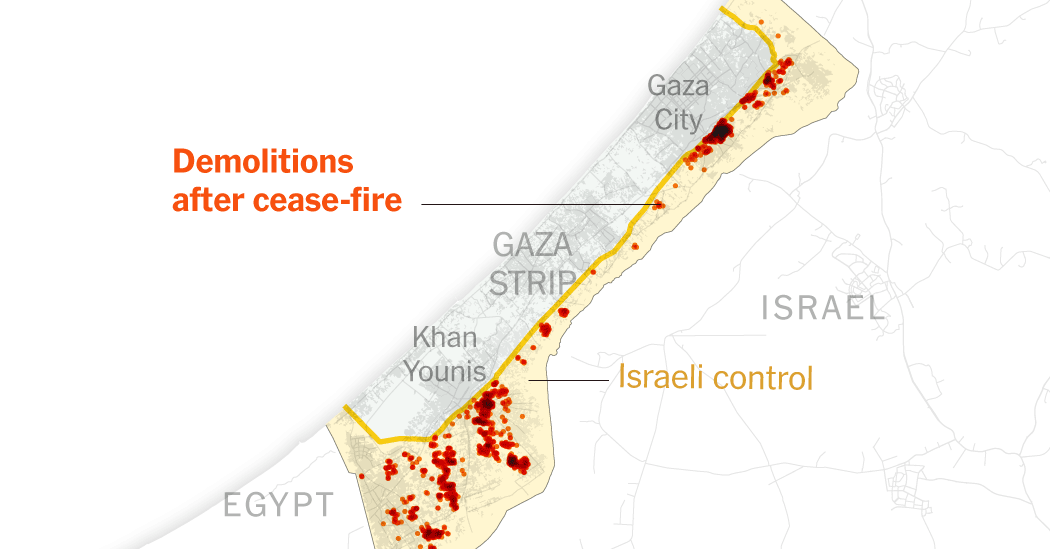
Israel has demolished more than 2,500 buildings in Gaza since the cease-fire began, according to a New York Times analysis of satellite imagery from Planet Labs. It says it is destroying tunnels and booby-trapped homes.
This is what Israel’s actions look like. A nighttime video from Oct. 30, when the cease-fire was in effect, shows what appears to be a large-scale controlled demolition in a part of Shejaiya, a neighborhood in Gaza City, that is under Israeli military control.
As part of the cease-fire agreement reached earlier that month, the Israeli military withdrew its forces beyond an agreed-upon boundary inside Gaza, represented on maps published by Israel as a yellow line. That left Israel in control of about half of the enclave.
Most of the demolitions since the cease-fire began have been in those Israeli-controlled areas.
But dozens of buildings have been destroyed beyond the yellow line in areas effectively under Hamas control, where the Israeli military had agreed to halt its operations.
In satellite images taken shortly after the truce, clusters of intact buildings can be seen in the Shejaiya neighborhood, which spans the yellow line. Shots of the same area months later show that it has largely been reduced to wasteland. And scores of buildings, the images show, were destroyed beyond the yellow line, in some cases as far as 900 feet over.
Many of the structures were likely to have already been severely damaged after two years of Israeli bombardment. A United Nations assessment found that, as of Oct. 11, more than 80 percent of Gaza’s structures were damaged or destroyed. The people who lived in them are believed to have been displaced by successive evacuation orders and raging fighting.
Israeli officials say the widespread demolitions are happening as part of efforts to “demilitarize” Gaza. Since the cease-fire, they say the military has destroyed underground tunnels that were once used by militant groups, and has leveled buildings that were booby-trapped.
At the height of the war, which began after Hamas attacked southern Israel on Oct. 7, 2023, the Israelis estimated that the tunnel network spanned hundreds of miles, with thousands of entrances. Hamas has used the tunnels to store weapons, hide hostages and stage ambushes of Israeli soldiers.
Many Palestinians in Gaza argue that Israel has been flattening entire neighborhoods, with little regard for those who once lived or owned property there. Given the extent of the tunnel network, they say they fear that if Israel tries to dismantle it all, many more of the remaining structures in the territory could be imperiled.
Niveen Nofal, 35, who lived in Shejaiya before being forced to move, said she felt a deep sense of loss to learn that Israel was leveling her neighborhood. “Our hopes and dreams have been turned into mounds of rubble,” she said.
The scale of ongoing destruction is stark. Across eastern Gaza, in areas under Israeli control, satellite imagery reveals that entire blocks have been erased since the cease-fire, as well as swaths of farmland and agricultural greenhouses.
“Israel is wiping entire areas off the map,” said Mohammed al-Astal, a political analyst based in Gaza. “The Israeli military is destroying everything in front of it — homes, schools, factories and streets. There’s no security justification for what it’s doing.”
An Israeli military official, who spoke on the condition of anonymity under military rules, said Israel was not indiscriminately knocking down buildings. He said they sometimes collapsed when Israeli soldiers detonated explosives in the tunnels beneath them.
The official acknowledged that the military was carrying out demolitions on both sides of the yellow line, but said that Israeli ground forces had not crossed the line to do so. The Times was unable to verify that claim.
He also said that the Air Force was striking structures that posed a threat to Israeli soldiers, and that some of these were adjacent to the yellow line. Some tunnels, he said, traverse the withdrawal line, so detonating them could cause buildings on either side of it to collapse.
President Trump’s 20-point plan for ending the Gaza war, which formed the basis for the cease-fire, said that “all military, terror, and offensive infrastructure, including tunnels and weapons production facilities, will be destroyed.” But Israel and Hamas also agreed to suspend “all military operations, including aerial and artillery bombardment.”
One former Israeli military official questioned the scope of the demolition.
“This is absolute destruction,” said Shaul Arieli, who commanded forces in Gaza in the 1990s. “It’s not selective destruction, it’s everything.”
Classified maps from the Israeli military intelligence directorate show an expansive tunnel network in the Shejaiya area and scores of locations where the military believes militants have booby-trapped homes and roads.
The Israeli military allowed The Times to view those maps, which it said were produced for soldiers deployed in Gaza. The Times could not independently verify the accuracy of the maps.
Husam Badran, a senior Hamas official in Qatar, said the Israeli demolitions were violating the cease-fire agreement.
“The agreement isn’t vague, it’s clear,” he said in an interview. “Destroying people’s homes and property isn’t allowed. They’re hostile actions.”
Israeli officials have said that the military will continue carrying out the demolitions “until the last tunnel,” as the defense minister, Israel Katz, put it in a post on social media in November. “If there are no tunnels,” Mr. Katz wrote,” there is no Hamas.”
Ashraf Nasr, 32, who lived in Shejaiya before being displaced, said he was filled with sadness to see his hometown pulverized.
“Our memories have been erased,” he said. “But Hamas gave Israel the pretext to carry out this disaster. It militarized civilian spaces.”