

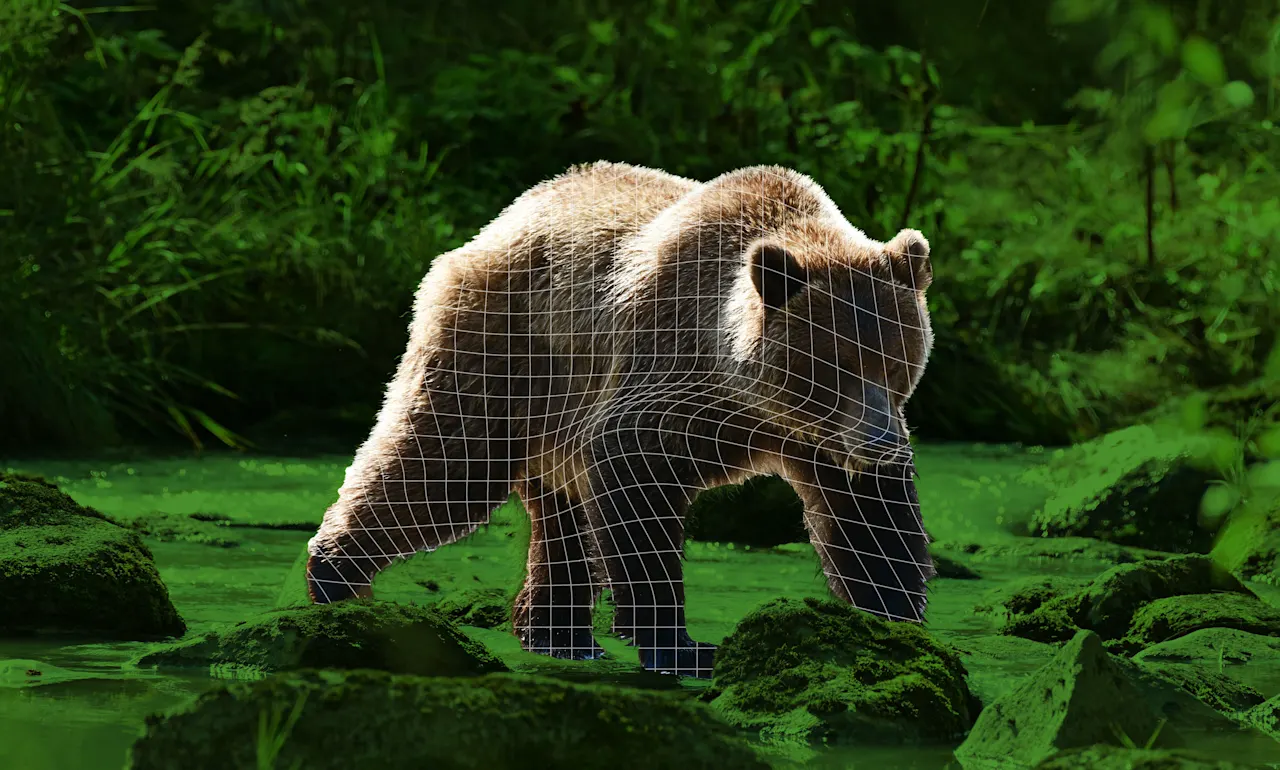
When a grizzly bear attacked a group of fourth- and fifth-graders in western Canada in late November 2025, it sparked more than a rescue effort for the 11 people injured—four with severe injuries. Local authorities began trying to find the specific bear that was involved in order to relocate or euthanize it, depending on the results of their assessment.
The attack, in Bella Coola, British Columbia, was very unusual bear behavior and sparked an effort to figure out exactly what had happened and why. That meant finding the bear involved—which, based on witness statements, was a mother grizzly with two cubs.
Searchers combed the area on foot and by helicopter and trapped four bears. DNA comparisons to evidence from the attack cleared each of the trapped bears, and they were released back to the wild. After more than three weeks without finding the bear responsible for the attack, officials called off the search.
The case highlights the difficulty of identifying individual bears, which becomes important when one is exhibiting unusual behavior. Bears tend to look a lot alike to people, and untrained observers can have a very hard time telling them apart. DNA testing is excellent for telling individuals apart, but it is expensive and requires physical samples from bears. Being trapped and having other contact with humans is also stressful for them, and wildlife managers often seek to minimize trapping.
Recent advances in computer vision and other types of artificial intelligence offer a possible alternative: facial recognition for bears.
As a cultural anthropologist, I study how scientists produce knowledge and technologies, and how new technology is transforming ecological science and conservation practices. Some of my research has looked at the work of computer scientists and ecologists making facial recognition for animals. These tools, which reflect both technological advances and broader popular interest in wildlife, can reshape how scientists and the general public understand animals by getting to know formerly anonymous creatures as individuals.
New ways to identify animals
A facial recognition tool for bears called BearID is under development by computer scientists Ed Miller and Mary Nguyen, working with Melanie Clapham, a behavioral ecologist working for the Nanwakolas Council of First Nations, conducting applied research on grizzly bears in British Columbia.
It uses deep learning, a subset of machine learning that makes use of artificial neural networks, to analyze images of bears and identify individual animals. The photos are drawn from a collection of images taken by naturalists at Knight Inlet, British Columbia, and by National Park Service staff and independent photographers at Brooks River in Katmai National Park, Alaska.
Bears’ bodies change dramatically from post-hibernation skinny in the spring to fat and ready for winter in the fall. However, the geometry of each bear’s face—the arrangement of key features like their eyes and nose—remains relatively stable over seasons and years.
BearID uses an algorithm to locate bear faces in pictures and make measurements between those key features. Each animal has a unique set of measurements, so a photograph of one taken yesterday can be matched with an image taken some time ago.
In addition to helping identify bears that have attacked humans or are otherwise causing trouble for people, identifying bears can help ecologists and wildlife managers more accurately estimate bear population sizes. And it can help scientific research, like the behavioral ecology projects Clapham works on, by allowing individual tracking of animals and thus better understanding of bear behavior.
Miller has built a web tool to automatically detect bears in the webcams from Brooks River that originally inspired the project. The BearID team has also been working with Rebecca Zug, a professor and director of the carnivore lab at the Universidad San Francisco de Quito, to develop a bear identification model for Andean bears to use in bear ecology and conservation research in Ecuador.
Animal faces are less controversial
Human facial recognition is extremely controversial. In 2021, Meta ended the use of its face recognition system, which automatically identified people in photographs and videos uploaded to Facebook. The company described it as a powerful technology that, while potentially beneficial, was currently not suitable for widespread use on its platform.
In the years following that announcement, Meta gradually reintroduced facial recognition technology, using it to detect scams involving public figures and to verify users’ identities after their accounts had been breached.
When used on humans, critics have called facial recognition technology the “plutonium of AI” and a dangerous tool with few legitimate uses. Even as facial recognition has become more widespread, researchers remain convinced of its dangers. Researchers at the American Civil Liberties Union highlight the continued threat to Americans’ constitutional rights posed by facial recognition and the harms caused by inaccurate identifications.
For wildlife, the ethical controversies are perhaps less pressing, although there is still potential for animals to be harmed by people who are using AI systems. And facial recognition could help wildlife managers identify and euthanize or relocate bears that are causing significant problems for people.
A focus on specific animals
Wildlife ecologists sometimes find focusing on individual animals problematic. Naming animals may make them “seem less wild.” Names that carry cultural meaning can also frame people’s interpretations of animal behavior. As the Katmai rangers note, humans may interpret the behaviors of a bear named Killer differently than one named Fluffy.
Wildlife management decisions are meant to be made about groups of animals and areas of territory. When people become connected to individual animals, including by naming them, decisions become more complicated, whether in the wild or in captivity.
When people connect with particular animals, they may object to management decisions that harm individuals for the sake of the health of the population as a whole. For example, wildlife managers may need to move or euthanize animals for the health of the broader population or ecosystem.
But knowing and understanding bears as individual animals can also deepen the fascination and connections people already have with bears.
For example, Fat Bear Week, an annual competition hosted by explore.org and Katmai National Park, drew over a million votes in 2025 as people campaigned and voted for their favorite bear. The winner was Bear 32, also known as “Chunk.” Chunk was identified in photographs and videos the old-fashioned way, based on human observations of distinguishing characteristics—such as a large scar across his muzzle and a broken jaw.
In addition to identifying problematic animals, I believe algorithmic tools like facial recognition could help an even broader audience of humans deepen their understanding of bears as a whole by connecting with one or two specific animals.
Emily Wanderer is an associate professor of anthropology at the University of Pittsburgh.
This article is republished from The Conversation under a Creative Commons license. Read the original article.