

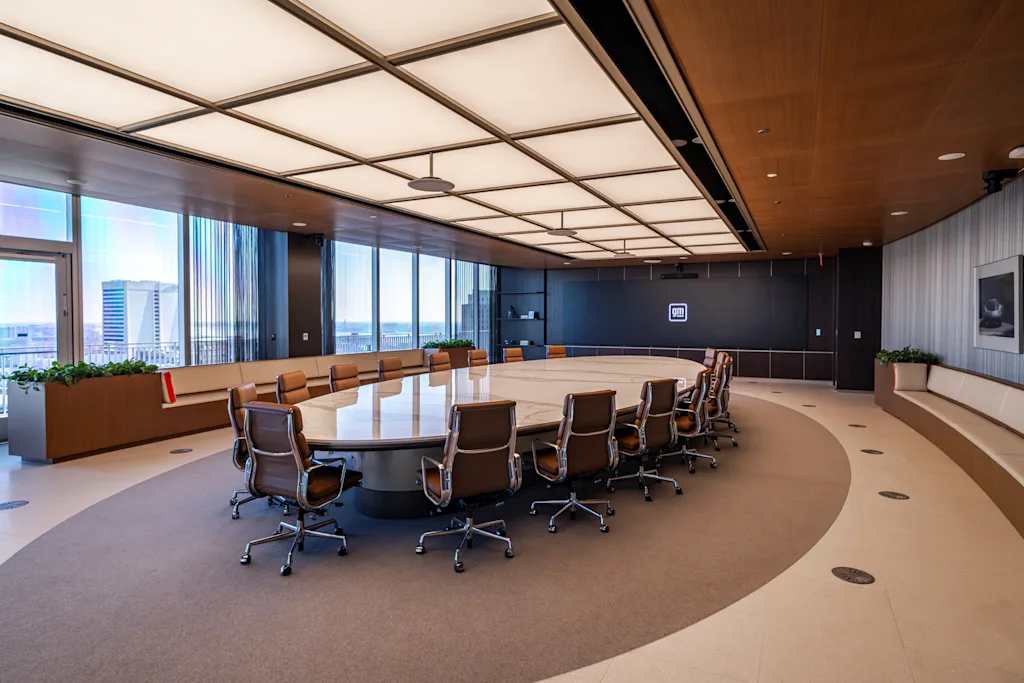
However uncertain the outlook is for the American auto industry in the age of tariffs, growing competition from China, and the rise of EV upstarts, the view inside the new boardroom at General Motors is stylishly optimistic.
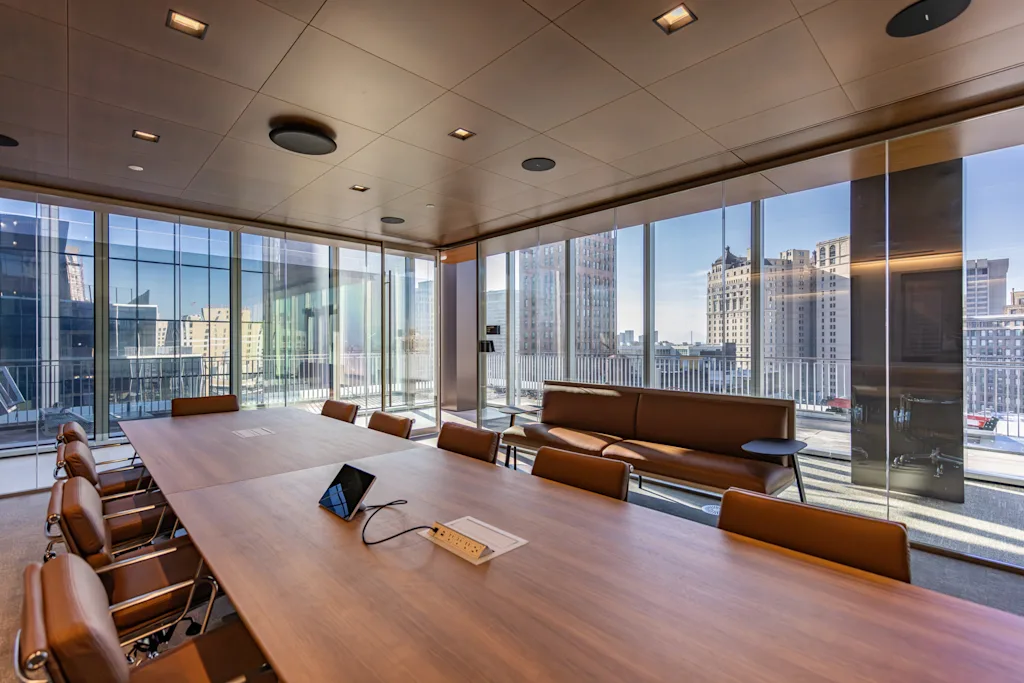
Part of the automaker’s new corporate headquarters that’s opening January 12, the boardroom is a large and elegant space with a massive marble table surrounded by mainstay elements of mid-century modern design. Fluted wood wall treatments, subtle curves, geometric overhead lighting, minimalist bench seating, and sweeping views of a changing downtown Detroit combine to create a physical manifestation of how GM sees itself evolving through the 21st century—drawing on the past while looking to the future.
When so much of the car industry can feel tossed in an ever-changing sea, the boardroom and the rest of GM’s headquarters evoke a steadier throughline of ambition and legacy.
“It’s culture setting,” says David Massaron, GM’s vice president of infrastructure and corporate citizenship. “I think this space really does a great job of being a beacon of who we want to be, what our identity is. … A headquarters really serves as a reinforcing notion of our culture, of who we are.”
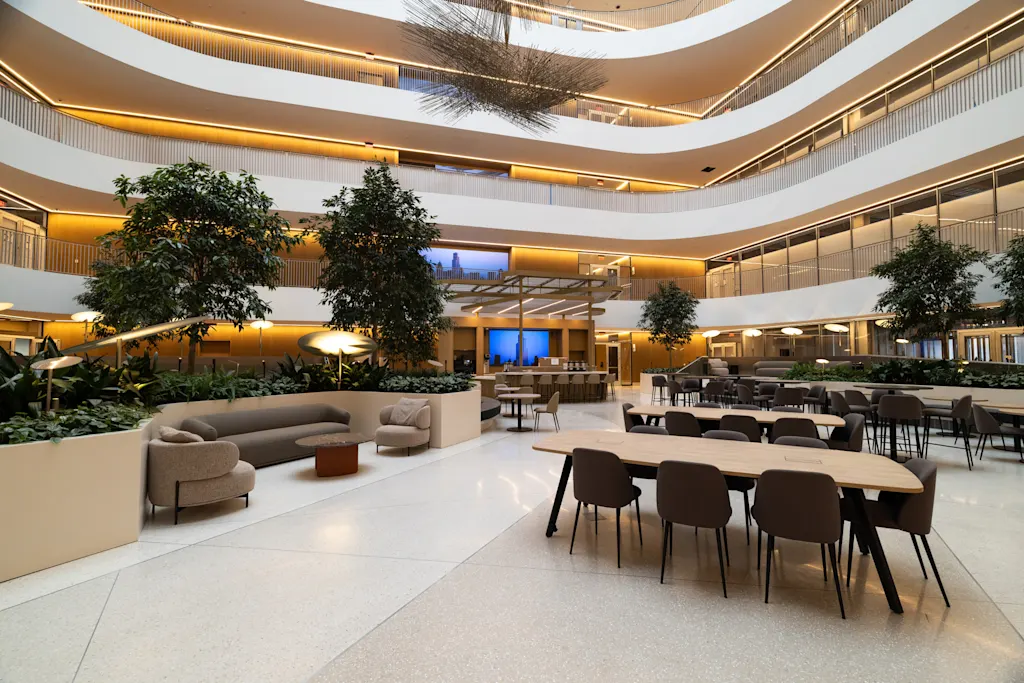
Filling four floors and about 200,000 square feet in a brand-new 12-story tower in Detroit, the headquarters will serve as permanent office space for GM executives and employees in the finance, legal, marketing, and communications departments, and will have open workstations. In contrast to GM’s previous headquarters in the troubled Renaissance Center complex a mile away, the new space is much smaller and more manageable, with room for hundreds of employees, not thousands.
Its design draws heavily on GM’s past. The overarching design language of the space comes from the mid-century modern design of the company’s main real estate footprint, the GM Technical Center, in suburban Warren, Michigan.
Designated a National Historic Landmark, the complex first opened in 1956 with a stunning design by architect Eero Saarinen that let modernist design loose on corporate America and accelerated its infusion into the homes, furnishings, and products of the post-war world. Saarinen’s streamlined design put an emphasis on natural materials and light, and brought art into and around the buildings on the campus in a holistic way.
Crystal Windham, GM’s executive director of global industrial design, says that legacy deeply influenced her team’s approach to the new headquarters space, which was designed with the Gensler architecture firm. Elements of mid-century modernism, and Saarinen’s Technical Center specifically, wound their way into the headquarters in a wide variety of forms, from furniture pieces and material choices to the artwork on the walls.
“Because of the history and the respect for that, there are all types of interpretations here. There are details within it that you can play up or play down. It’s a full palette of moments to pull from,” Windham says.
Some elements are literal recreations. On the wall next to a waiting area outside top executive offices, steel picture frames that mount to the floor and ceiling are near-exact replicas of frames Saarinen designed for the Technical Center campus.
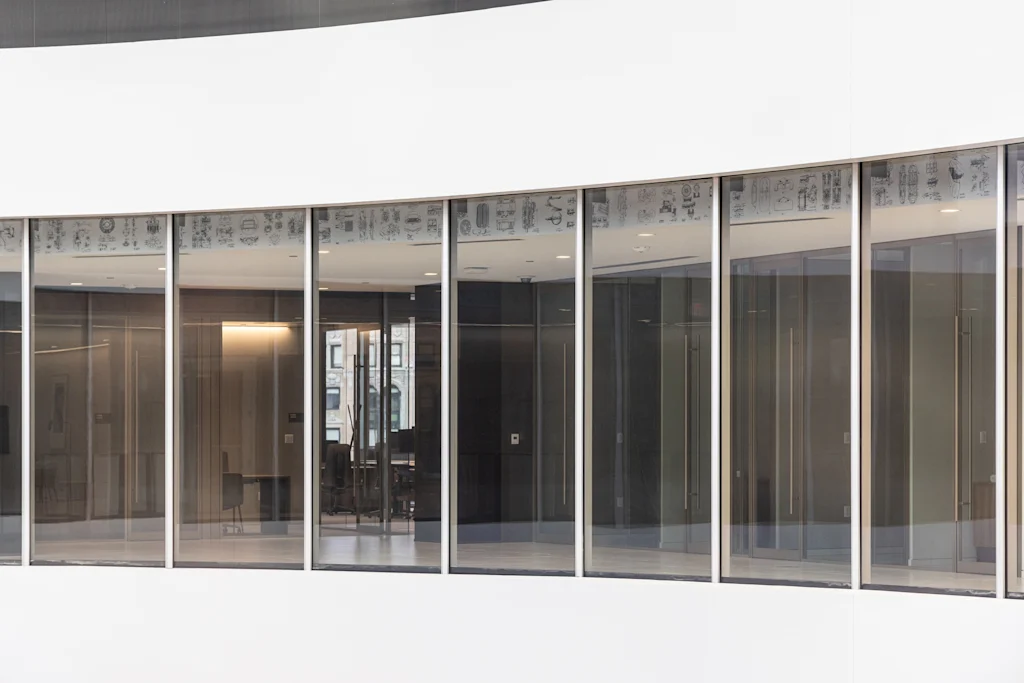
Other items are drawn directly from GM’s large archive. Historic drawings from the company’s 49,000-deep set of patent applications are peppered throughout the space, including in a ring of wallpaper near the top of the building’s atrium. Other notable patents are framed in executives’ offices—a mechanical heart in CEO Mary Barra’s, and the first automatic gearshift changer in president Mark Reuss’s.
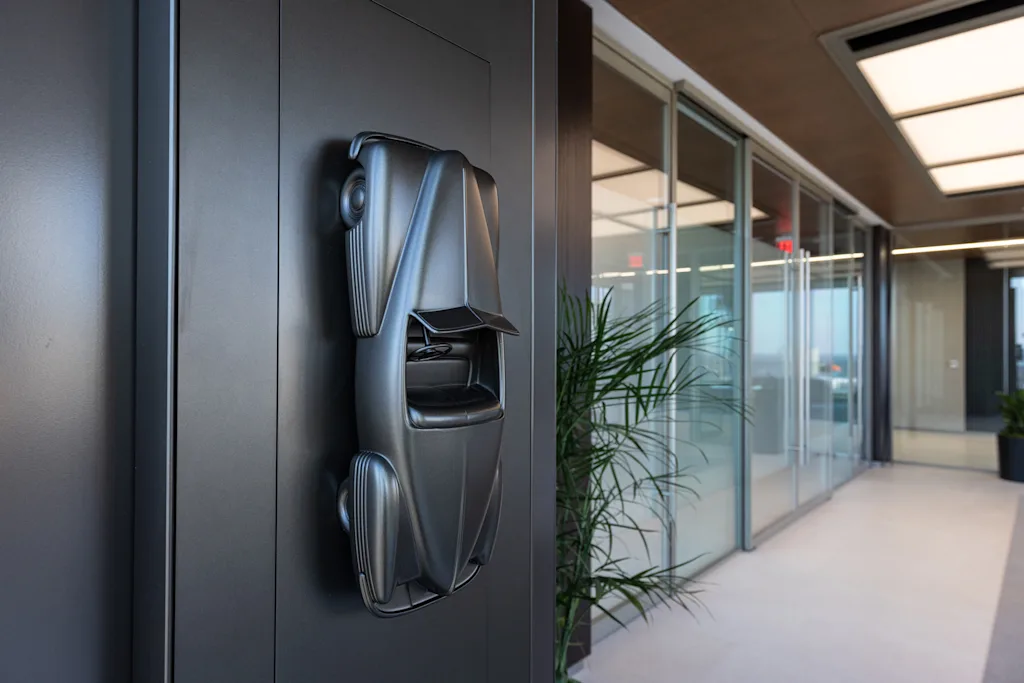
Scale models of cars, old and new, can be seen in almost any direction. Touches of automotive materials can also be found throughout the space, from throw pillows made out of the interior fabric used in 1956 Cadillacs to chrome pendant lights that recall muscle car tailpipes.
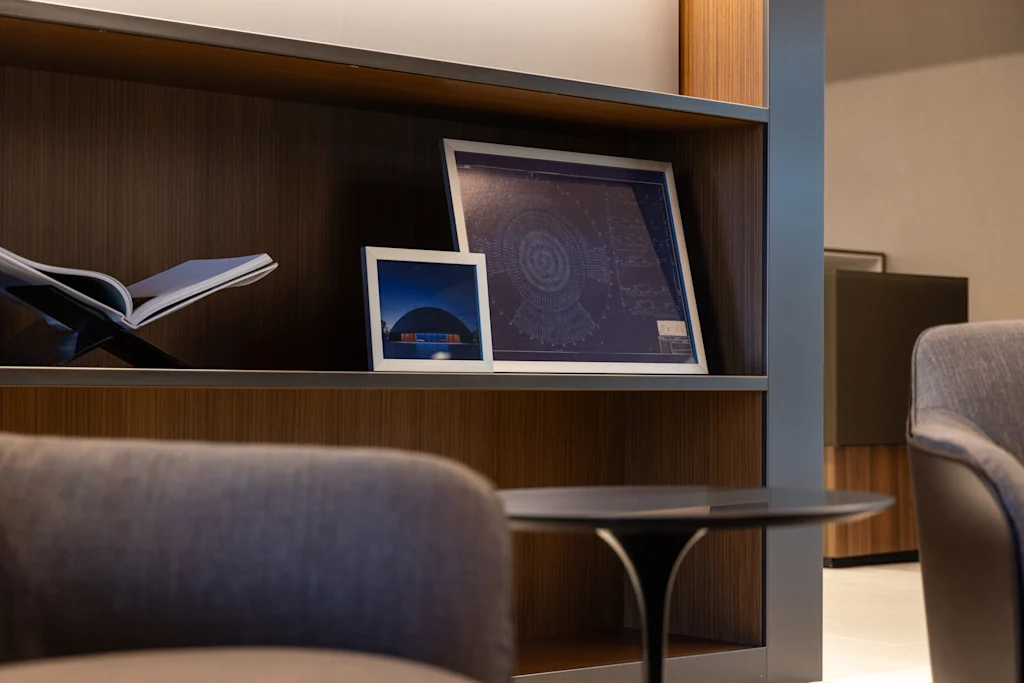
“What we loved when we were working on this project was just going back and relooking at our history,” says Rebecca Waldmeir, design manager of architecture and experience at GM. “[Saarinen] would say that when you’re trying to design spaces to relate to each other, they need to sing the same message. We need to sing some of that message into our space, too.”
This ethos has made its way into the otherwise contemporary setting of this new 12-story mixed-use building in the heart of downtown Detroit. Alongside a 49-story hotel and condo tower, the building is part of the $1.4 billion Hudson’s Detroit project developed by Bedrock, the real estate firm that billionaire Dan Gilbert has steered to redeveloping large swaths of Detroit’s once-crumbling downtown.
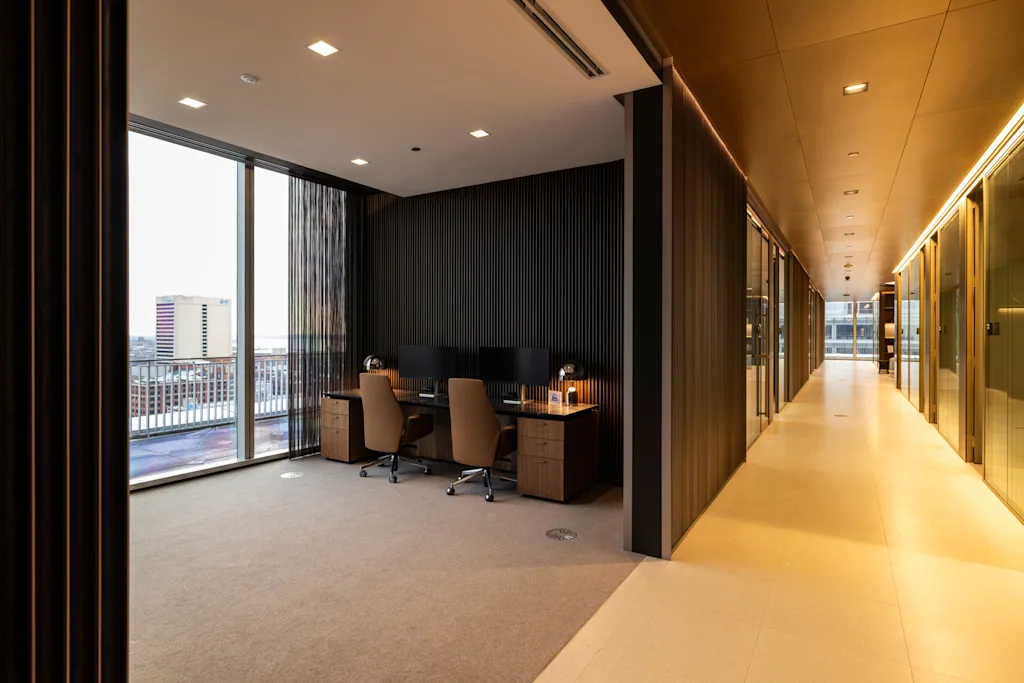
For all its effort in honoring a rich design legacy, the headquarters is still a headquarters, with spaces made for the work of a multibillion-dollar corporation to get done. The executive offices and other hoteling workspaces are outfitted with office furniture from Halcon, and there’s at least one Eames lounge chair on the premises.
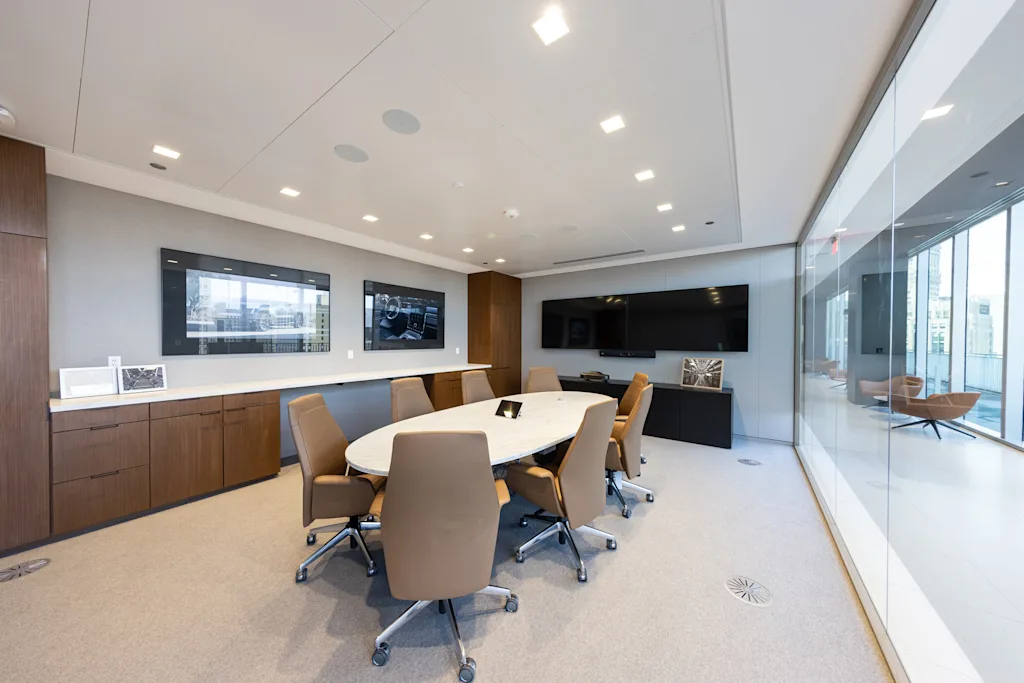
Shared workspaces are buffered from more active circulation areas, and most of the main executive areas have lounge-like waiting spaces that can double as informal meeting spaces during downtimes. That huge marble table in the executive boardroom was fabricated in GM’s own facility—typically used to make concept cars and scale models—and designed to have a solid flat surface free of the holes and ports of modern IT equipment. All that infrastructure is hidden away.
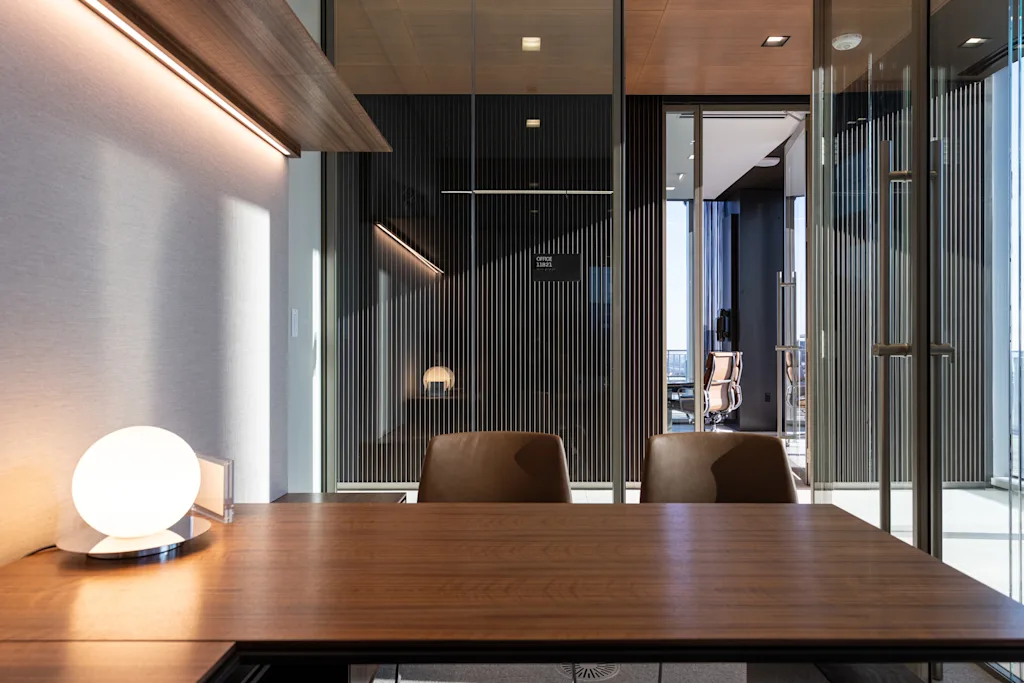
“We wanted, first of all, for the look and feel to be appropriately placed for the time, to be timeless in and of itself, and the layout to be very flexible for many uses and very open and collaborative,” Windham says.
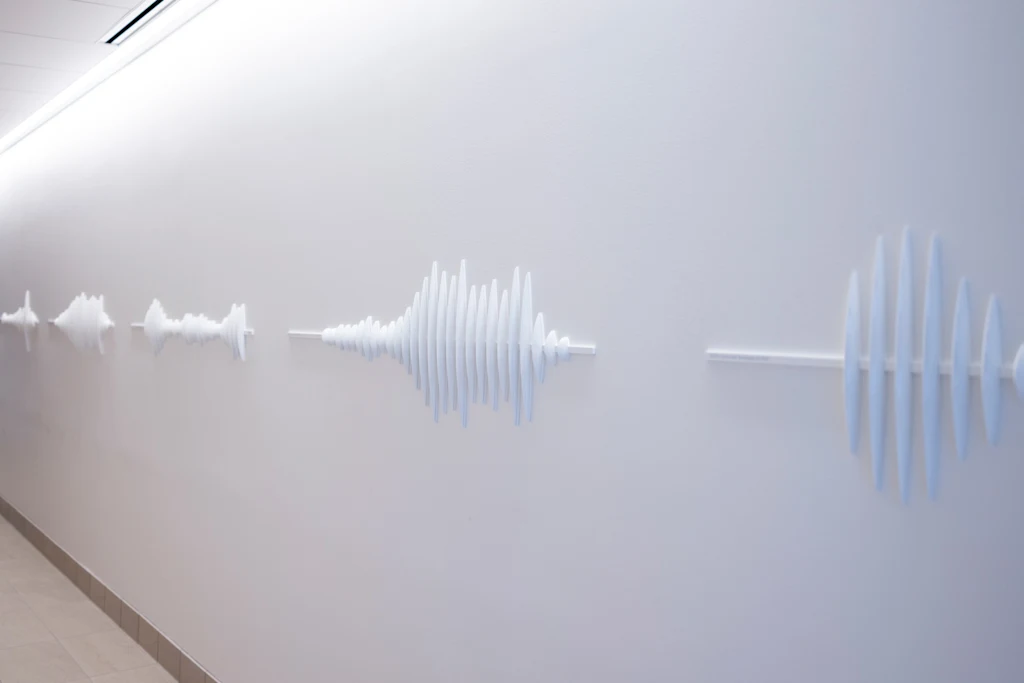
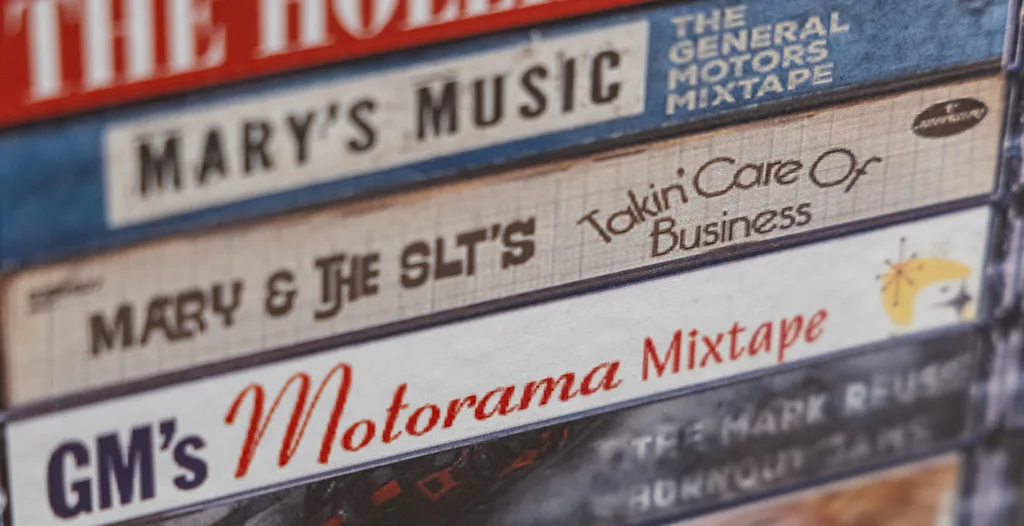
The design also left room for some intentionally contemporary elements. A hallway on each floor features a series of artworks that turn the sound signatures of GM vehicles into abstracted soundwaves. And a vestibule outside the bathrooms on the executive floor is decorated with custom-made wallpaper showing stacks of cassette tapes of some of the estimated 80,000 songs that reference GM cars—from “Little Red Corvette” and “Pink Cadillac” to the countless country songs featuring Chevy trucks.
The mere existence of this headquarters carries its own message, as GM leaves the Renaissance Center. Plans are still forming between GM and Bedrock over how to deal with the largely empty 5-million-square-foot space, but GM isn’t looking back. The new headquarters—a much smaller footprint, more centrally located in a resurgent downtown—represents a new chapter for the company’s long history of innovation.
“Being in the middle of the city, being part of that vibrancy is really leaning into the dynamic change that the industry is going through,” Massaron says. “We’re trying to remind ourselves and the world that we’re ready to lead and we’re going to continue to lead.”