

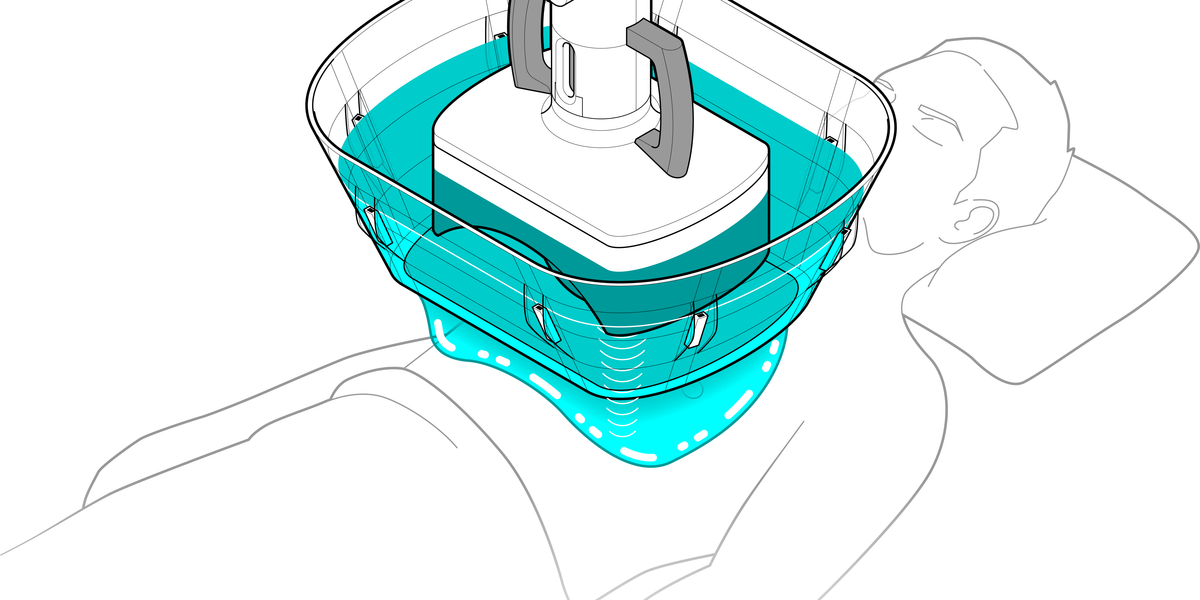
For many years, doctors and technicians who performed medical ultrasound procedures viewed bubbles with wary concern. The phenomenon of cavitation—the formation and collapse of tiny gas bubbles due to changes in pressure—was considered an undesirable and largely uncontrollable side effect. But in 2001, researchers at the University of Michigan began exploring ways to harness the phenomenon for the destruction of cancerous tumors and other problematic tissue.
The trouble was, creating and controlling cavitation generated heat, which harmed healthy tissue beyond the target area. Zhen Xu, who was working on a Ph.D. in biomedical engineering at the time, was bombarding pig heart tissue in a tank of water with ultrasound when she made a breakthrough.
The key was using extremely powerful ultrasound to produce negative pressure of more than 20 megapascals, delivered in short bursts measured in microseconds—but separated by relatively long gaps, between a millisecond and a full second long. These parameters created bubbles that quickly formed and collapsed, tearing apart nearby cells and turning the tissue into a kind of slurry, while avoiding heat buildup. The result was a form of incisionless surgery, a way to wipe out tumors without scalpels, radiation, or heat.
“The experiments worked,” says Xu, now a professor at Michigan, “but I also destroyed the ultrasound equipment that I used,” which was the most powerful available at the time. In 2009, she cofounded a company, HistoSonics, to commercialize more powerful ultrasound machines, test treatment of a variety of diseases, and make the procedure, called histotripsy, widely available.
So far, the killer app is fighting cancer. In 2023, HistoSonics’ Edison system received FDA approval for treatment of liver tumors. In 2026, clinicians will conclude a pivotal kidney cancer study and apply for regulatory approval. They’ll also launch a large-scale pivotal trial for pancreatic cancer, considered one of the deadliest forms of the disease with a five-year survival rate of just 13 percent. An effective treatment for pancreatic cancer would represent a major advance against one of the most lethal malignancies.
Histotripsy’s Benefits for Cancer Treatment
HistoSonics is not the only developer of histotripsy devices or techniques, but it is first to market with a purpose-built device. “What HistoSonics has developed is a symphony of technologies, which combines physics, biology, and biomedical engineering,” says Bradford Wood, an interventional radiologist at the National Institutes of Health, who is not affiliated with the company. Its engineering effort has spanned multiple disciplines to produce robotic, computer-guided systems that turn physical forces into therapeutic effects.
Over the past decade, research has confirmed or found other benefits of histotripsy. With precise calibration, fibrous tissue—such as blood vessels—can be spared from damage even in the target zone. And while other noninvasive techniques may leave scar tissue, the liquefied debris created by histotripsy is cleared away by the body’s natural processes.
In HistoSonics’ early trials for pancreatic cancer, doctors used focused ultrasound pulses to ablate, or destroy, tumors deep within the pancreas. “It’s a great achievement for the entire field to show that it is possible to ablate pancreatic tumors and that it’s well tolerated,” says Tatiana Khokhlova, a medical ultrasound researcher at the University of Washington, in Seattle, who has worked on alternative histotripsy techniques.
Khokhlova says the key to harnessing histotripsy’s benefits “will be combining ablation of the primary tumor in the pancreas with some other therapy.” Combination treatment could fight recurrent cancer and tiny tumors that ultrasound might miss, while also tapping into a surprising benefit.
Histotripsy generally seems to stimulate an immune response, helping the body attack cancer cells that weren’t targeted directly by ultrasound. The mechanical destruction of tumors likely leaves behind recognizable traces of cancer proteins that help the immune system learn to identify and destroy similar cells elsewhere in the body, explains Wood. Researchers are now exploring ways to pair histotripsy with immunotherapy to amplify that effect.
The company’s capacity to explore the treatment‘s potential for different conditions will only improve with time, says HistoSonics CEO Mike Blue. The company has fresh resources to accelerate R&D: A new ownership group, which includes billionaire Jeff Bezos, acquired HistoSonics in August 2025 at a valuation of US $2.25 billion.
Engineers are already testing a new guidance system that uses a form of X-rays rather than ultrasound imaging, which should expand use cases. The R&D team is also developing a feedback system that analyzes echoes from the therapeutic ultrasound to detect tissue destruction and integrates that information into the live display, says Blue.
If those advances pan out, histotripsy could move well beyond the liver, kidney, and pancreas in the fight against cancer. What started as a curiosity about bubbles might soon become a new pillar of noninvasive medicine—a future in which surgeons wield not scalpels, but sound waves.
This article appears in the January 2026 print issue.
From Your Site Articles
Related Articles Around the Web