

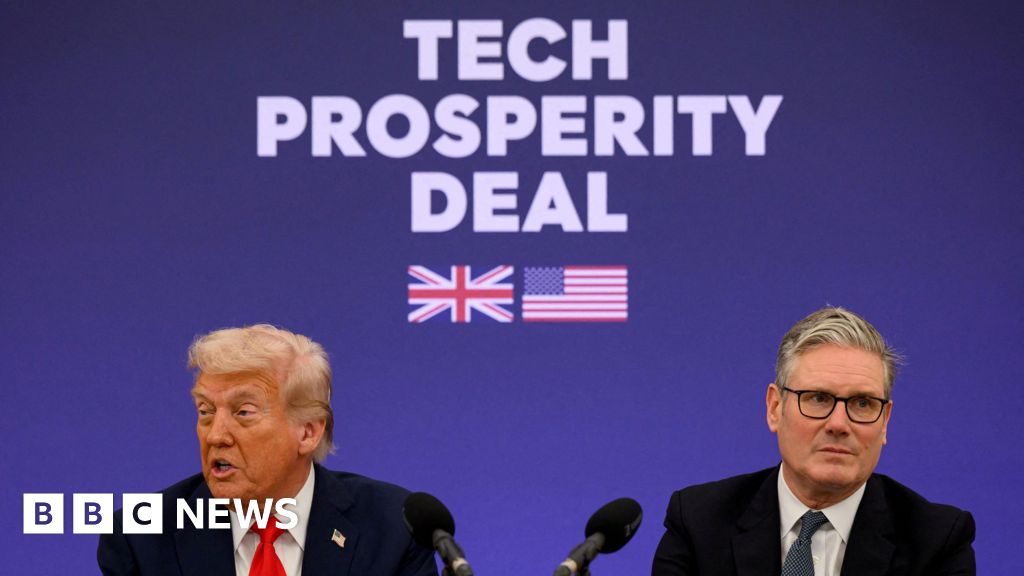
Downing Street says the UK remains in “active conversations with US counterparts at all levels of government” about a wide-ranging tech deal.
The BBC understands talks over the Technology Prosperity Deal have stalled because of US concerns about what it considers to be wider UK trade barriers.
Billed as “historic” when it was unveiled during US President Donald Trump’s state visit in September, the partnership saw both countries pledge to co-operate further in areas such as AI and quantum computing.
“We’re confident of securing a deal that will shape the future of millions on both sides of the Atlantic,” the Prime Minister’s official spokesman said.
He said he would not comment directly on what were “live” discussions but added “negotiations of this kind are never straightforward”.
The New York Times – which first reported the story – said there were “broader disagreements” between the two sides, including over digital regulations and food safety rules.
The UK government did not comment on these specific claims. The White House has not responded to the BBC’s request for a comment.
However, Trump’s science adviser Michael Kratsios on Tuesday evening said the administration hoped to restart talks over the deal.
“In line with Section III of the US-UK Technology Prosperity Deal, we hope to resume work with the United Kingdom once the UK has made substantial progress in implementing its commitments under the Economic Prosperity Deal,” Kratsios wrote on X.
“We look forward to continuing our productive collaboration across AI, quantum, nuclear, and other critical technology areas under the Deal.”
When the deal was announced the government was keen to highlight the benefits it said it would bring.
“This Tech Prosperity Deal marks a generational step change in our relationship with the US,” Prime Minister Sir Keir Starmer said in a statement.
Technology secretary Liz Kendall said the partnership would “transform lives across Britain” and was a “vote of confidence in Britain’s booming AI sector.”
At the same time the deal was revealed, a series of US tech firms announced a flurry of investment in the UK.
A total of £31bn in planned spending was set out by tech giants including Microsoft, Nvidia and Google.
It is believed those investment plans are unaffected.
Google, Microsoft and Nvidia have also been approached for comment, but the firms have not yet responded to the BBC.
Nvidia boss Jensen Huang said in September his company’s UK investment reflected his belief it could become an “AI superpower” – an ambition championed by Sir Keir’s government.
It said investment announced by tech firms alongside the Tech Prosperity Deal would be used to scale-up AI infrastructure such as data centres, across the UK.
The tech pact was documented in a Memorandum of Understanding (MOU) which said both countries would seek to collaborate across AI, quantum computing and nuclear power.
It said this could include working together to build “powerful quantum machines,” support innovation in AI hardware and explore potential new ways to use advanced nuclear energy.
But the MOU also states any proposals are not binding and that it only “becomes operative alongside substantive progress being made to formalise and implement” the wider US-UK Economic Prosperity Deal, signed in May.
The Trump administration has sought to rewrite the global rules on trade, imposing tariffs on many countries – including traditional allies like the UK – and seeking new deals which it argues are fairer to the US.
For the UK that has meant haggling over various sectors of the economy, a process which has yielded agreements on cars and more recently, pharmaceuticals.
However, a proposed deal to eliminate tariffs on UK steel exports to the US has been put on hold indefinitely, the BBC understands.
Allie Renison, director of communications firm SEC Newgate UK and a former government trade adviser, said the current impasse over tech reflected the US and UK’s “slightly piecemeal approach” to inking trade deals.
“Instead of having everything done at once, different areas are being linked to different parts,” she told the BBC – noting how concerns about separate trade areas may now be affecting tech agreements.
While questions hung over what the potential roadblocks could mean for US tech firms’ pledged investments in the UK, Ms Renison added, it was unlikely to be little more than “a bit of posturing in the wider negotiations”.
Additional reporting by Michael Race and Philippa Wain