


Ben MorrisTechnology of Business Editor
A stream of hot caramel runs through the Thomas Tunnock factory just outside Glasgow.
From the second floor where it is made, it runs along conveyor belts down to the first floor, bringing a a sweet, warm aroma to the building.
But working with caramel is not easy. Experienced workers have to check that it is at the right consistency, and it takes a team of 12 to spread the caramel in five layers that make up the Tunnock’s wafer biscuit.
“We’re making roughly 20 tonnes of caramel a day,” says Stuart Louden, the firm’s engineering and transport manager, and the fifth generation of the Tunnock family to work at the business.
“Operators do a lot of caramel testing, just on sight and on feel. So basically, they walk up to the caramel and just give it a squeeze.”
Once made, a conveyor belt takes the caramel down to the floor below, where the spreading team works.
“Spreading caramel onto wafers is very, very difficult because it’s so sticky,” says Mr Louden.
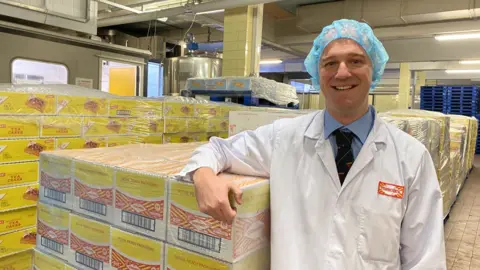
While this is a labour intensive part of the Tunnock’s operation, most of the rest of the factory is automated.
The company has always tried to use the latest technology to help keep up with the competition. Compared with the snack giants like McVitie’s or Fox’s, Tunnock’s is a small player.
“We are a small fish in a big pond, and to try and keep up with some of these bigger companies that we are competing against, you’ve got to have the good machines there to get the output,” says Mr Louden.
They do have machines to spread the caramel, which work at night, but the human workforce is more flexible and takes up less space.
Between them, the machines and humans turn out around seven million wafer bars and 4.5 million tea cakes a year.
Raising output can be a balancing act for the firm, between maintaining their traditions and increasing output.
For example, like their caramel production, Tunnock’s marshmallow is made under close human supervision.
Meanwhile, the wrapping of the wafer bar is folded around the product, rather than sealed at the ends. If Tunnock’s switched to sealing then the production line could run more quickly.
“It’s a nice thing. If you give people a caramel wafer, and somebody’s not had one for 20 or 30, years, they go, ‘I remember having one of these when I was a kid’.”
The makers of a new robot arm for the cake industry are hoping to bridge that gap between speed and tradition.
Canada’s Unifiller, part of Coperion a big maker of equipment for food production, spent years developing a robot arm, called HIRO.
It’s designed to decorate cakes and can handle all sorts of toppings, including caramel.
“If you can squeeze it through a pastry bag… then it will go through our equipment and the the decorating tips,” says Derek Lanoville, the research and development manager at Coperion.
But making equipment for the food industry involves extra challenges – perhaps the biggest being hygiene.
“You have to make things easy to take apart, so that people clean them. The bottom line is, if it’s not easy to take apart, you don’t clean it.”
Unifiller’s robot arm comes from Swiss robotics firm Stäubli, which could supply an arm that’s easy to clean.
Another complication is the variability of food products like cakes.
On production lines in most industries components will be the same size, often to within fractions of a millimetre. That’s not the case in baking, where the cakes rolling down a line will be different – not by much – but enough,perhaps, to upset a robot.
“The cake may not be perfectly centred on the cardboard it’s sitting on. It may be a little bit oval, may be a little bit higher or slightly domed. So, our solution has to accommodate that,” says Mr Lanoville.

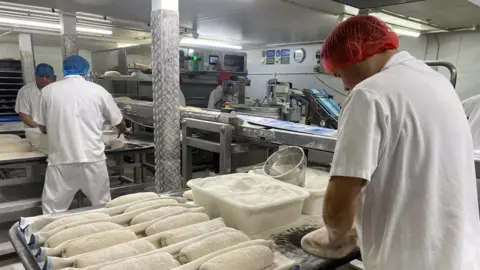
For Anomarel Ogen, human hands are still essential to the baking process.
Mr Ogen is head baker at The Bread Factory, which is where products for the café chain Gail’s are baked.
Their bakery in northwest London runs 24 hours a day and 365 days a year, supplying sourdough loaves to Gail’s, as well as supermarkets, shops and restaurants.
It uses around 16 tonnes of flour to produce up to 40,000 loaves a day, which sounds like a lot but, compared with the giant bakers, is still a medium-sized business.
Machines mix the dough and divide it into into smaller, loaf-sized quantities.
They use a range of flours that are farmed using sustainable methods that prioritise soil health.
Mr Ogen says that means their dough is delicate. We watch one of their workers forming loaves from the dough.
“Look at his hands, and look how gentle he actually is with the movement, how little pressure he is actually putting in. That requires years of skill. This is not fully replaceable by machines just yet,” says Mr Ogen.
Having staff in the factory also adds flexibility to the production process. If the recipe is tweaked, they can monitor the impact that has on the dough and change the baking process, if necessary.
“You can automate more, but you still need to put in gatekeeping right along the path, to make sure that you can safeguard the process,” says Mr Ogen.
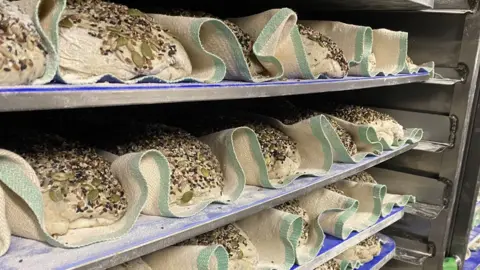
Introducing new tech to a production line is always a balance, says Craig Le Clair, principal analyst at the research firm Forrester, and also the author of Random Acts of Automation: How to Fight Back When Automation Threatens Your Work, Your Life, and Everything You Do.
“The key in food as well as other industries is developing a hybrid model that integrates automation without losing the “soul” of a handcrafted product, like a decorated cake.
“Process transformation must apply automation only to areas that benefit from consistency, speed, and volume, while keeping core value-add elements strictly human,” he says.
Back at equipment maker Coperion, Mr Lanoville has plans to develop the robot arm further.
“What we’re focused on this year is really nailing down our scanning, vision and and safety systems so that, so that our our customers can work the way that they work, without the robot being intrusive.”
Meanwhile in Glasgow, Mr Louden has plans to upgrade his production line, but much hinges on the financial environment. Cocoa prices have been volatile over the past two years, which has a big impact on his firm.
“When it comes to investing another two-and-a-half million pounds in equipment, we just need to wait, because the last couple of years just have not been the right time, and we don’t want to put ourselves financially in a position that it could hurt us.”