

John LaurensonBusiness reporter, Lugano, Switzerland
 AFP via Getty Images
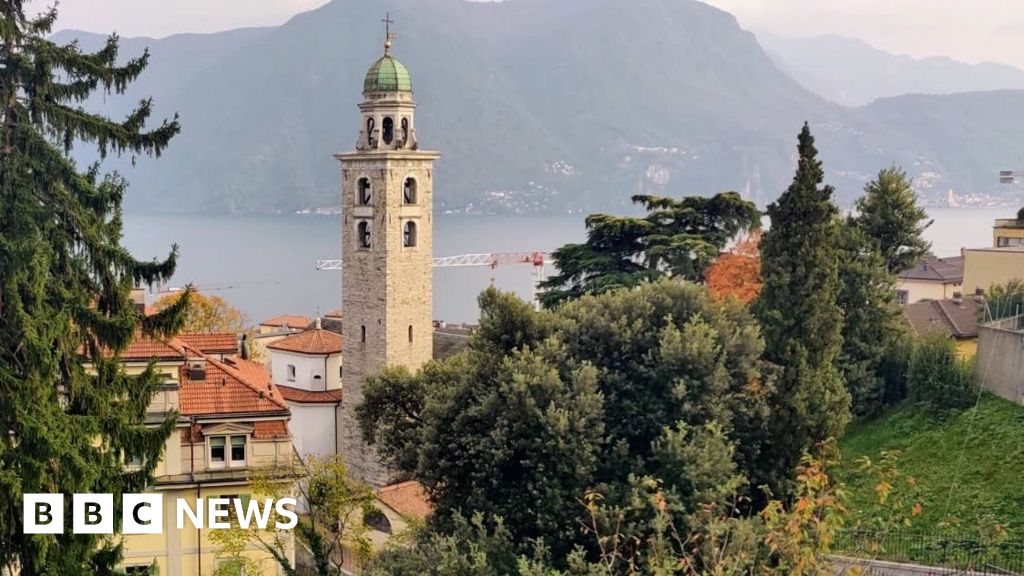
In a McDonald’s by a lake surrounded by mountains, in the centre of the Swiss city of Lugano, a customer orders coffee.
“Can I pay with bitcoin?” he asks, and the person behind the counter holds out what looks like a credit card payment terminal.
It is in fact a machine for paying by crypto currency. The equipment has been distributed free to local retail businesses by the city council.
The buyer pays by contactless, from the bitcoin wallet on his mobile phone. The bill comes to 0.00008629, which is roughly $8.80 (£6.60).
Few people who have bought bitcoin would probably think about using it to purchase actual things in shops. It is instead generally seen as an investment, a bet on its value going up.
But in Lugano, in the Italian-speaking part of Switzerland, it’s a different story.
While you can of course still pay for everything in Swiss francs, some 350 shops and restaurants now also accept bitcoin. The local authority has even started taking payments in crypto currency for municipal services. You can, for example, pay for pre-school childcare in bitcoin.
I get talking to the McDonald’s customer, Nicolas, who comes from France. He is what you might call a bitcoin true believer.
“What’s great about paying in bitcoin is the feeling of freedom it gives you,” he says. “You are no longer dependant on a financial system with its middlemen and its costs.”
Nicolas says he’s discovered bitcoin cards in Switzerland. These are prepaid gift cards. You buy a certain sum in Swiss francs but download it in bitcoin onto a digital wallet on your phone.
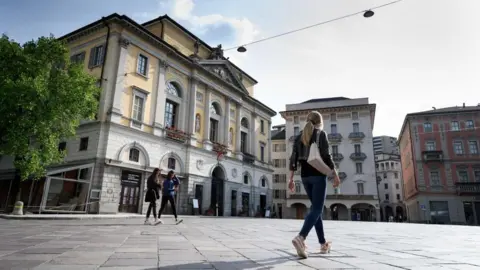
I walk through the centre of Lugano, down a high street where just about all the shops sell luxury stuff. Jewellery or expensive clothes mainly.
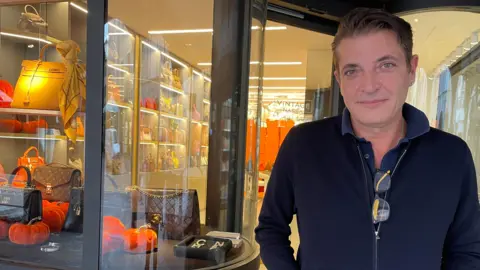
In a shop called Vintage Nassa that sells new and second-hand bags and watches, the owner Cherubino Fry tells me he accepts bitcoin because the processing fee he has to pay per transaction is less than those charged by credit card companies.
For bitcoin it is generally below 1%, while for debit cards it can be as high as 1.7%, and up to 3.4% for credit cards. Although for the latter two it can vary from country to country.
I ask Mr Fry if he does much business in bitcoin.
“In reality, not a lot. For now, only sporadically, only some clients,” he says. “But using bitcoin will be like a tree growing, and this tree will grow very big in five, 10 years.”

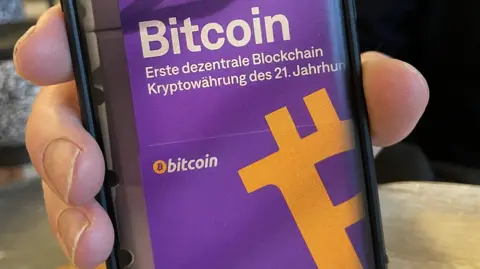
A stone’s throw from Mr Fry’s shop, I visit the headquarters of Plan B, an initiative launched in 2022 by the City of Lugano in collaboration with crypto currency platform Tether.
With the B standing for bitcoin, its stated aim is to educate people about cryptocurrency, and “to make Lugano the European hub for bitcoin”.
“I want to talk about an experiment I did this July,” says Plan B hub director Mir Liponi. She explains that she had a problem with her bank, which resulted in her not being able to access her funds.
For 11 days she had no way of paying, other than with bitcoin, but she says that experiment turned out well, and that you can mostly survive just on bitcoin in Lugano.
“It’s missing public transportation at the moment… another one is fuel. Groceries are okay. I got things delivered at home, even.
“Plenty of medical places, but not a dentist. And another big thing is [energy] bills. You cannot pay bills in bitcoin yet.”
Ms Liponi adds that in the future she wants to see “circular economies where people earn bitcoin, keep bitcoin, spend bitcoin, pay for services in bitcoin”.
Yet elsewhere, similar bitcoin projects to Lugano’s have come unstuck.
In 2021, El Salvador made bitcoin legal tender alongside the US dollar. To encourage its use the government gave people the bitcoin equivalent of $30 that they downloaded via an app.
“So what people did was download the app, exchange the bitcoin for dollars and never use it again,” says Vincent Charles, head of crypto currency firm Unchain Data.
He went to El Salvador earlier this year to see how bitcoin uptake was going, and concluded that people don’t really use it, and retailers and service providers rarely accept it.
However, there are other successful bitcoin adoption examples from around the globe. Slovenian capital Ljubljana was declared the world’s most crypto-friendly city in a report back in April, followed by Hong Kong and Zurich.
Back in Lugano, not everyone is seemingly impressed with bitcoin. In a park on the lakefront there used to be a statue representing Satoshi Nakamoto, the pseudonym used by the unknown person or persons who claim to have invented the crypto currency back in 2008.
In August, vandals broke the sculpture into bits and threw it into Lake Lugano.
“It’s interesting because not that many things get vandalised around here,” says Lucia, a passerby who lives in the city. “People are usually fairly well behaved. And you don’t see often people having very strong political opinions either.”
She adds, though, that she herself is skeptical of cryptocurrencies in general.
“At the University of Lugano where I study there’s a club to promote bitcoin and everything. I do find it surprising that institutions such as my university would promote cryptocurrencies so much. I think they are associated with crime, with the dark web and speculation.
“A lot of people lose their money because they invest in a cryptocurrency and then it crashes.”
 AFP via Getty Images
Sergio Rossi is a professor of economics at Switzerland’s University of Fribourg. He says that bitcoin is a risk for shopkeepers in Lugano or elsewhere because of its volatility – its value can go sharply up and down.
So, he says it is important that they instantly convert the bitcoin they receive into Swiss francs, euros, or another currency issued by a government or central bank. These are also known as “fiat” currencies.
He adds: “There is also a reputational risk with those cryptocurrencies used in illegal transactions, which could affect the city of Lugano and its financial institutions.”
Prof Rossi also cautions that people’s bitcoin is held by a digital third party, which makes it risky. “If the platform where my digital wallet is recorded fails or goes bankrupt, my cryptocurrencies disappear instantaneously.
“And therefore, I lose the corresponding amount forever. By contrast, in Switzerland, all bank deposits are guaranteed up to the amount of 100,000 Swiss francs ($125,000; £94,000). This means that if the bank where my savings are recorded goes bankrupt, I can recover them up to this amount.”
At Lugano town hall I ask Mayor Michele Foletti if he is concerned that Lugano could be a magnet for mafia money.
“No. You can use fiat money to do something good or something bad,” he says. “The same with bitcoin.
“And mafia people are more interested to use fiat for money laundering. When they sell drugs or something like this, they receive [physical] fiat money, not bitcoin because the more anonymous way is cash,” he says.
He adds that bitcoin continues to be positive for Lugano, and that 110 crypto-sector companies have now moved to, or started up, in the city.